Demucs logo

Demucs

Demucs is an open-source music source separation model that splits a finished song into separate stems.

The current fourth release, Hybrid Transformer Demucs, separates drums, bass, vocals and the remaining accompaniment, and an experimental six-source model adds guitar and piano. It reaches a signal-to-distortion ratio…

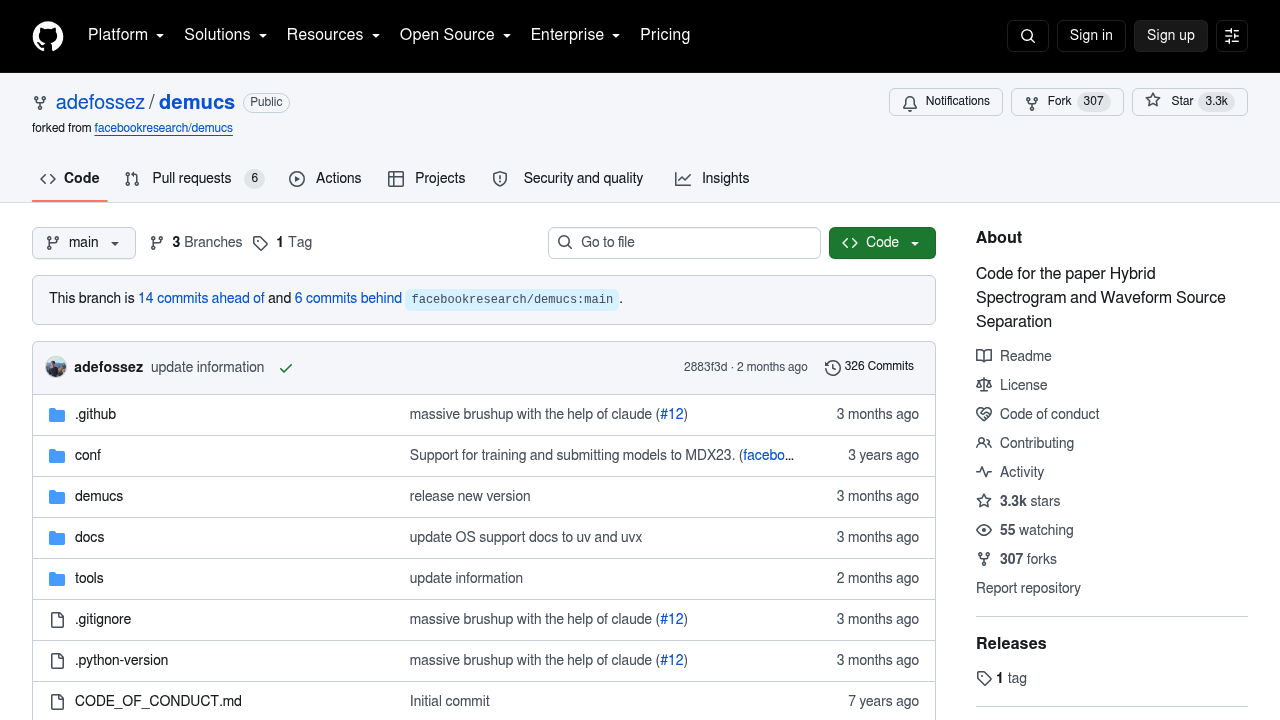
Demucs screenshot

Demucs is an open-source music source separation model that splits a finished song into separate stems. The current fourth release, Hybrid Transformer Demucs, separates drums, bass, vocals and the remaining accompaniment, and an experimental six-source model adds guitar and piano. It reaches a signal-to-distortion ratio of 9.00 dB on the MUSDB HQ test set, or 9.20 dB with sparse attention and per-source fine-tuning, and was trained on MUSDB HQ plus 800 additional songs. The code is free to download and run locally.

Two groups use it. Musicians, remixers and karaoke fans run it from the command line to pull out a vocal track or isolate a drum part, while machine learning scientists use the repository to reproduce the paper, train their own models and compare results. A graphical interface, Docker image, Colab notebook and web demo are linked for people who prefer not to set up Python by hand. The maintainer has left Meta and is no longer actively developing it, so expect slow replies.

Common workflows include creating an instrumental backing track, extracting vocals for sampling or study, and a two-stem karaoke mode that separates voice from everything else. Separated files can be exported as float32 or int24 audio. Producers prepare stems for remixing, researchers calling the model from another Python program build it into audio pipelines, and entrants reproduced the results from the SDX 2023 challenge. Version 4.1.0 brought modernized packaging, lighter inference dependencies and pretrained models hosted on Hugging Face. GPU acceleration speeds things up but has memory requirements worth checking first.

Demucs alternatives

See all →

Frequently asked

6 questions
What does Demucs separate from a song?
It splits music into drums, bass, vocals and the rest of the accompaniment. An experimental six-source model also isolates guitar and piano.
Who uses Demucs?
Musicians who want stems for remixing or practice, and machine learning researchers working on source separation. The repository supplies training code for the latter group.
Can Demucs make a karaoke track?
A two-stem mode separates vocals from the full accompaniment, giving an instrumental version. Outputs can be exported as float32 or int24 files.
Does Demucs cost anything?
Free, open-source software that you run on your own machine. Pretrained models are hosted on Hugging Face and the package is on PyPI.
What are Demucs's limitations?
The maintainer is no longer actively working on it, so replies are slow and new features are unlikely. The piano stem in the six-source model shows bleeding and artifacts.
How do I run Demucs?
Install it from PyPI and run the command line, call it from a Python program, or use the Docker image or Colab notebook. A graphical interface and web demo exist as well, and a GPU needs enough memory.

Reviews (0)

Write review

No reviews yet. Be the first to share your experience.