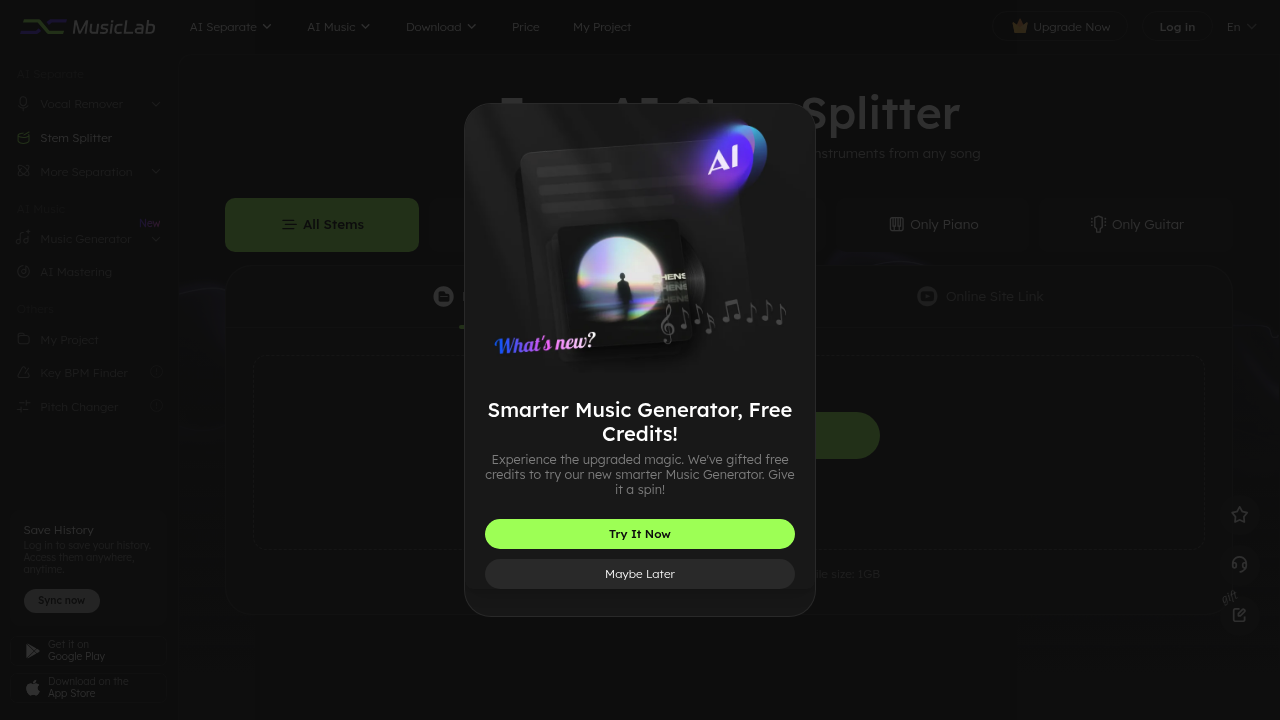
This tool uses source separation algorithms to split audio tracks into individual components. Upload an audio or video file and the system analyzes the waveform to isolate vocals, drums, bass, guitar, piano, and other instruments into separate stems. Each stem gets exported as an independent audio file you can manipulate individually.
The processing pipeline accepts files in MP3, WAV, MP4, MKV, MOV, M4A, FLAC, AC3, M4B, M4R, MKA, OGG, and MP2 formats. You can upload local files up to 1GB or paste YouTube and SoundCloud URLs directly. The system fetches the audio from these services and runs the separation without requiring downloads on your end. All exports come out in WAV format, which preserves the full fidelity of the separated tracks.
The separation engine identifies frequency patterns and spectral characteristics unique to each instrument type. Vocals get extracted by analyzing the human voice frequency range, typically between 85Hz and 255Hz for fundamental frequencies. Percussion separation focuses on transient detection and rhythmic patterns. Harmonic instruments like guitar and piano get isolated through overtone analysis. The algorithm maintains the original audio quality throughout this process, though some artifacts can appear when stems overlap heavily in the frequency spectrum.
Files process locally after upload, with the separation happening on the server side. The free trial handles tracks up to six minutes and processes three files per day. This limitation exists because stem separation requires significant computational resources. Each minute of audio needs to be analyzed across multiple frequency bands simultaneously. The Pro plan extends this to sixty-minute files with unlimited daily processing and packs enhanced separation algorithms that reportedly improve accuracy on complex mixes.
Additional features include a vocal remover specifically for karaoke track creation, a key and BPM finder that analyzes tempo and pitch, and a pitch changer for transposing separated stems. There's also an AI mastering tool and music generator, though these sit outside the core separation functionality. The system saves your processing history so you can re-download previous separations.
Mobile apps exist for both iOS and Android. They work similarly to the web version but with the same file size and duration constraints.
The main technical limitation is file size. One gigabyte caps all uploads. For lossless formats like WAV or FLAC, this translates to roughly sixty minutes at CD quality. Compressed formats like MP3 can fit longer tracks within that size limit. The free tier's six-minute restriction makes it useful for testing but impractical for full-length songs. Three files per day won't support serious production workflows.
Separation accuracy depends heavily on the source material. Clean studio recordings with distinct instrument placement separate better than live recordings or heavily compressed files. Bass and drums typically separate cleanly because they occupy distinct frequency ranges. Vocals and melodic instruments can bleed into each other when they share similar frequencies. The algorithm struggles with lo-fi recordings, heavy distortion, or tracks where instruments are panned to the center and occupy overlapping frequency spaces.
The YouTube and SoundCloud integration simplifies the workflow for quick separations. No need to download, convert, then upload, and just paste the link. This works well for reference tracks or covers but respects each service's terms of service limitations.