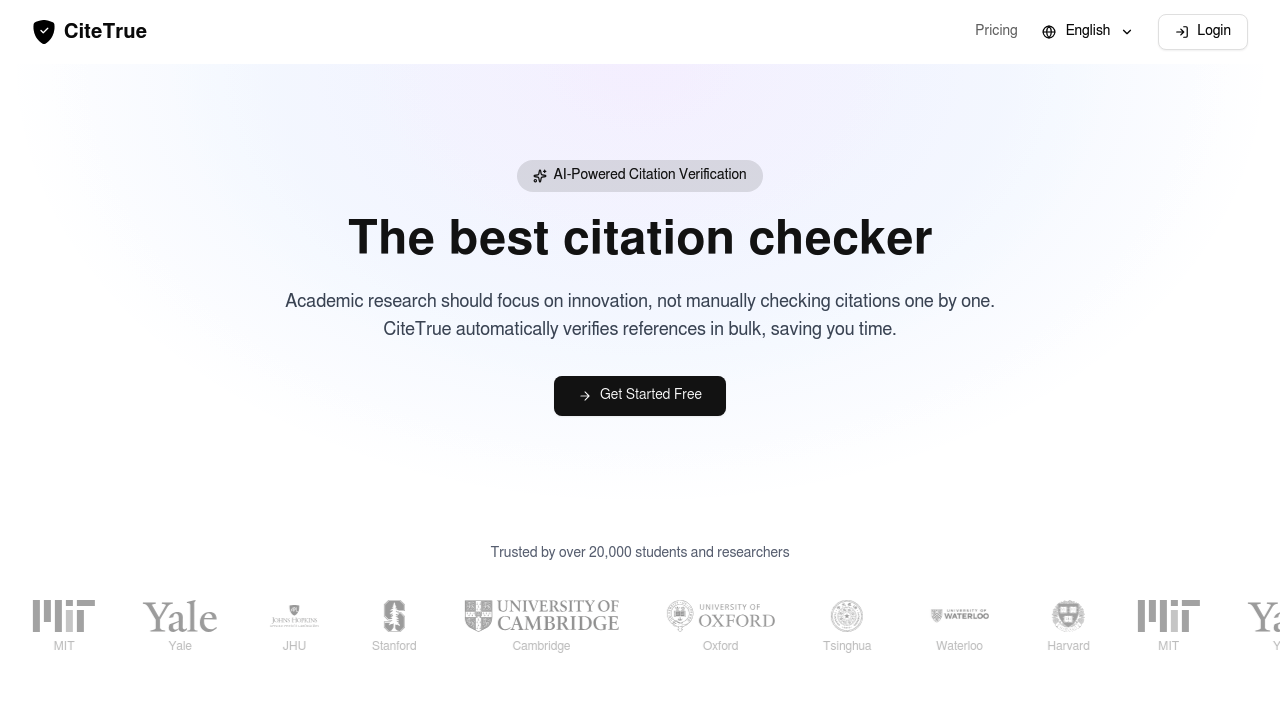
This service cross-references citations against millions of academic papers, journals, and books in leading databases. Users upload a list of references in any citation format, and the system processes them in batches. The verification engine checks four primary elements: author names, publication years, journal titles, and DOIs. Each citation gets run through a proprietary scoring model that combines advanced retrieval algorithms with AI language models to generate confidence scores.
The data pipeline works through automated matching. When you submit citations, the system queries academic databases to find corresponding papers. It doesn't just look for exact matches. The retrieval algorithms account for variations in formatting, abbreviations, and common citation errors. If a paper exists but details don't align perfectly, the confidence score reflects that discrepancy. The AI component helps parse citations that might be malformed or incomplete, extracting the core identifying information before database lookups begin.
Output comes as a detailed verification report. Each citation receives a confidence score indicating authentication likelihood. The system flags citations that appear fake or AI-generated, which matters because language models sometimes invent plausible-sounding references that don't actually exist. When this service detects formatting issues in legitimate citations, it corrects them automatically during verification. Reports export to CSV or PDF for further analysis or record-keeping.
The batch processing capability handles scale efficiently. Free accounts process up to 100 citations per batch, while paid tiers handle 1000 citations at once. This matters for researchers reviewing extensive bibliographies or academic advisors checking student papers. Single-click verification beats manual lookups.
Over 20,000 students and researchers use this service. The free plan includes 100 verifications monthly with CSV and PDF export. Paid plans start at $5.99 monthly for 1000 verifications, scaling to $11.99 for 5000 verifications, and $47.99 for 20000 verifications. Annual subscriptions save 40 percent compared to monthly billing.
Technical limitations center on volume constraints. Monthly verification caps mean heavy users need higher-tier plans or must wait for quota resets. Batch size restrictions also apply, though 1000 citations per batch covers most use cases. The system depends on what's indexed in its academic databases. Obscure publications from smaller journals or non-English sources might not verify as reliably as mainstream academic literature. The confidence scoring model works probabilistically, so edge cases exist where legitimate citations score lower than they should or vice versa.
This service accepts citations in any format, which creates parsing challenges. The AI handles most variations, but extremely non-standard formatting might confuse the extraction algorithms. There's no API access mentioned, so integration with reference management software or institutional systems isn't available through automated means. Users need to export their citations, run verification, then import results back into their workflow manually.
The scoring methodology combines retrieval with language understanding, but the specifics of how confidence scores get calculated aren't fully transparent. This black-box aspect means users need to apply judgment when interpreting borderline scores. A citation flagged with moderate confidence requires human review rather than automatic rejection.