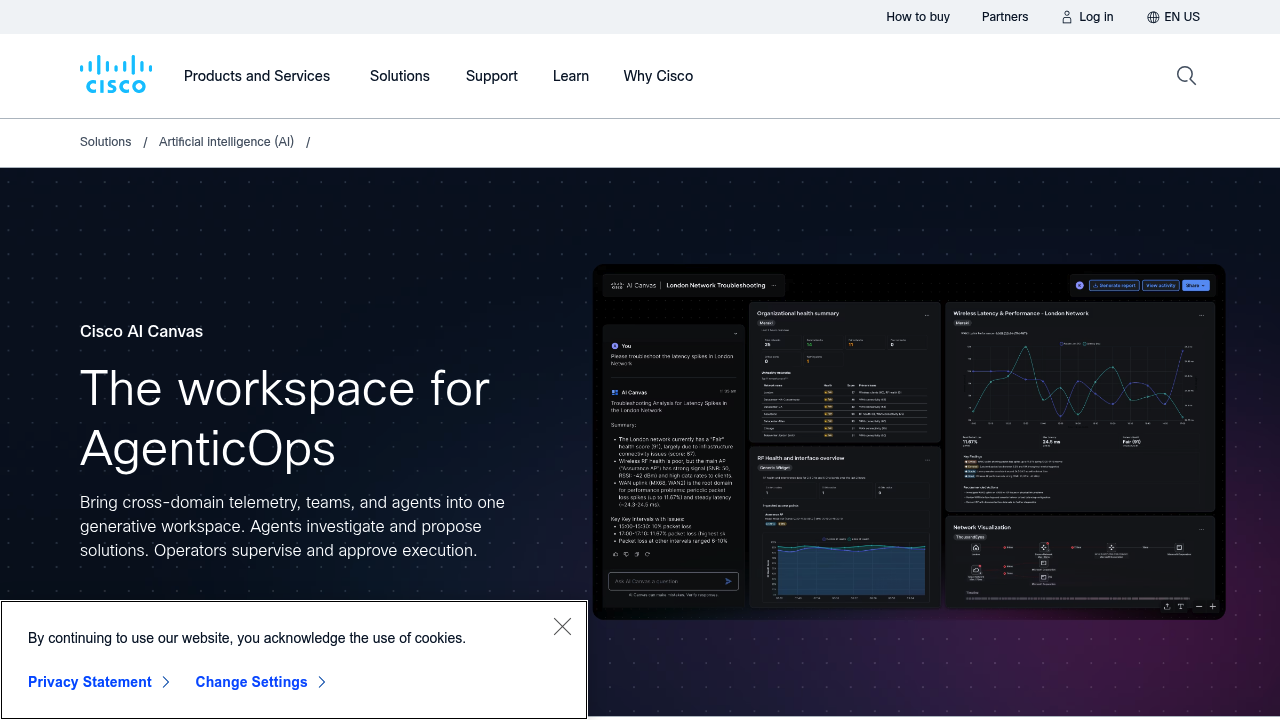
Cisco AI Canvas creates a unified workspace where IT operations teams handle incidents across networking, security, collaboration, and observability domains simultaneously. This system addresses the reality that 75% of mean time to resolution gets consumed just finding the problem. Rather than switching between separate tools for each domain, teams work inside a persistent canvas that aggregates cross-domain telemetry and maintains a single source of truth throughout incident lifecycles.
This system implements what Cisco calls AgenticOps. AI agents investigate issues by retrieving and correlating signals across domains, then propose specific solutions with supporting evidence. Human operators review these proposals, approve actions, and supervise execution. This division puts automation in charge of investigation speed while keeping humans in control of decisions and risk management. The workspace visualizes evidence that agents surface, letting teams pin relevant data and eliminate services that aren't affected through evidence-backed correlation.
Cross-domain signal correlation happens automatically. When an incident appears in one area, the system pulls telemetry from networking gear, security appliances, collaboration tools, and observability platforms to identify root causes that span multiple domains. Teams don't manually hunt through separate consoles. The canvas presents correlated findings with the evidence trail visible.
The underlying intelligence comes from the Cisco Deep Network Model, trained on over 40 years of Cisco operational expertise. This foundation gets refined continuously with live telemetry data and insights from Cisco's Technical Assistance Center and customer experience teams. The model learns from actual network behavior patterns rather than theoretical scenarios.
Integration coverage spans Cisco's infrastructure portfolio. AI Canvas connects with Catalyst Center, Nexus Hyperfabric, Intersight, Meraki, Nexus Dashboard, SD-WAN, Cyber Vision, and ThousandEyes. Third-party product integrations expand over time, though specific non-Cisco tools aren't detailed in available documentation.
IT operations teams managing complex multi-domain environments get the most value. Network operators handling Cisco infrastructure can investigate incidents without context-switching between domain-specific tools. Incident responders gain faster correlation when issues cross traditional boundaries between networking, security, and application performance. Cross-domain operations teams benefit from the unified view that breaks down silos between specialized groups.
The agentic remediation workflow requires human approval before execution. Agents don't act autonomously. They investigate and recommend. Operators decide and authorize. This governance model suits environments where change control and risk assessment matter more than fully automated responses.