
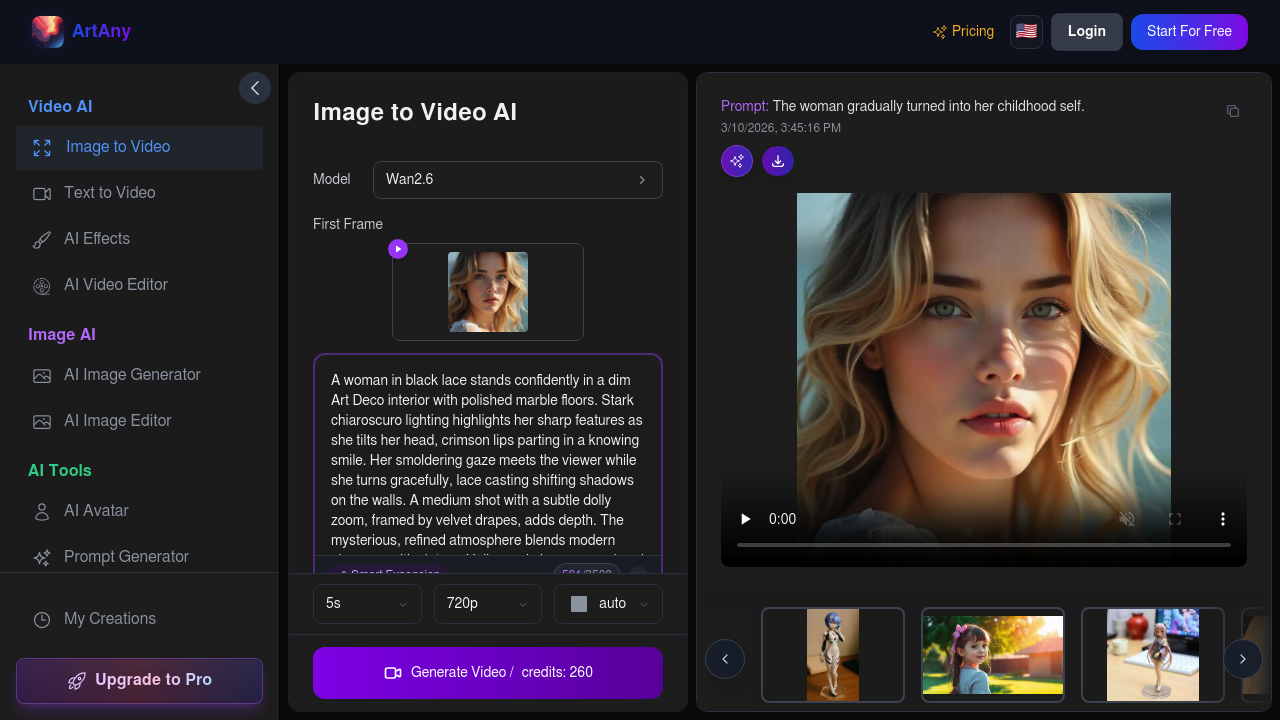
Converting still images into moving video used to require video editing expertise and timeline manipulation. This tool automates that process through AI models that analyze uploaded images and generate five-second animated sequences at 720p resolution. Users upload an image, add optional text prompts describing desired motion or effects, and the system produces video output using one of several available AI models.
The service centers on the Wan2.6 model for standard video generation, consuming 260 credits per 720p five-second clip. Users can choose from multiple model variants depending on speed and quality needs. Wan2.1-turbo processes videos for 100 credits, optimized for faster generation. Wan2.1-plus costs 200 credits per video with enhanced quality. Wan Vace runs 320 credits for specialized effects. The ArtAny-plus model requires 300 credits while ArtAny-turbo provides quicker processing. Each model handles the same five-second duration and 720p output but differs in processing approach and visual characteristics.
Smart Expansion handles first frame preparation before video generation begins. FLF2V (First-Last Frame to Video) lets users define both starting and ending keyframes, with the AI interpolating motion between these fixed points. This matters for creators who need specific beginning and ending states rather than letting the AI determine the final frame position.
The prompt system operates at two complexity levels. Standard text prompts work for basic animation descriptions. JSON structured prompting provides granular control over camera behavior, timing sequences, element weights, and physics parameters when using the Veo3 model specifically. This JSON approach specifies lens type, aperture settings, frame rate, temporal controls for when actions occur, and weight adjustments that emphasize certain visual elements over others. The dedicated AI Video Generation Assistant helps optimize prompts regardless of format chosen.
Audio integration accepts MP3, WAV, M4A, AAC, OGG, and FLAC files up to two minutes maximum. Seed control allows reproducible generations when users want consistent results across multiple attempts with the same parameters.
Pricing operates on annual subscription tiers with a 30% discount compared to monthly billing. The Lite Plan runs $11.10 monthly when billed annually, allocating 14,400 credits yearly. That translates to approximately 144 videos at the standard 260-credit cost per 720p clip, though cheaper models stretch this further. The Starter Plan costs $19.90 monthly (annual billing) with 36,000 credits supporting roughly 360 videos per year. Premium subscribers pay $34.90 monthly for 66,000 annual credits, enough for about 660 standard videos, and this tier removes advertisements. The Advanced Plan delivers 156,000 credits annually at $62.90 monthly, covering approximately 1,560 videos. All paid tiers include commercial licensing, access to every AI model, the prompt generator tool, video history tracking, and unlimited access to faster models. Credits roll over and never expire across all plans.
The credit system creates hard generation limits. Users must calculate whether their monthly output fits within their tier's allocation. Someone needing five videos weekly would consume about 260 videos annually, fitting comfortably in the Starter Plan but exceeding Lite Plan capacity.
Video duration stays locked at five seconds. Longer sequences require multiple generations or external stitching. The 720p resolution works for social media and web content but falls short for broadcast or high-resolution display needs. Audio files can't exceed two minutes, though the five-second video length makes this restriction mostly irrelevant unless planning multi-clip projects.
Content creators producing short-form social media clips benefit most from the one-tap conversion workflow. Marketers animating product photography or promotional stills avoid learning timeline-based editors. Video producers prototyping motion concepts can test ideas quickly before committing to full production.