
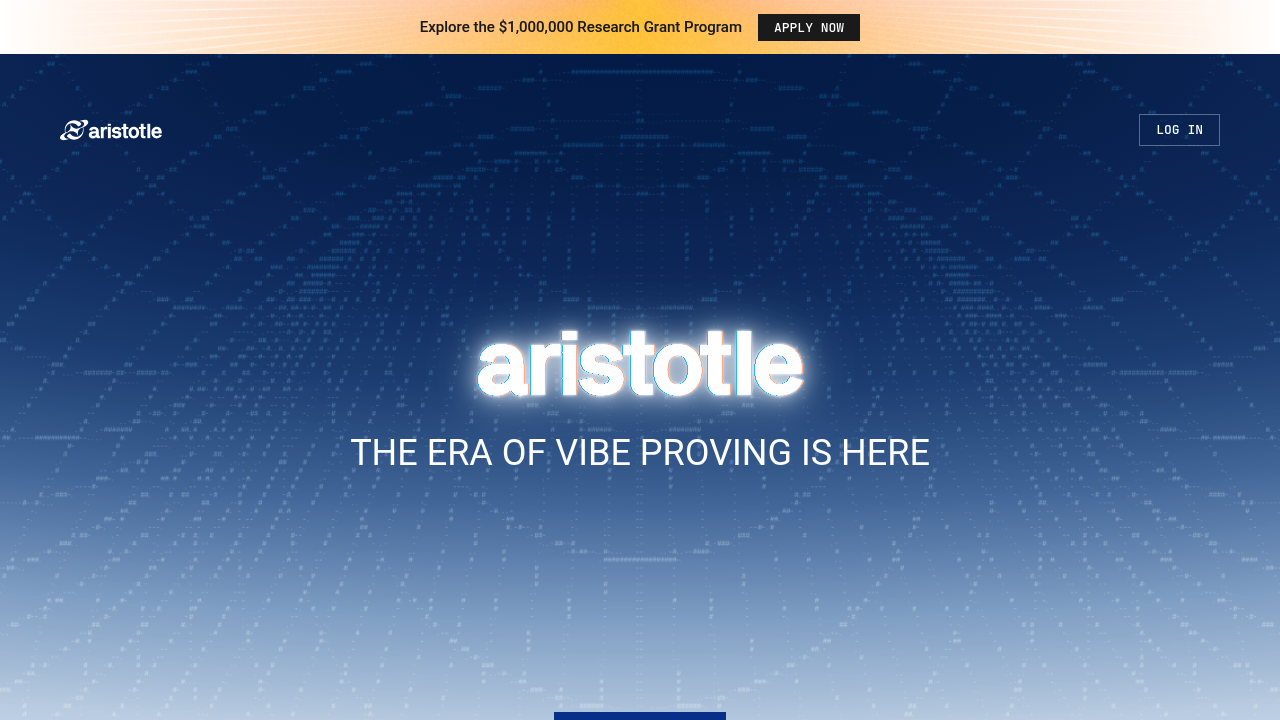
You open Aristotle and paste in a mathematical proof written in plain English. The system reads through your argument and starts converting it into Lean4 code, the formal verification language that proves math is actually correct rather than just convincing.
The interface shows your proof transforming line by line. English statements about limits or topological spaces become precise Lean syntax. It's not just translation. The system verifies each step logically connects to the next.
Sometimes you've got a formal proof that's mostly done but has gaps marked with "sorry" statements where you couldn't figure out the details. Aristotle fills those holes. You feed it a theorem with multiple missing pieces and it completes the entire chain of reasoning, producing verified code that actually compiles.
The counterexample feature catches mistakes before you waste hours. When you formalize a statement incorrectly or your logic breaks down, Aristotle generates a concrete case where your claim fails. You see exactly where the reasoning went wrong.
It handles research-level problems. The system describes itself as IMO gold-medal-level, meaning it tackles competition math at the international olympiad standard. The "Vibe Proving" approach apparently differs from typical formal verification workflows, though the site doesn't elaborate much on what makes it different.
The $1,000,000 Research Grant Program suggests they're betting on serious mathematical applications beyond casual use. This isn't for checking homework. It's built for mathematicians pushing into new territory who need machine-verified proofs of complex theorems. The friction comes when your informal reasoning doesn't map cleanly to formal logic and you have to rewrite how you think about the problem entirely.