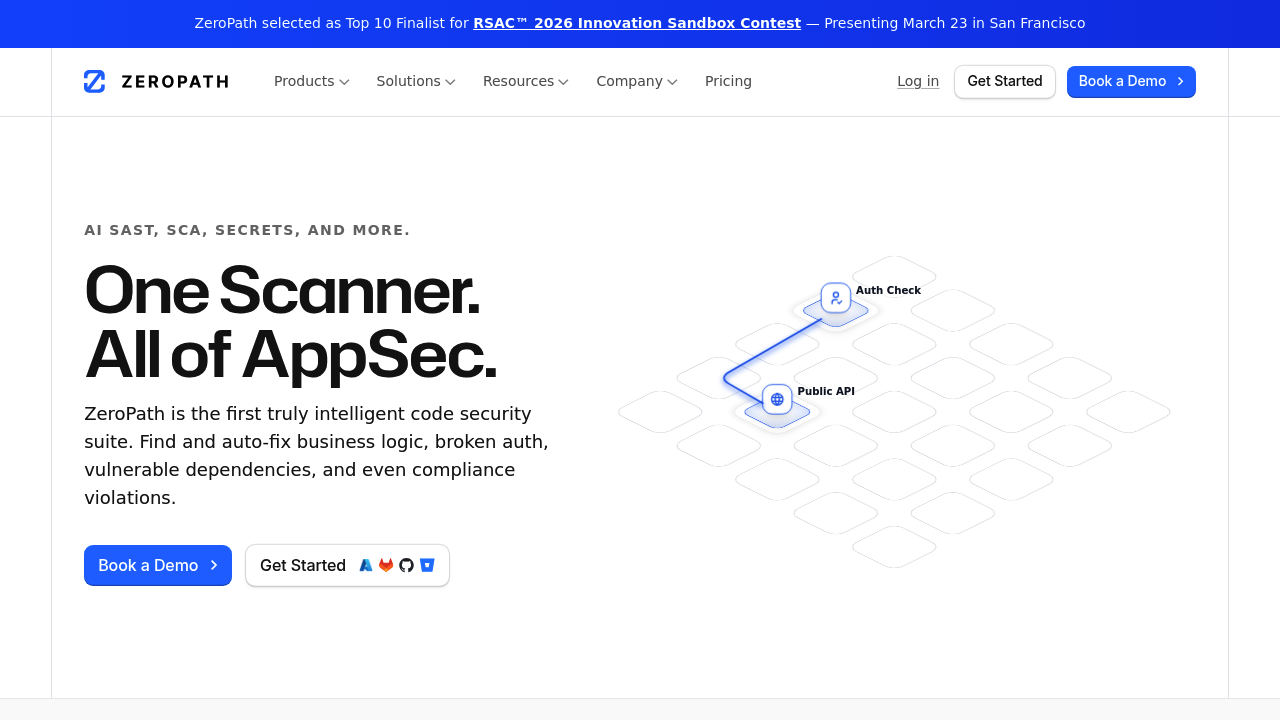
Traditional security tools won't scan your codebase for auth bypasses or business logic flaws that only emerge when you understand how the entire application actually works. ZeroPath does that—treating security analysis as a reasoning problem rather than pattern matching.
It scans repositories without build scripts or configuration files. You point it at code. It figures out the rest. ZeroPath generates abstract syntax trees and maps authentication flows. It spots vulnerabilities that traditional SAST tools miss because they're looking for known patterns instead of understanding what the code is trying to accomplish. Over 200,000 scans run monthly (according to ZeroPath).
Application security engineers get automatically generated patches for confirmed vulnerabilities. ZeroPath verifies exploitability before flagging issues. Fewer false positives clutter your backlog. It handles software composition analysis with reachability awareness—so you're not patching dependency vulnerabilities in code paths that never execute.
Continuous pull request review catches problems before merge. Custom policy enforcement works at scale without requiring teams to manually configure rules for each repo. Managing security across dozens of microservices? ZeroPath applies consistent policies automatically.
Secrets detection validates whether exposed credentials actually work (rather than just flagging anything that looks like an API key). Infrastructure as Code scanning covers Terraform and similar tools.
The "zero-config" promise sounds great until you hit edge cases in unusual codebases. But ZeroPath made the RSAC 2026 Innovation Sandbox top ten—presenting in March. Teams reportedly save 120+ hours weekly, though that number probably varies wildly depending on your existing security debt.