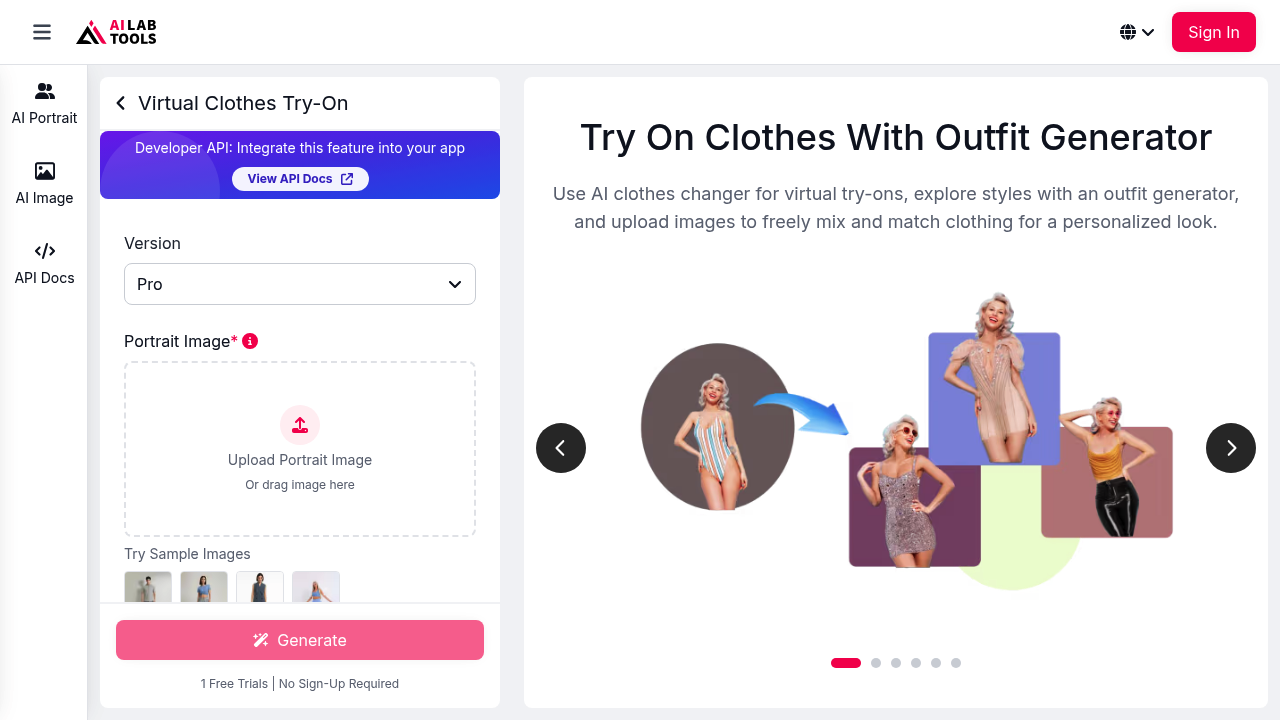
AILabTools offers a virtual try-on solution that connects browsing clothes online with seeing them on your actual body. Users upload a portrait photo alongside images of clothing items they want to test, and the system generates realistic visualizations showing how those outfits would look when worn. This approach tackles one of online shopping's biggest friction points: uncertainty about fit and appearance.
This application separates tops from bottoms during upload, which creates flexibility most virtual try-on systems don't provide. You can upload a blazer from one retailer and jeans from another, then see them combined on your portrait. This mix-and-match capability extends beyond simple visualization into practical wardrobe planning, letting users experiment with combinations from their existing closet or potential purchases without physically changing clothes.
AILabTools maintains 99% system stability uptime across its infrastructure, which supports over 50 high-performance APIs beyond just the outfit generator. This reliability matters when you're building a workflow around virtual try-ons, whether for personal shopping decisions or commercial applications.
For developers and businesses, AILabTools provides API access that enables integration into third-party applications. E-commerce platforms could embed the try-on feature directly into product pages. Fashion apps could build personalized styling services around it. Marketing teams could generate model images without coordinating photoshoots.
The free trial requires no sign-up and provides one complete try-on session. Sample images come included for users who want to test functionality before uploading personal photos. Once you generate an outfit visualization, you can download the result for saving or sharing.
Data handling follows a strict 24-hour deletion policy. Every uploaded portrait, every clothing image, and every generated result gets automatically removed from servers within one day. This addresses privacy concerns for users uploading personal photos, though it also means you can't return to previous results after that window closes.
Fashion enthusiasts use this service for pre-purchase decisions, reducing return rates by catching style mismatches before checkout. Online shoppers visualize items from multiple stores together, building complete outfits across retailers. Clothing designers generate mockups without hiring models. E-commerce platforms reduce customer hesitation by showing products on the shopper's own image rather than generic models.
The system needs clear portrait photos to function properly. Blurry images or unusual angles will degrade output quality. The lighting, pose, and resolution of your portrait directly impact how realistic the final visualization appears.
That single free trial without sign-up provides a genuine test drive but won't support ongoing use. Heavy users will hit that limit quickly. The 24-hour deletion policy, while privacy-friendly, prevents building a saved history of tried-on outfits. You can't revisit last week's combinations or track outfit ideas over time unless you manually download and store each result.
The virtual wardrobe planner feature extends beyond single outfit generation into broader styling assistance. It provides personalized recommendations based on uploaded items, though the specifics of how these recommendations get generated aren't detailed in available information.
For businesses, the developer API represents the most significant value proposition. Integration capabilities transform a standalone application into embedded functionality within existing platforms. Fashion retailers could reduce return rates. Styling services could scale personalized recommendations. Marketing teams could produce diverse model imagery without traditional production costs.
This service sits at the intersection of personal shopping convenience and commercial application potential, offering both casual users and developers a way to visualize clothing combinations without physical try-ons.