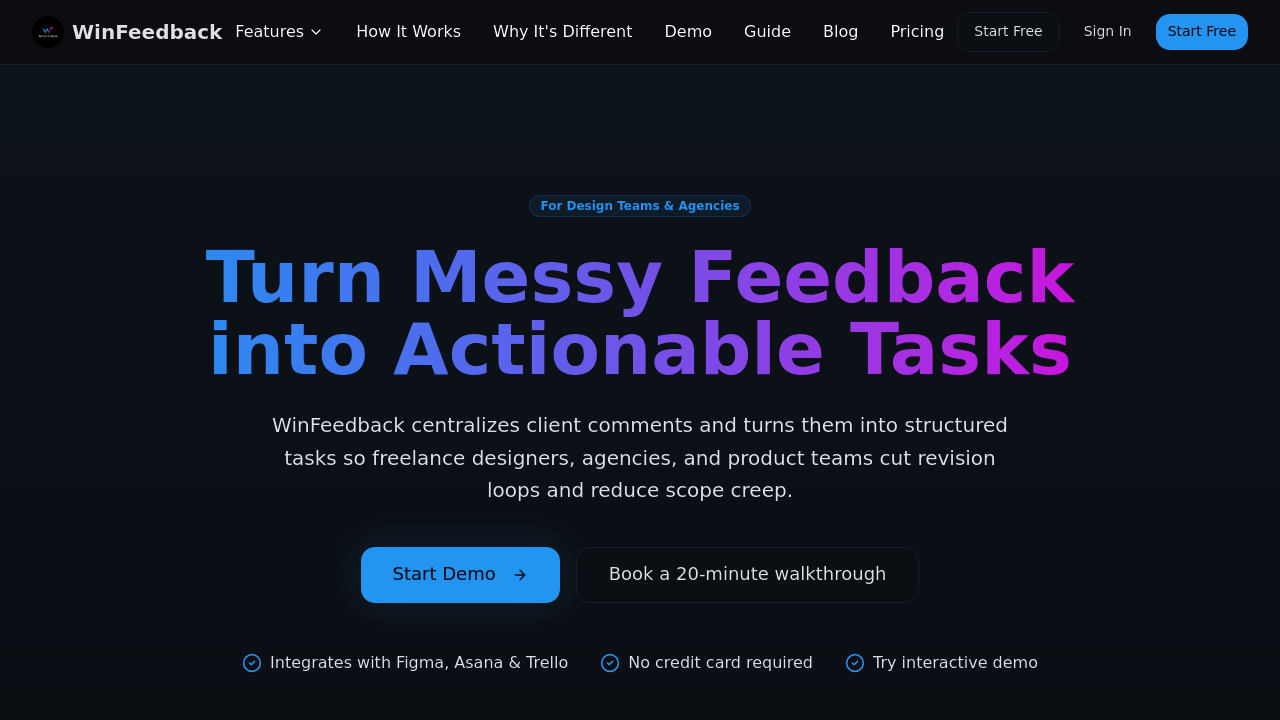
WinFeedback sits between client feedback and design execution, parsing unstructured comments into structured task specifications. The system ingests feedback through client-facing sharing links, then routes it through an AI translation layer that converts subjective statements into quantified parameters. This translation process achieves 94% to 98% accuracy depending on the subscription tier, with higher tiers using team-calibrated or custom-trained models that learn from a specific organization's terminology and standards.
The technical pipeline starts when a client submits feedback through a shared link. The AI analyzes the comment against design context pulled from Figma, including layer structure and design tokens. It then generates a structured task with specificity metrics, time estimates, and scope classification. Time estimation works in two modes: baseline algorithmic prediction (accurate to within 30 minutes on lower tiers) or team velocity-based calculation (within 15 minutes on higher tiers) that adjusts based on historical completion data from that specific team.
Output tasks include translated requirements, estimated effort, and automatic scope flags. The system tracks revision counts against preset caps and alerts teams when feedback pushes beyond agreed boundaries. This prevents the common agency problem where vague requests balloon into uncompensated work. The service claims agencies typically waste $4,500 monthly interpreting unclear feedback, and its structured approach reduces revision loops by 30% to 50%.
Integration architecture uses one-click sync to push completed tasks directly into Figma, Asana, or Trello. The Solo plan restricts users to one integration at a time. The Per-Project plan enables all three simultaneously. Higher tiers promise early access to additional integrations and custom development for enterprise workflows. Task sync happens in under 10 minutes from initial feedback submission to appearance in the connected project management tool.
Workflow customization ranges from three preset templates on the Solo plan to unlimited custom configurations on Team and Enterprise tiers. These workflows define how feedback gets categorized, routed, and prioritized within the translation pipeline. The analytics dashboard surfaces patterns in client feedback types, team velocity trends, and scope creep indicators. Custom reporting becomes available at Team level and above.
Storage limits create practical boundaries. Solo accounts get 1 GB, Per-Project allocates 5 GB per active project, and Team delivers 100 GB shared across the organization. Editor seats also scale: one on Solo, two per project on Per-Project, ten on Team, unlimited on Enterprise. Viewer access stays unlimited across all tiers.
The Solo plan costs $49 monthly with 50 feedback items, while Per-Project runs $40 monthly per active project with 100 items each. Team sits at $299 monthly for 1,000 items total, and Enterprise charges $499 monthly with no item limits. Higher tiers also upgrade support response times from 48 hours down to 4 hours, add SOC 2 certification, and include SSO through SAML.
Technical constraints show clearly. The 94% accuracy floor means roughly one in twenty translations needs manual correction. Time estimates carry 15 to 30 minute margins of error even with team calibration. The system requires existing Figma files and active Asana or Trello accounts, it won't work as a standalone tool. Monthly feedback limits force teams to prioritize which client comments get processed through the AI versus handled manually.
The service targets a narrow use case: design teams already embedded in the Figma and modern PM tool ecosystem who face high volumes of ambiguous client feedback.