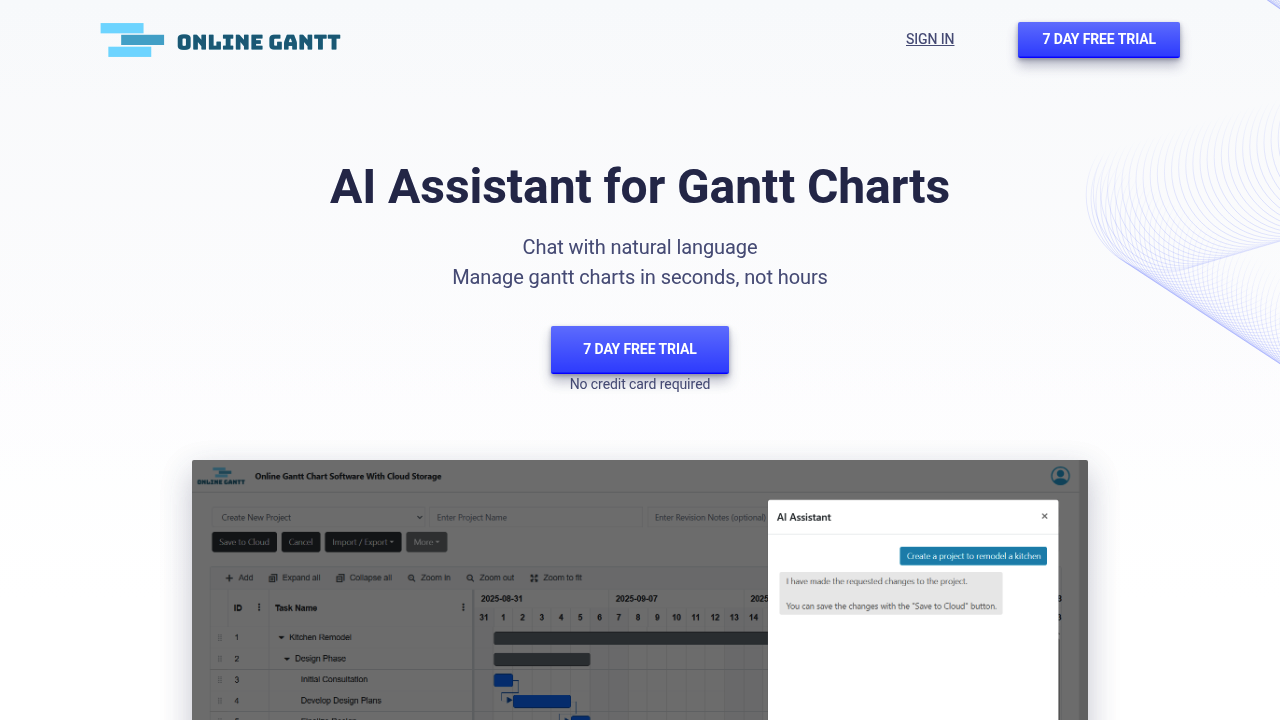
This system processes natural language commands to manipulate Gantt chart data without requiring manual clicking or dragging. Users type conversational instructions like "extend all design tasks by two days" or "create a marketing campaign template with five phases," and the system parses these requests to execute bulk operations on the underlying project data structure. The AI interprets temporal relationships, dependency chains, and resource allocations from plain English.
The natural language processing layer sits between the chat interface and the Gantt chart database. When you ask to revise task completion percentages or adjust dependencies, the system translates your intent into specific database operations. It can generate entire project templates from descriptions, automatically creating task hierarchies, duration estimates, and logical dependency sequences based on common project patterns it recognizes.
The assistant answers questions about project health by querying the current state of your charts. Ask about potential bottlenecks and it'll analyze the critical path. Request insights on timeline risks and it'll flag tasks with tight dependencies or resource conflicts. This works by running calculations on your project data and presenting results conversationally rather than through traditional reporting interfaces.
For bulk editing, the system applies pattern matching to identify which tasks meet your criteria, then executes changes across multiple items simultaneously. This beats manual editing when you're adjusting dozens of tasks that share characteristics. The conversational approach means you do not need to learn complex filter syntax or remember where specific settings live in menus.
The underlying architecture keeps user data isolated from the training pipeline. Your project information stays within your workspace and does not feed back into model improvement cycles. This matters for teams handling confidential roadmaps or proprietary timelines.
The technical limitation here is that performance depends on how precisely you phrase requests. Vague instructions might produce unexpected results since the system has to infer your exact intent. You'll need to verify bulk changes actually hit the right tasks, especially in complex projects with hundreds of items.
The service runs at eight dollars monthly per user. This includes both the cloud-based Gantt chart software and the AI assistant functionality. There's a seven day trial that doesn't require payment details upfront. The per-user pricing model means costs scale linearly with team size, which can add up quickly for larger organizations compared to flat-rate project management tools.