
Visual Studio Code logo

Visual Studio Code

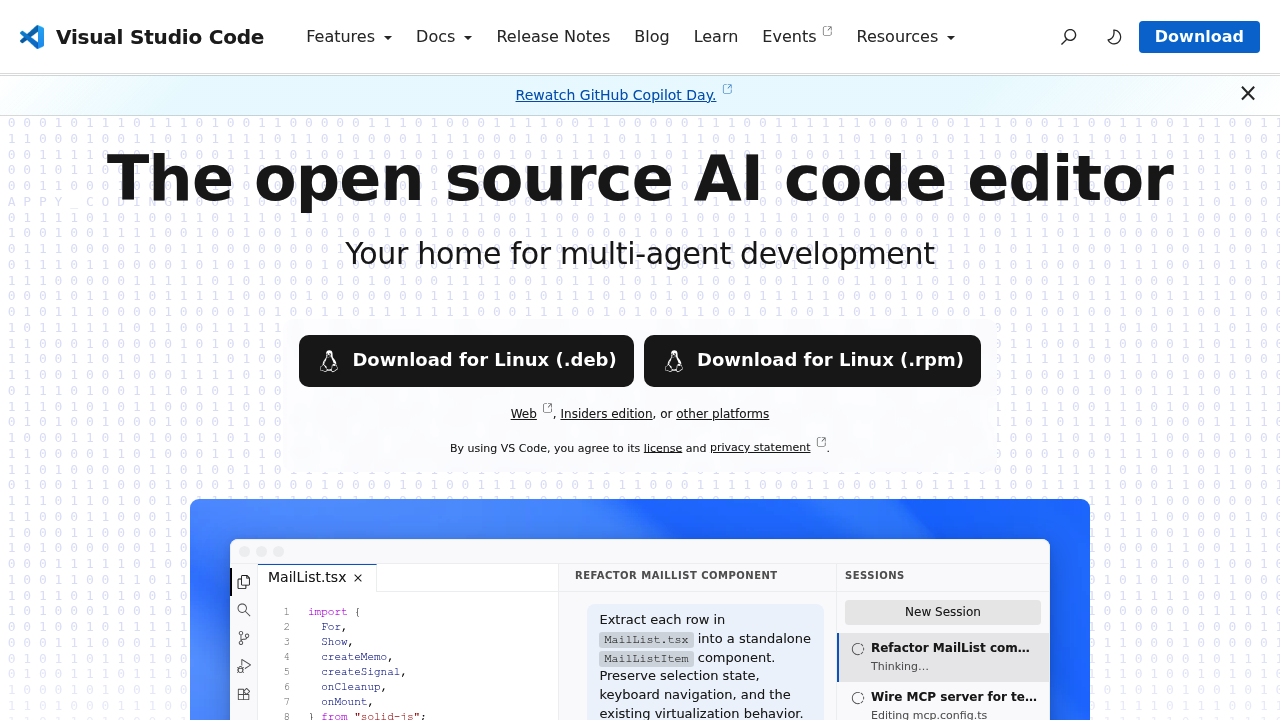
Visual Studio Code is a free, open source code editor that runs on Windows, macOS and Linux and now includes built-in AI agents.

The editor offers an integrated terminal, version control, build tasks, run and debug features, and IntelliSense across languages, and it can be customized through themes, settings and keybindings. AI agents can plan,…

Visual Studio Code screenshot

Visual Studio Code is a free, open source code editor that runs on Windows, macOS and Linux and now includes built-in AI agents. The editor offers an integrated terminal, version control, build tasks, run and debug features, and IntelliSense across languages, and it can be customized through themes, settings and keybindings. AI agents can plan, code and debug, work with any agent or model, and run sessions across local, background and cloud environments. There is no paid plan for the editor itself, and downloads are free for each operating system.

VS Code is used by developers at every level, from students writing a first Python script to professional teams working across large codebases. Web developers, data scientists, systems programmers and cloud engineers all use it, because extensions add support for Python, C/C++, C#, Jupyter notebooks, MongoDB, Stripe and many other stacks. Teams use shared custom rules and agents to keep AI output consistent with their own standards, and the editor can be used in the browser through the web version and on Insiders builds for early features.

A Python developer can install the Python and Jupyter extensions and work with notebooks, linting and debugging in one window. A backend engineer can use Remote Development to code inside containers or over SSH. A frontend developer can ask an agent to extract a component, run the build and review the diff before committing. A team lead can define custom instructions and agents to enforce conventions, while GitLens adds history and blame inside the editor. Developers can code in any language, and Azure and MCP server integrations extend the agents to external services. The marketplace offers thousands of extensions for tasks beyond the defaults.


Visual Studio Code alternatives

See all →

Frequently asked

6 questions
What can the AI agents in Visual Studio Code do?
Agents plan, code and debug on your behalf, reading the repository, running commands, building the project and proposing changes. You can use any agent or model and view all sessions in one place.
Who should use Visual Studio Code?
Developers of every level, from students to professional teams, use it. Extensions cover Python, C/C++, C#, Jupyter, MongoDB, Stripe and more, so it fits web, data, systems and cloud work.
How would a developer refactor a component with VS Code?
Asking an agent to extract a component works well: it reads the files, creates the new component, updates references and runs the build to verify. The diff can be reviewed before committing with built-in version control.
Is Visual Studio Code free?
The editor is free and open source, with downloads for macOS, Windows and Linux in deb and rpm packages. The page offers to start building with AI agents for free. No paid plan is listed for the editor.
Does Visual Studio Code work for every language?
Many languages work out of the box and through extensions, so you can code in any language. Language-specific features such as debugging and notebooks often depend on installing the matching extension.
Where can I run Visual Studio Code?
Windows, macOS and Linux are supported, and there is a web version plus an Insiders edition. Remote Development lets you work in containers or on remote machines, and the editor is fully customizable.

Reviews (0)

Write review

No reviews yet. Be the first to share your experience.