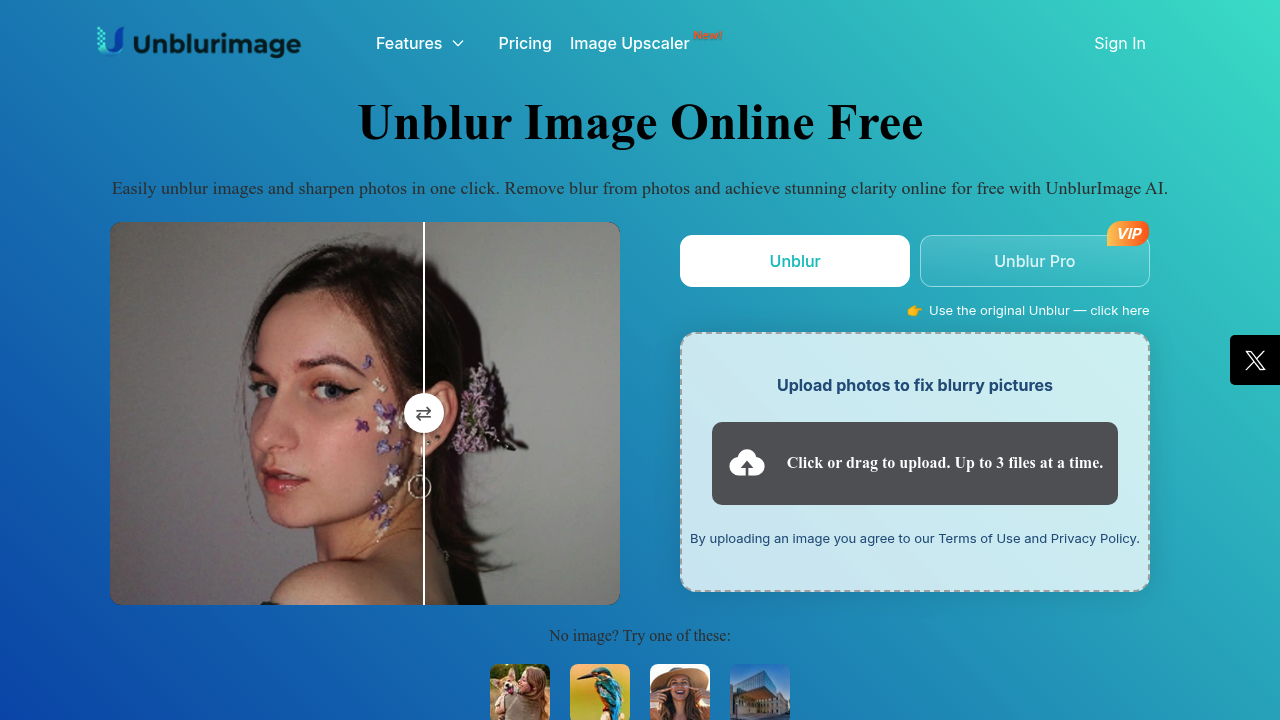
You know that frustrating moment when you find the perfect photo but it's blurry? This service tackles that problem head-on. UnblurImage AI uses artificial intelligence to sharpen photos, remove motion blur and poor focus, and generally rescue images that would otherwise end up in the trash. It also upscales images to 4x their original size and 4K resolution, while reducing noise from high ISO, scanning artifacts, and compression.
The core feature set covers most image recovery scenarios. You can unblur photos, restore old photographs, enhance overall image quality with sharper lines and richer colors, and clean up noisy images. It handles multiple formats including PNG, JPG, and HEIC. You're allowed to upload up to 3 files at a time. There's also video unblurring capability, which sets it apart from purely photo-focused tools.
Does it actually work? The tech appears solid for standard unblurring tasks. Motion blur and focus issues get addressed through AI processing. The upscaling to 4K means you can potentially print or enlarge photos that were previously too small. Noise reduction handles different types of grain and artifacts, which matters if you're working with old scans or low-light smartphone shots.
But here are the constraints. The free plan gives you 6 image chances per week and 10 video chances per week. That's pretty limited if you've got a backlog of photos to fix. Video processing on the free tier only shows you a 30 second preview, which won't help much if you need to unblur longer clips. The 3-file upload limit means batch processing isn't really an option. Once you burn through your weekly free chances, you'll need to buy credits.
Speaking of which, the pricing runs on a credit system. One credit equals one image enhancement. Pro features like Unblur Pro or Restore Pro cost 3 credits per image. Video enhancement costs 1 credit per second, which adds up fast. The smallest paid package starts at $10 for 50 credits, putting each credit at 20 cents. But the pricing scales dramatically if you buy in bulk. At the top end, 100,000 credits costs $1,000, dropping the per-credit price to just a penny. That's a 95% savings compared to the smallest package.
The credit model makes sense for occasional users but gets expensive if you need Pro features regularly. Three credits per image means that $10 package only covers about 16 Pro enhancements. For video work, even a short 60-second clip would eat 60 credits. You'd need to jump to at least the 500-credit tier at $50 to make video work affordable.
Who benefits most? E-commerce sellers who need clean product photos. Photographers rescuing client shots. Social media creators improving visual content quality. Anyone who wants to print or enlarge photos without pixelation. The old photo restoration feature specifically helps people digitizing family archives.
The API integration means developers can build this into other applications, which opens up automation possibilities. But there's no mention of team features or collaboration tools, so this seems aimed at individual users or developers rather than agencies.
Free downloads are included, which is good. You're not paying just to preview results. The service delivers actual usable files. Just plan around those weekly limits if you're sticking with the free tier.