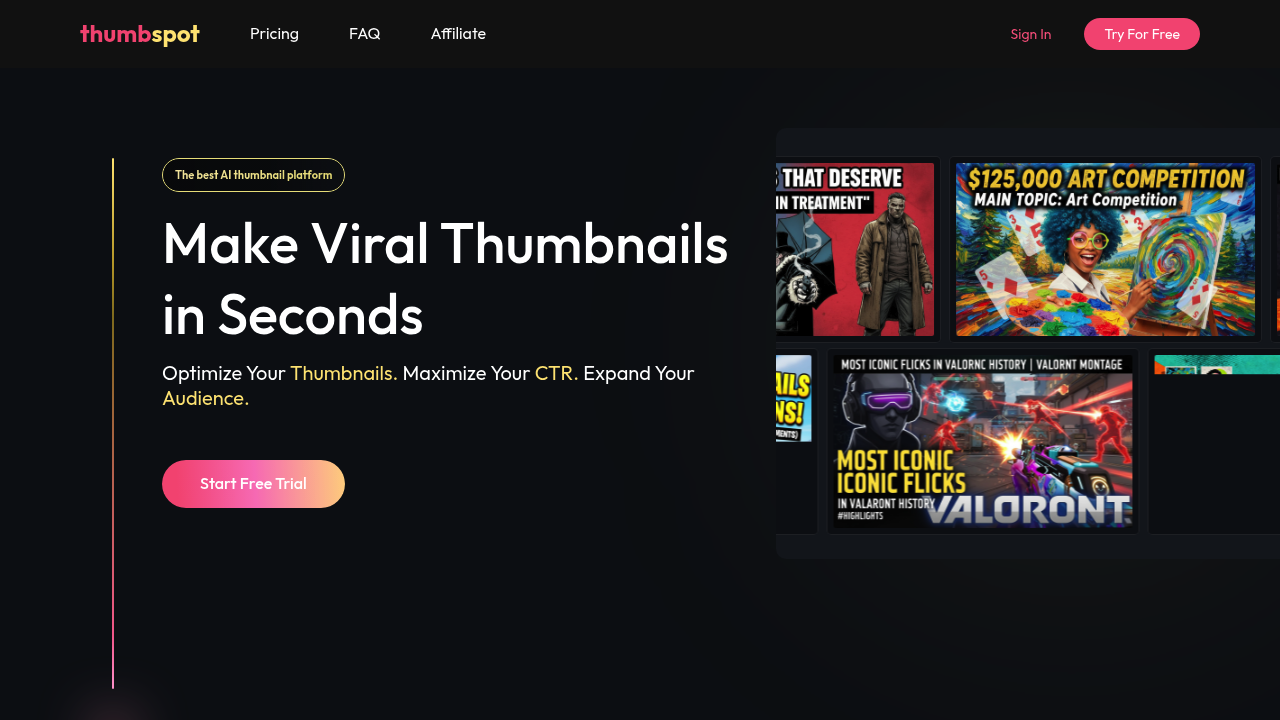
Thumbspot generates YouTube thumbnails from video titles or descriptions using AI models trained on viral content patterns. You input text describing your video, and the system processes it through a template matching algorithm that pulls from over 20 categories including Gaming, Tech Review, Tutorial, Vlog, Comedy, Finance, Fitness, Cooking, Beauty, Music, Education, Entertainment, Sports, Cars, Travel, Fashion, DIY, Pets, News, and Kids. The system displays trending templates with actual view counts from real videos, ranging from 380,547 to 25,048,847 views, giving you data-backed options rather than generic designs.
The technical pipeline works in stages. First, the AI analyzes your input text to determine content category and emotional tone. Then it generates thumbnail compositions based on templates that've performed well in similar contexts. You can upload photos to create an AI persona, which is a digital version of yourself that the system can insert into thumbnails. This involves facial recognition and feature mapping to maintain consistency across different thumbnail styles. The face swap functionality uses similar computer vision techniques to replace faces in templates while preserving lighting and perspective.
Thumbnail recreation is interesting from a technical standpoint. You upload a reference image, and the system analyzes its composition, color palette, text placement, and visual hierarchy. It then generates a new thumbnail matching those patterns while incorporating your specific content. The editing tools let you fine-tune outputs, adjusting elements the AI generated. All thumbnails export at high resolution suitable for direct YouTube upload, which means the system outputs at YouTube's recommended 1280x720 pixel minimum.
The service integrates directly with YouTube for thumbnail uploads. You can also upload existing channel thumbnails as reference material, which feeds into the AI's understanding of your brand's visual style. This creates a feedback loop where the system learns your preferences over time.
Credit allocation determines usage limits. The Starter plan includes 400 monthly credits, producing approximately 40 thumbnails. Creator offers 1,200 credits for roughly 120 thumbnails. Pro provides 4,800 credits for about 480 thumbnails. This credit system suggests different operations consume varying amounts, likely based on computational complexity. Face swapping and persona generation probably cost more than basic template application.
Persona limitations exist. Starter and Creator plans restrict you to one AI persona. Only Pro supports multiple personas, which matters if you run several channels or feature different hosts. This restriction makes sense from a storage and processing perspective since each persona requires maintaining facial data and model weights.
The pricing structure starts at $11 monthly for Starter, $21 monthly for Creator, and $64 monthly for Pro. Annual subscriptions save 20 percent, translating to $42, $96, and $180 in yearly savings respectively. There's a free trial available, though no permanently free tier exists.
Technical limitations center on the credit system's monthly caps. Once you exhaust your credits, you wait for the next billing cycle or upgrade. The service doesn't mention API access, which means you can't automate thumbnail generation through external scripts. No team features appear in the documentation, so collaboration workflows aren't supported. The system also lacks mobile apps or browser extensions, restricting you to web-based access.
The trending template approach creates a dependency on their data collection. If their view count metrics become outdated or their template library stagnates, the system's effectiveness diminishes. you are trusting their curation of what constitutes "viral" content.