
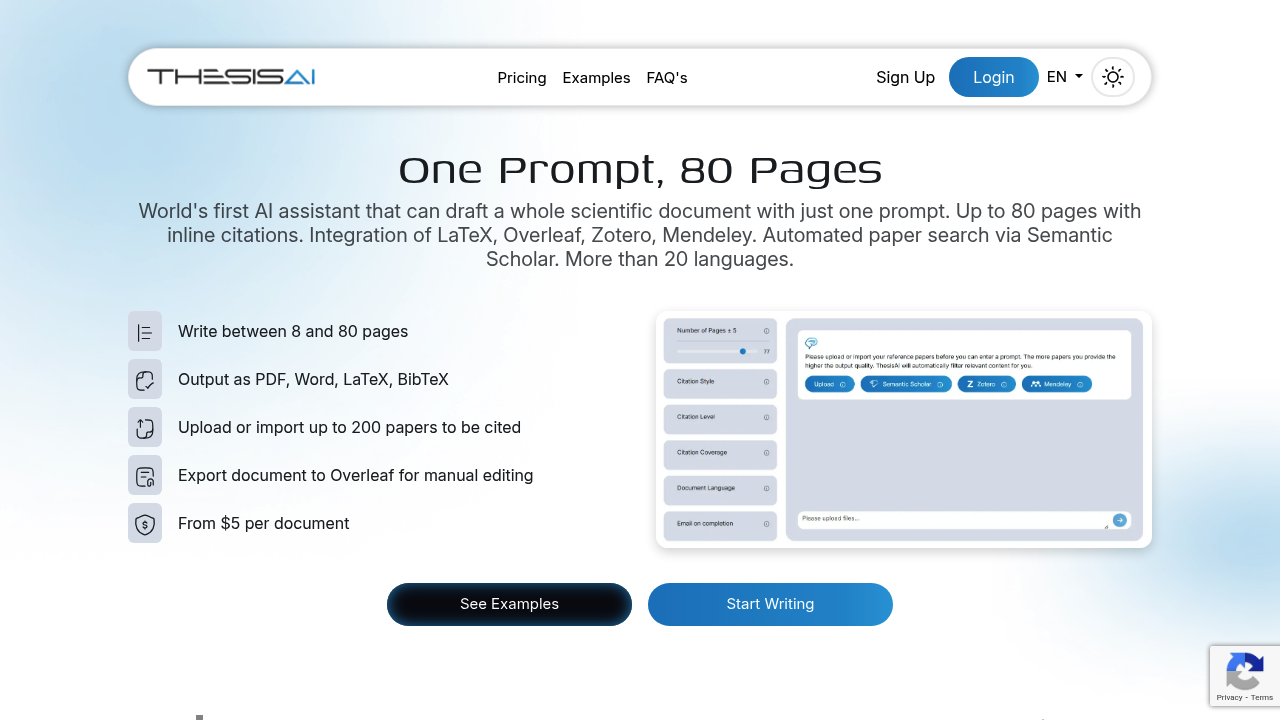
ThesisAI turns a single prompt and a set of source papers into a referenced academic draft. Users upload or import up to 500 papers, pick a citation style, and receive a document between 8 and 80 pages in which each claim carries an inline citation pointing back to a source that can be checked. Papers can also be found through automated Semantic Scholar search, and the finished draft exports as PDF, Word, LaTeX or BibTeX, or goes straight to Overleaf for manual editing. The workspace supports more than 20 languages and offers an MCP connector so other AI assistants can drive it. The output is a first draft, meant to be reviewed, edited and completed by the author rather than submitted as is.
The product fits university students working on theses, dissertations and literature reviews, and doctoral candidates who have already collected dozens or hundreds of papers and need a structured starting text. Academic researchers preparing review sections for grant applications or journal articles can use it to get a sourced skeleton quickly. Librarians and writing-centre staff may use it to demonstrate how citations trace back to sources. Because the text keeps its references visible, it suits people who care about verification: a supervisor or reviewer can follow any statement to the paper it came from. Writers in non-English-speaking countries can work in one of more than 20 supported languages.
A common workflow starts by importing a Zotero or Mendeley library, choosing a citation style and describing the topic in one prompt. The draft appears with sections such as Abstract, Introduction and Theoretical Foundations, each paragraph citing page-level sources. A student can then export to Word to rewrite in their own voice, or send the LaTeX version to Overleaf to adjust formatting before submission. A researcher starting a new topic can let Semantic Scholar search surface relevant papers, then check which statements are supported by sources and which are not. Teams can also connect it to an AI assistant through MCP, so a literature review is requested from within an existing research workflow.