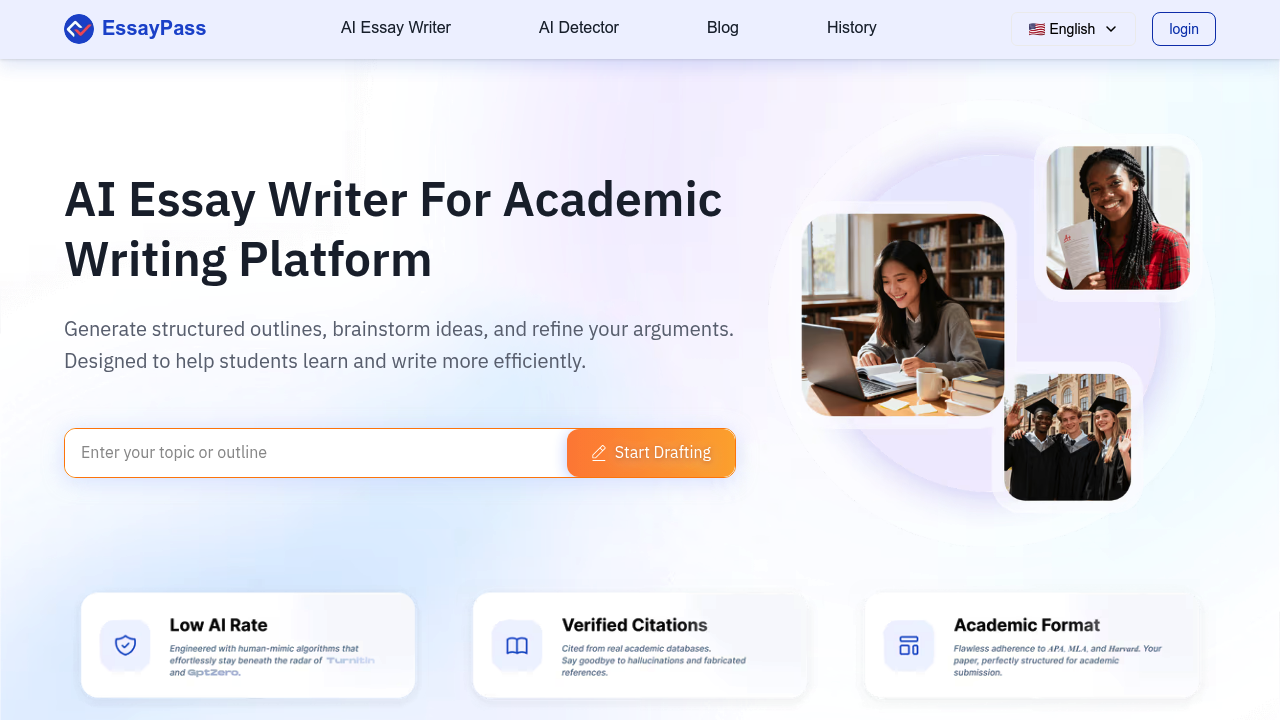
A graduate student stares at a blank document at 2 AM, three days before her thesis chapter is due. She knows her argument but can't organize twelve different sources into a coherent structure. She feeds her research notes and main points into EssayPass, which generates an outline with proper academic hierarchy and suggests where each citation fits. Within minutes she's got a framework that turns her scattered ideas into a logical progression she can actually work with.
This service tackles the specific problem of academic writing paralysis. Students get structured outlines that follow scholarly conventions, then drafts written in the formal tone academic papers require. The system's trained on academic datasets, so it generates content that sounds appropriately scholarly rather than conversational. Citation references get formatted automatically, and similarity checking runs against academic journals and online databases to catch potential plagiarism issues before submission.
An international student writing economics papers in his second language uses the bilingual side-by-side view to verify he's explaining complex concepts correctly. He can see his draft in English on one side and his native language on the other, catching where his English phrasing doesn't quite capture what he means. The FAQ pack generator helps him anticipate questions his professor might raise.
The AI Agent Editor refines initial drafts, and mind map creation helps visualize connections between different research threads. Enterprise-grade encryption protects student work from data breaches. This service has helped 5M+ students and generated 50M+ drafts with a 98% satisfaction rate.
Here's where it gets murky. EssayPass explicitly positions itself as overcoming writer's block and improving efficiency, but academic institutions have wildly different policies about AI-generated content. Some schools allow AI for outlining and brainstorming. Others consider any AI-generated text academic dishonesty. A freshman using this for an entire essay draft could face expulsion depending on their university's honor code. EssayPass doesn't address these ethical boundaries.
The similarity checker catches plagiarism but doesn't verify factual accuracy. If the AI generates a plausible-sounding claim about historical events or scientific findings that's actually wrong, students need to fact-check every assertion themselves.
EssayPass costs one-tenth what private tutoring runs, making it financially accessible for students who can't afford writing centers or paid tutors.
Students at institutions with strict AI policies shouldn't use this. Those who need help understanding source material rather than structuring arguments won't find what they need. Anyone expecting this software to replace actual research or critical thinking will produce surface-level work that doesn't hold up under scrutiny.