
SiliconFlow logo
AI API FREEMIUM

SiliconFlow

You're building an AI app and need to run inference without spinning up your own GPU servers

SiliconFlow gives you instant access to dozens of open source and commercial models through a single API endpoint. You make one API call and your text, image, video, or multimodal model starts running. No containers to…

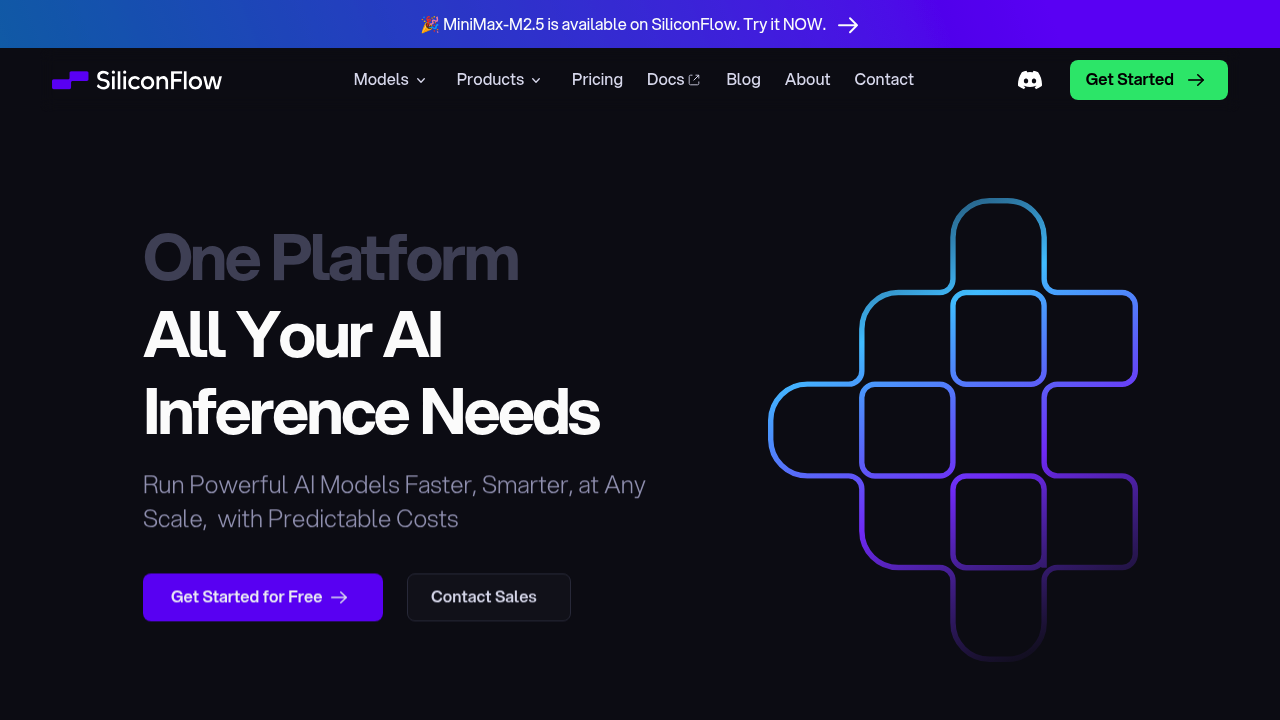
SiliconFlow screenshot

You're building an AI app and need to run inference without spinning up your own GPU servers. SiliconFlow gives you instant access to dozens of open source and commercial models through a single API endpoint.

You make one API call and your text, image, video, or multimodal model starts running. No containers to configure, no servers to provision. SiliconFlow handles everything serverless, so you only pay when tokens actually process. If you're prototyping a RAG system or coding assistant, you pick a model from their library and start sending requests. The unified API means you don't rewrite code when switching between models.

SiliconFlow runs a self-developed inference engine with end-to-end optimization. Works fast. When you need to fine-tune a model on your own data, you can upload datasets, process them, train the model, and deploy with one click. The fine-tuned version becomes available through the same API structure you're already using.

For production workloads where you can't risk throttling, you reserve GPUs. This guarantees capacity and keeps performance stable when traffic spikes. The service supports NVIDIA H100 and H200, AMD MI300, and RTX 4090 hardware. If your needs fluctuate, elastic GPUs scale up and down automatically while maintaining reliability.

The AI Gateway sits between your application and the models, handling smart routing so requests hit the right endpoint every time. You set rate limits to prevent runaway is priced at and monitor usage in real time. This matters when you're running customer-facing features that could rack up bills overnight if something breaks.

Where things get tricky is choosing between dozens of models without clear guidance on which performs best for your specific use case. The context windows vary wildly—some models handle 164K tokens total, others push to 262K. Output limits range from 66K to 262K tokens depending on which model you pick. You'll need to test multiple options to find what works.

Token pricing varies considerably by model. Step-3.5-Flash costs $0.1 per million input tokens and $0.3 per million output tokens. Kimi-K2.5 runs $0.23 input and $3.0 output. DeepSeek-V3 sits at $0.25 input and $1.0 output. GLM-5 charges $0.3 input but $2.55 output. You can start for free to test different models before committing to paid usage.

SiliconFlow targets developers building agents, content generation tools, AI assistants, and search systems where you need reliable inference without infrastructure headaches.


SiliconFlow alternatives

See all →

Frequently asked

7 questions
How much does SiliconFlow cost?
SiliconFlow charges per token with pricing that varies significantly by model. Step-3.5-Flash runs cheapest at $0.1 per million input tokens and $0.3 per million output tokens, while Kimi-K2.5 costs $0.23 input but jumps to $3.0 per million output tokens. DeepSeek-V3 sits at $0.25 input and $1.0 output, and GLM-5 charges $0.3 input with $2.55 output. You can start with their free tier to test models before spending money, then pay only when your API calls actually process tokens.
What models does SiliconFlow support?
SiliconFlow provides access to open source and commercial models including MiniMax-M2.5, GLM-5, Step-3.5-Flash, Kimi-K2.5, and DeepSeek-V3 through a single unified API. The platform supports text, image, video, and multimodal models that you access with the same API structure regardless of which model you choose. Context windows range from 164K to 262K total tokens depending on the model, with output limits varying from 66K to 262K tokens. The service runs on high-performance hardware including NVIDIA H100 and H200, AMD MI300, and RTX 4090 GPUs.
Can I fine-tune models on SiliconFlow?
You upload your dataset to SiliconFlow, process the data through their interface, train the model on your custom data, and deploy with one click. The fine-tuned model becomes available through the same API you're already using for pre-built models. Reserved GPUs guarantee capacity during training so you don't compete with other users for resources. Once deployed, you call your fine-tuned model exactly like any other model in their library without changing your code structure.
Does SiliconFlow have a free tier?
SiliconFlow offers a free option to get started so you can test different models before committing to paid usage. After the free tier, you switch to pay-per-use token-based pricing where you only pay when API calls actually process. The serverless setup means no monthly fees or commitments—you run a model, process some tokens, and get charged based on which model you picked and how many tokens went through.
What's the difference between reserved and elastic GPUs on SiliconFlow?
Reserved GPUs guarantee you specific GPU capacity that won't throttle when other users flood the platform, keeping performance stable when your traffic spikes unpredictably. Elastic GPUs scale automatically based on demand but you're sharing infrastructure with other workloads. Reserved makes sense for production apps where unpredictable slowdowns break user experience, while elastic works fine for prototyping or workloads that can tolerate occasional delays. Both options avoid the serverless pay-per-token model and give you predictable billing instead.
How does SiliconFlow compare to running models yourself?
You make one API call and inference starts immediately without configuring containers, provisioning servers, or managing GPU infrastructure. SiliconFlow handles the self-developed inference engine with end-to-end optimization so models run faster than typical deployments. The unified API means you switch between dozens of models without rewriting code, whereas running your own infrastructure locks you into whatever you deployed. Where it breaks down is choosing which model to use—the platform doesn't guide you on which performs best for your use case, so you'll test multiple options blindly.
What can I build with SiliconFlow?
Developers use SiliconFlow to build coding assistants, RAG systems, AI agents, content generation tools, and search features without managing GPU infrastructure. You pick a model from their library, start sending API requests, and the platform handles inference at scale. The AI Gateway lets you set rate limits so a bug in your code won't rack up massive bills overnight, and smart routing sends requests to the right endpoints automatically. The service works for prototyping or production workloads where you need reliable inference without spinning up your own servers.

Traffic

Estimated monthly website visits · last 9 months

427.8K visits/mo
Monthly visits
427.8K
↓ 35.5% MoM
Global rank
#65,186
VE #584
Category rank
#28
AI API
662.9K 568.8K 474.8K 380.8K 286.8K Dec 2025: 311K visits Dec 2025 Jan 2026: 286.8K visits Jan 2026 Feb 2026: 302.2K visits Feb 2026 Mar 2026: 406K visits Mar 2026 Apr 2026: 468.1K visits Apr 2026 May 2026: 434.2K visits May 2026 Jun 2026: 530.5K visits Jun 2026 Jul 2026: 662.9K visits Jul 2026 Aug 2026: 427.8K visits Aug 2026

Reviews (0)

Write review

No reviews yet. Be the first to share your experience.