
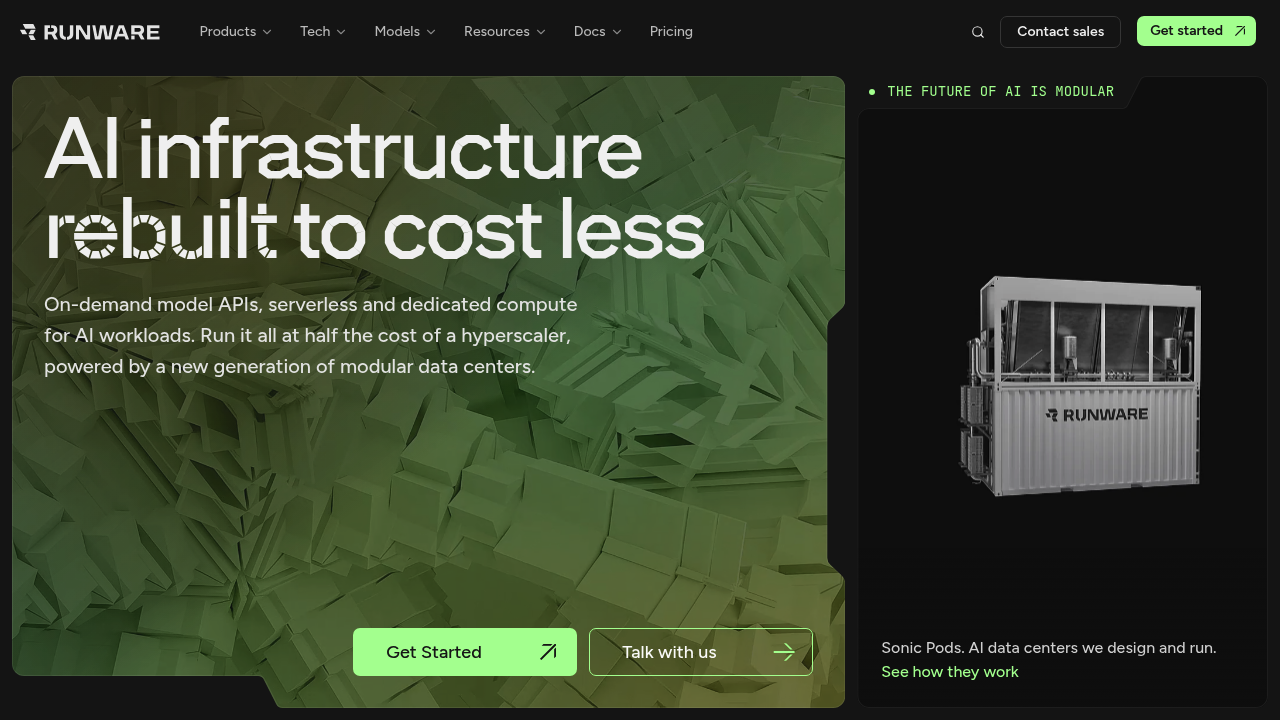
Runware is AI infrastructure that gives developers one API for hundreds of thousands of models, along with the compute to run them. More than 400K models spanning image, video, audio, language and 3D are addressed through one scheme, and switching models is a string change. A single request can batch an image, a video and an LLM chat. Beyond the API, Runware offers serverless GPU compute billed by the second, reserved capacity, and dedicated bare-metal clusters on its own modular data centers called Sonic Pods. Serverless starts at $1.99 per GPU-hour for an RTX PRO 6000, and reserved capacity runs from $0.63.
Runware is aimed at developers, startups and product teams adding generation features to production apps, and at AI companies that need inexpensive inference capacity. The company says over 1 million developers build on it and that applications on its infrastructure reach more than 300M end users. Teams with custom models can upload their own weights or bring containers, while organizations with predictable demand can reserve GPUs. Developers who work with coding agents can connect through a hosted MCP server.
Typical use cases include image and video generation features inside consumer apps, bulk asset generation where cost per output matters, and swapping between open, partner and community models without changing integration code. Teams stacking LoRAs or swapping a VAE on open models control every parameter. Companies run custom workloads on serverless GPUs that scale to zero when idle, then commit to reserved capacity once the baseline is known. Results stream back over SSE or arrive on a webhook per task, which suits asynchronous pipelines handling large batches. 3D asset generation at volume is another listed workload.