Cerebrium logo
AI API FREEMIUM from $100/mo

Cerebrium

Cerebrium is a serverless GPU platform for running AI workloads in production.

Teams deploy voice agents, video models, language models and any custom code, and it scales containers up and down automatically with cold starts of two to four seconds using memory and GPU snapshots. Billing is per…

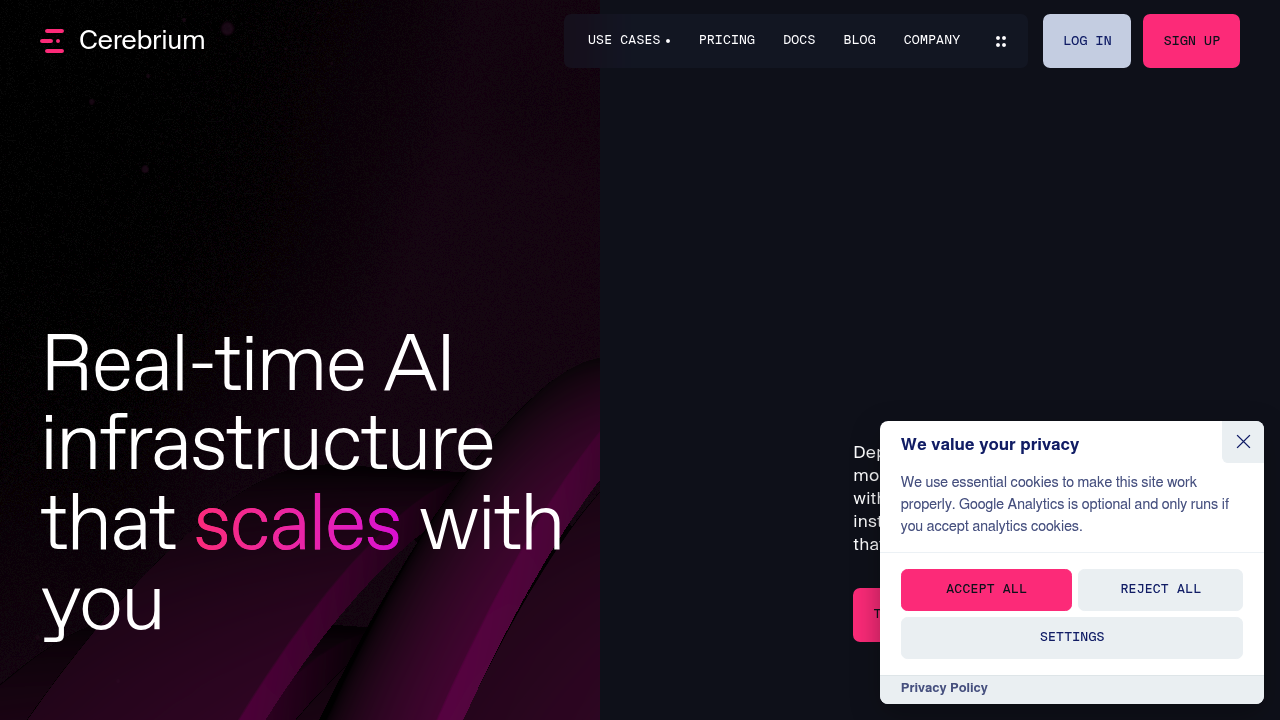
Cerebrium screenshot

Cerebrium is a serverless GPU platform for running AI workloads in production. Teams deploy voice agents, video models, language models and any custom code, and it scales containers up and down automatically with cold starts of two to four seconds using memory and GPU snapshots. Billing is per second of compute, for example an H100 at $0.000944 per second. The Hobby plan is free plus compute, while Standard costs $100 per month plus compute and adds unlimited apps, 1,000 containers, 30 concurrent GPUs and custom domains.

Machine learning engineers, AI startups and platform teams that want inference infrastructure without running Kubernetes are the core users. Developers can point to an entry point or Dockerfile and ship without rewrites, custom decorators or special SDKs. Hobby suits individuals testing a first deployment, Standard fits teams with ML apps live in production, and Enterprise adds volume discounts, unlimited concurrent GPUs, dedicated Slack support and ML engineering services. Regulated companies benefit from SOC 2, HIPAA, GDPR and ISO compliance plus region-specific data residency.

Documented examples include a voice agent responding in 500 milliseconds, a Twilio phone agent built with Pipecat, an outbound calling agent on LiveKit, and transcribing a one-hour podcast in under two minutes. Others cover serving open models with vLLM, deploying a vision-language model with SGLang, running Triton with TensorRT-LLM, hyperparameter sweeps with WandB, generating images with SDXL and serving embeddings and rerankers at high throughput. Capacity spans more than 2,500 GPUs across several clouds and regions, with logs, metrics and scaling events visible in real time.

Cerebrium alternatives

See all →

Frequently asked

6 questions
What does Cerebrium actually run?
It runs your own code or Dockerfile on serverless CPUs and GPUs. Typical workloads are voice agents, LLM inference, image and video models, embeddings and training jobs.
Who should consider Cerebrium?
ML engineers and teams shipping AI applications who prefer not to manage clusters. Enterprise customers can also get ML engineering services and onboarding.
Can I deploy a real-time voice agent on it?
Documented examples include a 500ms voice agent, a Twilio agent using Pipecat and an outbound agent using LiveKit. Fast cold starts and GPU snapshotting keep first-request latency low.
What does Cerebrium cost?
Hobby is free plus compute, and Standard is $100 per month plus compute. Compute is billed per second, with the first 100GB of storage free and extra storage at $0.05 per GB per month.
Are there restrictions on the free plan?
Limits on Hobby are 3 seats, up to 3 deployed apps, 500 containers and 5 concurrent GPUs. Logs are retained for a short period, and private Slack support begins on higher tiers.
How do I get started and monitor workloads?
Sign in through Try it now and deploy with the cerebrium CLI. Observability covers logs, metrics and scaling events, with native OpenTelemetry support for existing monitoring stacks.

Reviews (0)

Write review

No reviews yet. Be the first to share your experience.