
RivalSee logo
AI Monitor PAID from $70/mo

RivalSee

Your website could rank number one on Google and still be invisible when potential customers ask AI chatbots for recommendations

RivalSee tracks exactly that — whether AI platforms suggest your brand when different customer types ask questions, and what you need to fix to show up more often. This platform creates personas based on your actual…

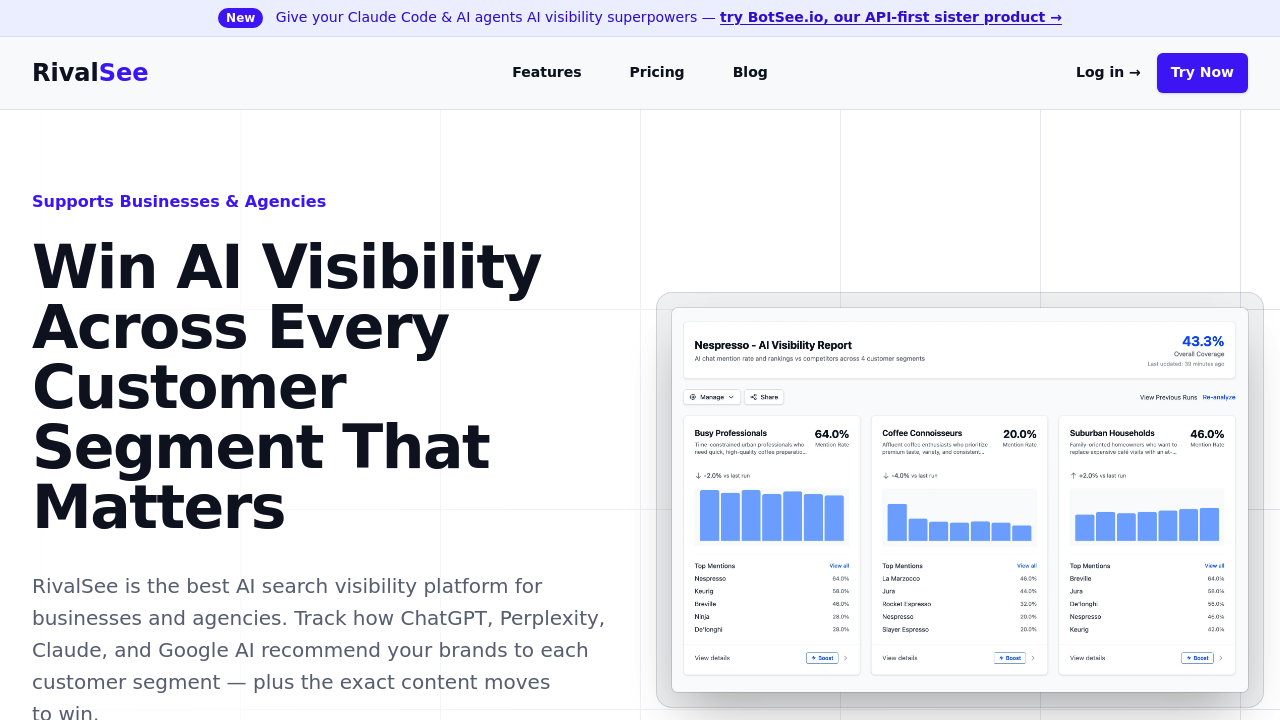
RivalSee screenshot

Your website could rank number one on Google and still be invisible when potential customers ask AI chatbots for recommendations. RivalSee tracks exactly that — whether AI platforms suggest your brand when different customer types ask questions, and what you need to fix to show up more often.

This platform creates personas based on your actual site content. Not generic keyword lists. These personas represent real customer segments and ask questions the way those customers would. A small business owner researching accounting software asks different questions than a CFO at an enterprise company. RivalSee simulates both, then checks whether major AI platforms recommend you in their responses. You see results across five different AI systems in one dashboard.

What makes this useful? The source tracking. When competitors get recommended instead of you, RivalSee shows which of their pages the AI cited and what content gaps exist on your site. You're not guessing why you lost. The win-loss analysis breaks down when you appear versus when competitors do, with trends over time so you can measure whether your optimization efforts actually work.

Does it actually help you improve visibility? The automated tracking runs weekly or bi-weekly depending on your plan, generating 150 to 250+ queries per analysis. That's a lot of data points. The content gap identification tells you what topics and angles you're missing. But here's the catch — you still need to create that content yourself. RivalSee points out the gaps, it doesn't fill them.

For agencies, the co-branded applications let you white-label reports for clients. Multi-site management comes with volume discounts. Clients get view-only access to their dashboards. Pretty straightforward agency setup.

The Startup plan runs $69.99 monthly with three customer segments and weekly tracking. Pro costs $129.99 and doubles the analysis frequency to twice weekly, bumps you to five customer segments, and includes personalized recommendations. Additional sites cost $59.99 or $109.99 per month depending on your plan. Enterprise pricing is custom. They offer a seven-day money-back guarantee, which is tight for testing something that runs weekly analyses.

This works best for businesses in competitive spaces where AI recommendations matter — software, services, consultants. If customers research your category through AI chat, you need to know whether you're getting mentioned. Agencies managing multiple clients benefit from the multi-site features and white-label reporting.

The main limitation? No trial period. You're paying upfront to discover where you stand, then paying more to track improvements. Worth it if AI visibility directly impacts your customer acquisition. Less clear if you're still figuring out whether that channel matters for your business.


RivalSee alternatives

See all →

Frequently asked

6 questions
Does RivalSee offer a free trial?
No trial available. You start with either the $69.99 Startup plan or the $129.99 Pro plan, with only a seven-day money-back guarantee to test things out. That's a tight window considering the weekly analysis schedule means you'll barely see two data runs before the refund period ends. For a tool where you're discovering problems you didn't know existed, the lack of a trial or longer guarantee feels limiting.
How does RivalSee track AI chatbot recommendations?
It creates personas based on your site content that represent different customer segments, then has those personas ask questions across five AI platforms — ChatGPT, Claude, Perplexity, Google AI, and Gemini. The Startup plan generates 150+ queries per analysis with three customer segments, while Pro runs 250+ queries with five segments. You see all the results in one dashboard showing whether you got recommended, which competitors appeared instead, and what content those AI systems cited when making their picks.
What can RivalSee do for marketing agencies?
Agencies get co-branded applications to present reports with their own branding, plus multi-site management with volume discounts on additional clients. Clients receive view-only dashboard access to see their AI visibility data. Additional sites cost $59.99 monthly on Startup or $109.99 on Pro, so managing ten clients would run you substantially less than ten separate subscriptions. The white-label reporting makes it presentable for client meetings without RivalSee's branding front and center.
Can RivalSee improve my content or just identify gaps?
It identifies the gaps and shows which competitor pages AI platforms are citing instead of yours, but you're still creating the content yourself. The platform tells you what topics you're missing and provides recommendations on what to optimize. Pro plan includes personalized improvement recommendations beyond the standard content gap analysis. Think of it as diagnostics rather than treatment — useful for knowing what's broken, but the actual fixing is on you.
How often does RivalSee check AI platforms for brand mentions?
Startup plan runs weekly analyses, while Pro runs twice weekly with historical tracking to monitor trends over time. Both plans automatically regenerate questions and personas so you're not stuck with outdated customer scenarios. The automated schedule means you're consistently tracking whether your optimization efforts are moving the needle, though weekly updates won't catch daily fluctuations in AI recommendations.
Who actually needs RivalSee?
Businesses in competitive spaces where potential customers research through AI chat rather than traditional search. Software companies, service providers, consultants — categories where people ask ChatGPT or Perplexity for recommendations instead of Googling. If your acquisition funnel includes customers asking AI "what's the best accounting software for small businesses," you need to know whether you're in that answer. Less relevant if your customers don't use AI for research or if brand awareness isn't a growth lever for you.

Traffic

Estimated monthly website visits · last 0 months

Not enough historical data for a chart yet.

Reviews (0)

Write review

No reviews yet. Be the first to share your experience.