Piper logo

Piper

Piper is a fast, local neural text-to-speech engine that converts text into spoken audio on your own hardware, with no cloud service involved.

It embeds espeak-ng for phonemization and installs with a single pip command. The project provides a command-line interface, a web server, a Python API and a C/C++ API, plus guidance for training new voices and building…

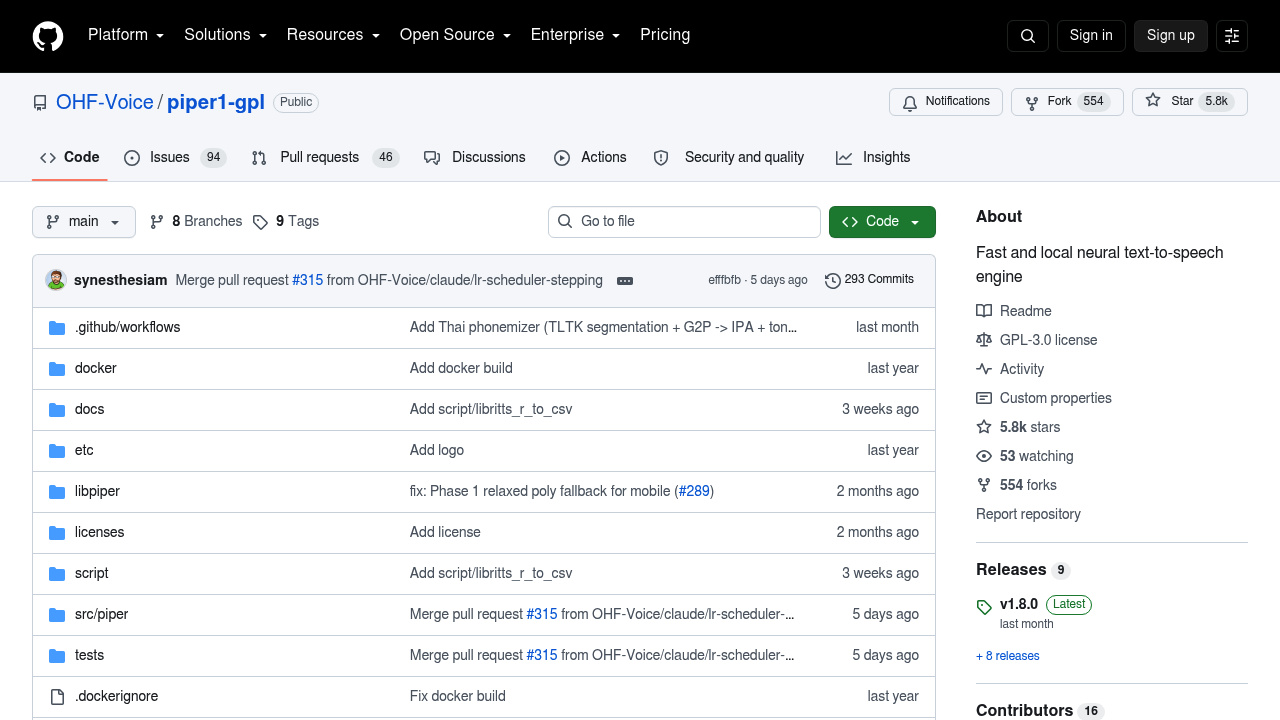
Piper screenshot

Piper is a fast, local neural text-to-speech engine that converts text into spoken audio on your own hardware, with no cloud service involved. It embeds espeak-ng for phonemization and installs with a single pip command. The project provides a command-line interface, a web server, a Python API and a C/C++ API, plus guidance for training new voices and building manually. This repository is maintained under the Open Home Foundation, is licensed GPL-3.0, and is free to use.

Piper is aimed at developers, hobbyists and accessibility projects that want offline voices with low latency. Smart home users get spoken responses through Home Assistant, and screen reader users rely on it through NVDA integrations. Engineers building voice assistants on small devices such as Jetson boards can run it locally, and teams building local AI stacks use it through projects like LocalAI. Programmers working in other languages can use bindings, including a Java option called Piper JNI. Researchers can train their own voices using the documented training workflow, and the Open Home Foundation is currently looking for new maintainers.

Typical use cases include reading Home Assistant notifications aloud, powering an offline voice assistant that never sends audio to a third party, and generating narration for videos and e-learning with scripted command-line calls. Developers expose a text-to-speech endpoint through the built-in web server for internal apps, or call the Python API to synthesize audio inside a program. Accessibility tools read clipboard content aloud, including with language detection, and game plugins add spoken dialogue. Because everything runs locally, it also suits privacy-sensitive deployments and environments without reliable internet access.

Piper alternatives

See all →

Frequently asked

6 questions
What does Piper do?
It converts text to speech using neural voices that run entirely on your own machine. It embeds espeak-ng for phonemization and offers a command-line tool, web server, Python API and C/C++ API.
Who uses Piper?
Developers, smart home enthusiasts and accessibility projects that want offline speech output. Known users include Home Assistant, NVDA and LocalAI.
How might I use Piper in a project?
You could read home automation alerts aloud, narrate documents from the command line, or run a local web server that returns audio for an app. Researchers can also train new voices with the project's training instructions.
Is Piper free?
Piper is free, open-source software released under the GPL-3.0 license, and installs with pip install piper-tts. No paid plan is offered.
What should I know about Piper's maintenance and license?
The Open Home Foundation is looking for maintainers for the project. Its GPL-3.0 license also carries copyleft obligations if you redistribute software that includes it.
How do I get started with Piper?
Install it with pip, then pick a voice from the project's voice list and run it from the command line or Python. There are also samples, an online demo, and documentation for the web server and the C/C++ API.

Reviews (0)

Write review

No reviews yet. Be the first to share your experience.