Luma API logo
AI API PAID from $25/mo

Luma API

Luma API gives developers programmatic access to Luma's generative media models.

Ray3.2 handles video, offering text-to-video, image-to-video, video-to-video edits, reframing, and up to 16 keyframes inside a single clip. Uni-1.1 handles image generation through a reasoning endpoint and a generation…

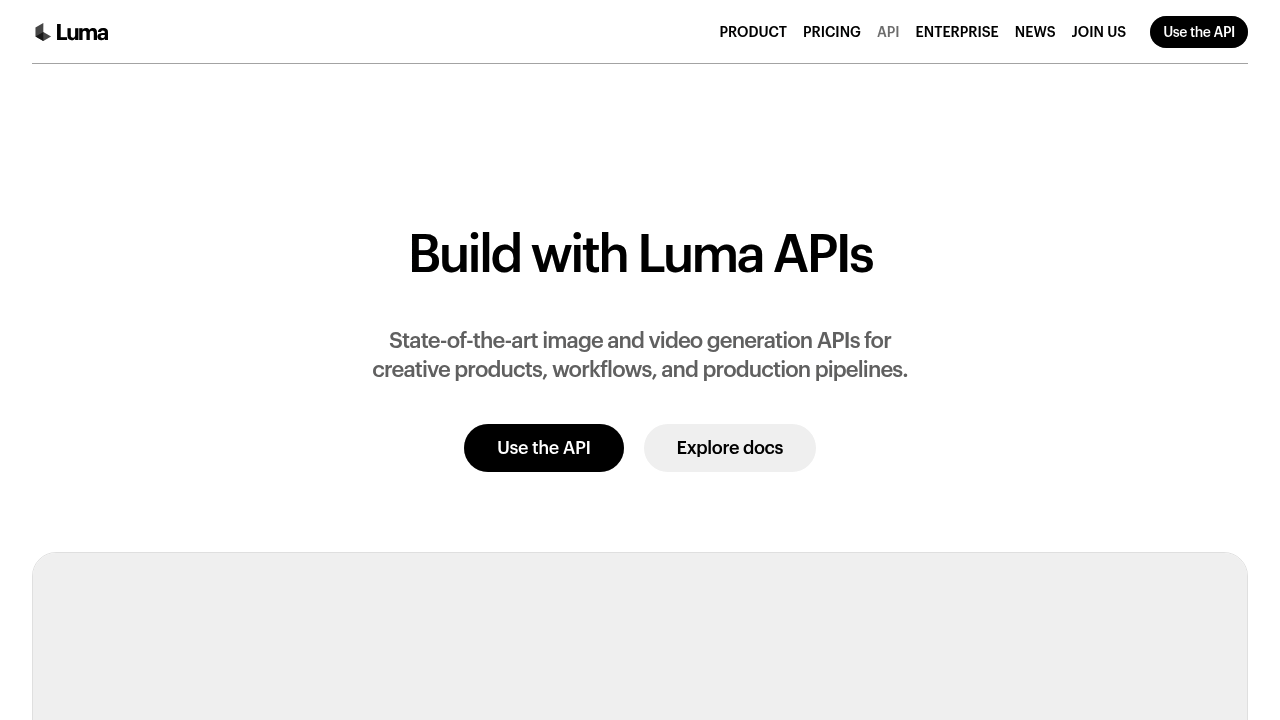
Luma API screenshot

Luma API gives developers programmatic access to Luma's generative media models. Ray3.2 handles video, offering text-to-video, image-to-video, video-to-video edits, reframing, and up to 16 keyframes inside a single clip. Uni-1.1 handles image generation through a reasoning endpoint and a generation endpoint. The Build tier is pay-per-use with no minimum commitment, and a five-second Ray3.2 clip starts at $0.15 at 540p.

The audience is engineering and product teams embedding video or image generation in their own software: creative app builders, marketing technology companies, e-commerce teams that need many variants of one shoot, and studios building production pipelines. Early-stage teams can prototype on the Build tier, while companies with steady volume can ask sales for the Scale tier, which adds dedicated capacity, guaranteed throughput and latency, moderation, prompt enhancement and a no-train guarantee. Existing users of the legacy Dream Machine video API can follow a migration guide.

Concrete uses include generating a product shot in several backdrops with Reframe, swapping a SKU across footage with video-to-video, and exporting HDR or EXR frames that composite alongside live-action plates in DaVinci Resolve or Nuke. Brand teams can use Uni-1.1 to update brand-consistent images across pages and campaigns at once. Developers can extend a prior video, interpolate between clips, and outpaint footage to a different aspect ratio. Pricing scales with resolution and duration: a ten-second 1080p clip is $3.60 in standard dynamic range, HDR output costs double and HDR with EXR triple, and an API console is available for testing requests.


Luma API alternatives

See all →

Frequently asked

6 questions
What can the Ray3.2 API do?
Video comes from text or images, edits existing footage with video-to-video, and reframes clips to new aspect ratios. Multi-Keyframe lets you set up to 16 keyframes in one clip, and output reaches 1080p.
Who should use Luma API?
Developers and product teams building creative products, brand workflows and production pipelines. Studios that need HDR and EXR output for compositing are a specific fit.
Can I create product variants at scale?
Reframe handles backdrops while video-to-video swaps the product, so one shoot can become many market-specific variants. Uni-1.1 does the same for brand images across pages and campaigns.
How is Luma API priced?
The Build tier is pay-per-use with no commitment, for example $0.15 for a 5-second 540p clip and $3.60 for a 10-second 1080p clip. HDR output is 2x the SDR price and HDR plus EXR is 3x, and the Scale tier is priced through sales.
What are the limits of the Build tier?
Rate limits apply and there is no latency SLA. Guaranteed throughput, SLA and moderation come with the Scale tier, sold in units of requests per minute with a four-unit minimum.
How do I get started with testing?
Use the API console to test requests and read the docs. Teams migrating from the legacy Dream Machine video API can follow the dedicated migration guide.

Reviews (0)

Write review

No reviews yet. Be the first to share your experience.