
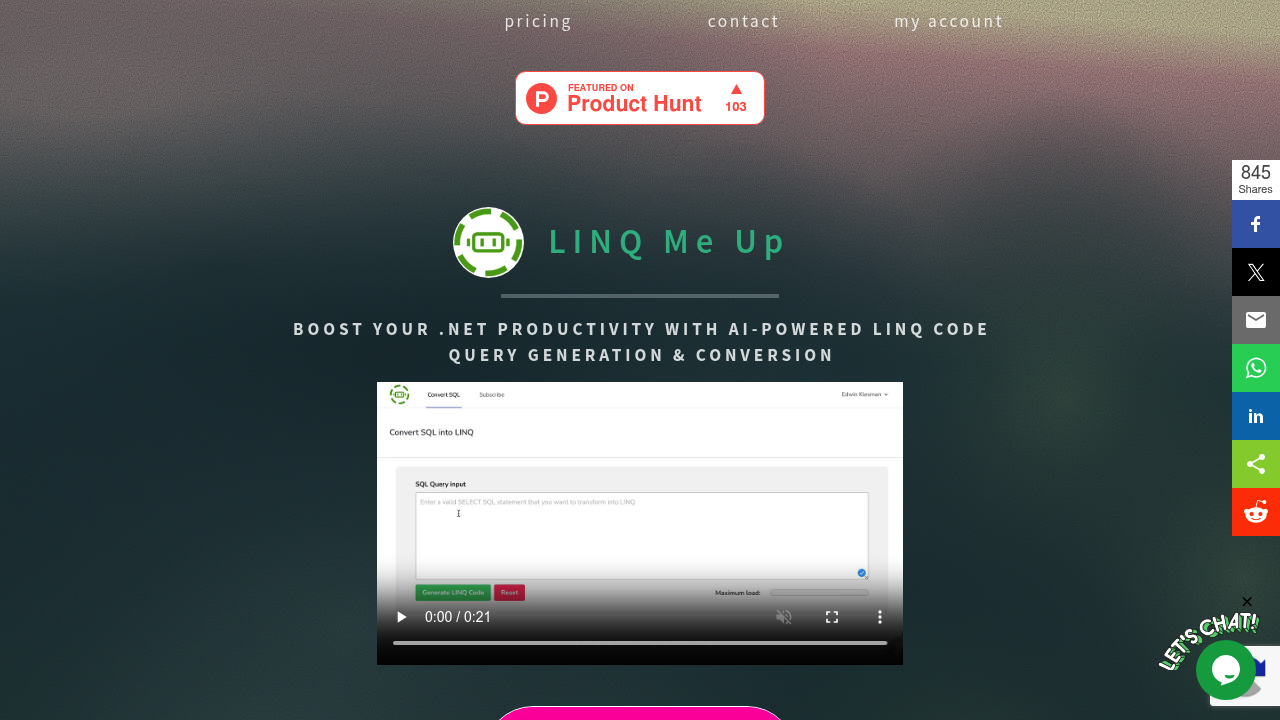
Converting database queries between SQL and LINQ typically consumes about 30 minutes of developer time, but LINQ Me Up reduces that to roughly 5 minutes through AI-powered translation. This application performs bidirectional conversion—transforming SQL queries into LINQ code and vice versa—while also generating LINQ queries tailored to XML, JSON, or POCO datasets. It supports both C# and Visual Basic, accommodates Method and Query syntax, and relies on AI analysis rather than rigid rule-based parsing to produce optimized results. Free credits let developers test the service before committing, with paid options starting at $1 per credit for pay-per-use access, $4.99 monthly for unlimited conversions under a fair-use policy, or $50 annually for the same benefits with a $9.88 savings over the monthly rate.
This service targets .NET developers who regularly shuttle between SQL databases and LINQ-based application code. Backend engineers maintaining legacy systems that mix SQL stored procedures with modern C# or VB.NET codebases benefit from rapid translation, as do developers migrating database logic into object-relational mapping layers. Teams working under tight deadlines find value in the time savings—each conversion reclaims roughly 25 minutes, translating to about $41.67 saved per query when factoring a $50 hourly rate. Developers comfortable with LINQ but less fluent in SQL, or vice versa, use it to bridge knowledge gaps without sacrificing code quality.
Typical workflows include refactoring monolithic applications where SQL queries embedded in stored procedures need conversion to LINQ for integration with Entity Framework or Dapper. Data engineers building ETL pipelines that consume JSON or XML feeds generate LINQ queries to parse and transform incoming datasets without manually writing boilerplate code. Consultants auditing client codebases use this converter to quickly understand SQL logic by translating it into more readable LINQ expressions. Since LINQ Me Up doesn't store input data and users retain full ownership of generated code, it fits environments with strict privacy requirements. Developers remain responsible for testing output before production deployment, making it a drafting assistant rather than a final authority.