
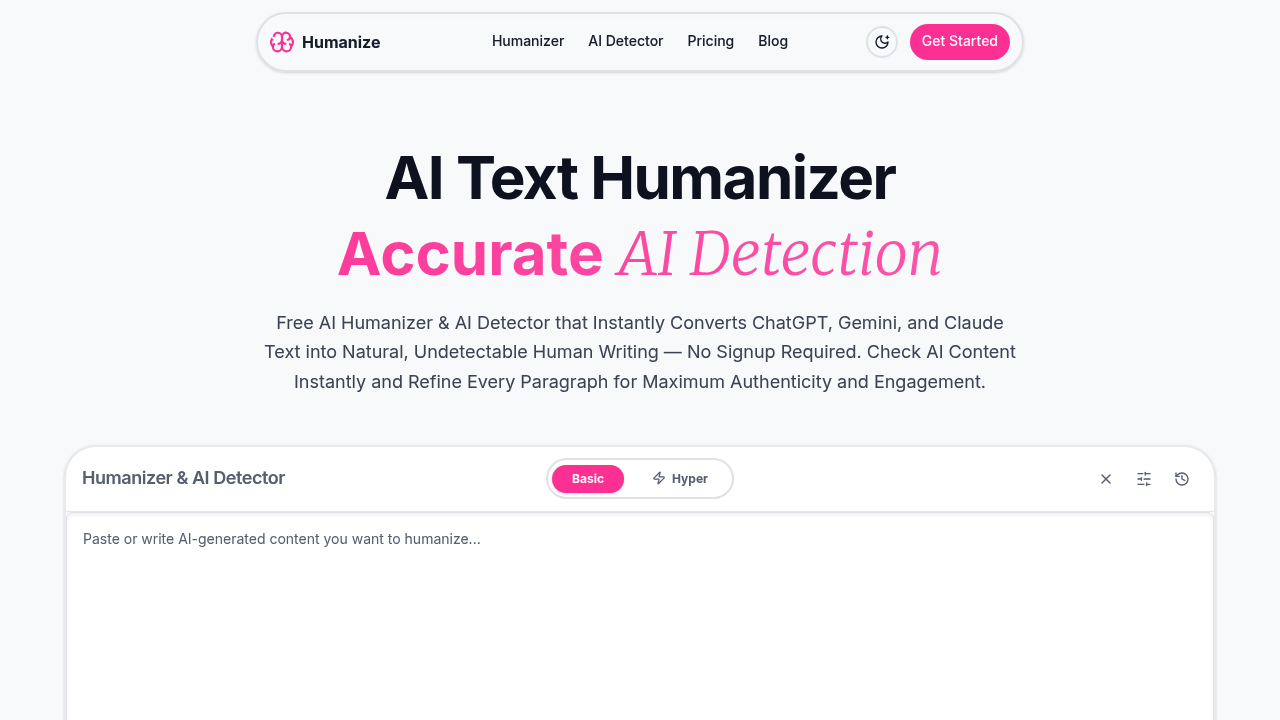
Transforms machine-written text into something that reads like a human wrote it. That's the pitch. Humanize takes output from AI writing tools and rewrites it to slip past detection systems like Turnitin, GPTZero, and Originality.ai. The SPR linguistic engine reconstructs syntax, tone, and semantics instead of just shuffling words around.
Does it actually work? They back it with a full refund guarantee if anything gets flagged as AI-generated, which is either confident or risky depending on how you look at it. Humanize offers two algorithms: Basic for straightforward rewriting and Hyper for deeper reconstruction. Over 12,000 users have rated it 4.9 out of 5, though real-world effectiveness depends on which detection tools you're trying to bypass and how they update their systems.
The built-in AI detector is useful. You paste text, see if it might get flagged, then humanize it in the same interface. Processing happens in real-time and Humanize claims zero data storage afterward. No tracking, no sharing, no keeping your text around. For anyone worried about privacy when processing sensitive content, that matters.
Here's what trips people up. The free tier caps you at 200 words per request and five daily attempts. That's barely enough to test properly. Only English works on the free plan, and you're stuck with the Basic algorithm. Paid plans give you access to all languages and higher word counts, but the Pro plan at $19.99 monthly is where you get the Hyper algorithm that presumably handles tougher detection. The Basic plan at $9.99 monthly still uses the Basic algorithm, just with more words and requests.
The Max plan at $49.99 monthly removes all limits on requests and word count. Could be worth it if you're processing volume daily. All paid plans bill annually with a 50% discount baked in, so that $9.99 monthly actually costs $119.99 upfront.
No information on team features or API access. If you need to integrate this into workflows or share accounts across multiple people, you're out of luck. Works with major AI writing tools but doesn't connect directly through extensions or plugins. You copy, paste, humanize, then copy again.
Who actually benefits here? Students trying to avoid academic AI detectors are the obvious users, though that raises ethical questions Humanize doesn't address. Content creators and SEO professionals who use AI drafts as starting points could legitimately need this to avoid false positives. Freelance writers under tight deadlines sometimes lean on AI assists and need the output to sound natural. Bloggers, developers writing documentation, startup founders cranking out copy.
The money-back guarantee separates this from competitors making similar claims. Most AI humanizers promise undetectability but won't refund you when it fails. This one does. Whether that promise holds up at scale with thousands of users is hard to verify from the outside.
This service solves a real problem for a specific crowd. Just know what you're getting into with the free tier limitations and the annual billing structure on paid plans.