
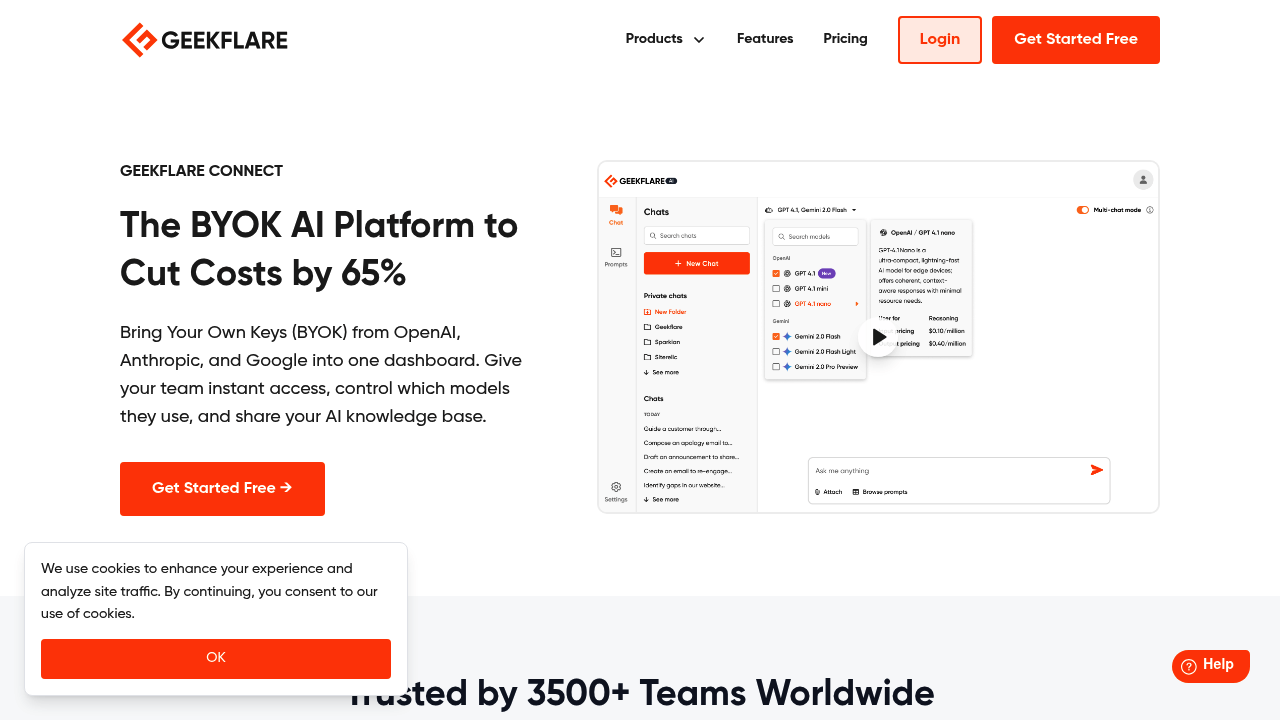
Teams looking to consolidate their AI tool spending can use Geekflare Connect to access multiple language models from leading providers through a single unified dashboard. This service operates on a Bring Your Own Keys model, letting organizations plug in their own API credentials and pay only for actual token consumption rather than per-seat subscriptions. A five-user workspace costs $16.50 monthly as a platform fee, with usage billed separately—roughly $2.50 for 2 million lite model tokens or $16.25 for 1.5 million pro model tokens. The interface supports side-by-side model comparison, so teams can query different AI systems simultaneously and evaluate responses before committing to one approach. Cost tracking tools provide visibility into which models consume the most budget, and shared workspaces allow teams to collaborate on prompts and chat histories without duplicating accounts across providers.
This tool fits organizations already using multiple AI models who want tighter budget control and team coordination. Engineering teams, product managers, and content operations with varied AI needs benefit from switching between models mid-conversation without juggling separate subscriptions. Companies spending heavily on individual per-seat licenses—which can total $100 monthly for minimal coverage—find the consumption model more economical when usage fluctuates. This solution suits businesses that need admin controls over which models different team members access, making it practical for departments with mixed skill levels or budget constraints.
Daily workflows include research teams comparing model outputs for accuracy, marketing departments testing campaign copy across different AI providers, and development teams prototyping features with various models before selecting one for production. The projects feature organizes chats by client or initiative, while shared prompts standardize how teams query models for consistent results. Live web access extends model capabilities beyond training data cutoffs, useful for current event analysis or competitive research. Organizations managing distributed teams use collaborative workspaces to maintain a shared AI knowledge base, reducing redundant queries and keeping everyone aligned on which models perform best for specific tasks.