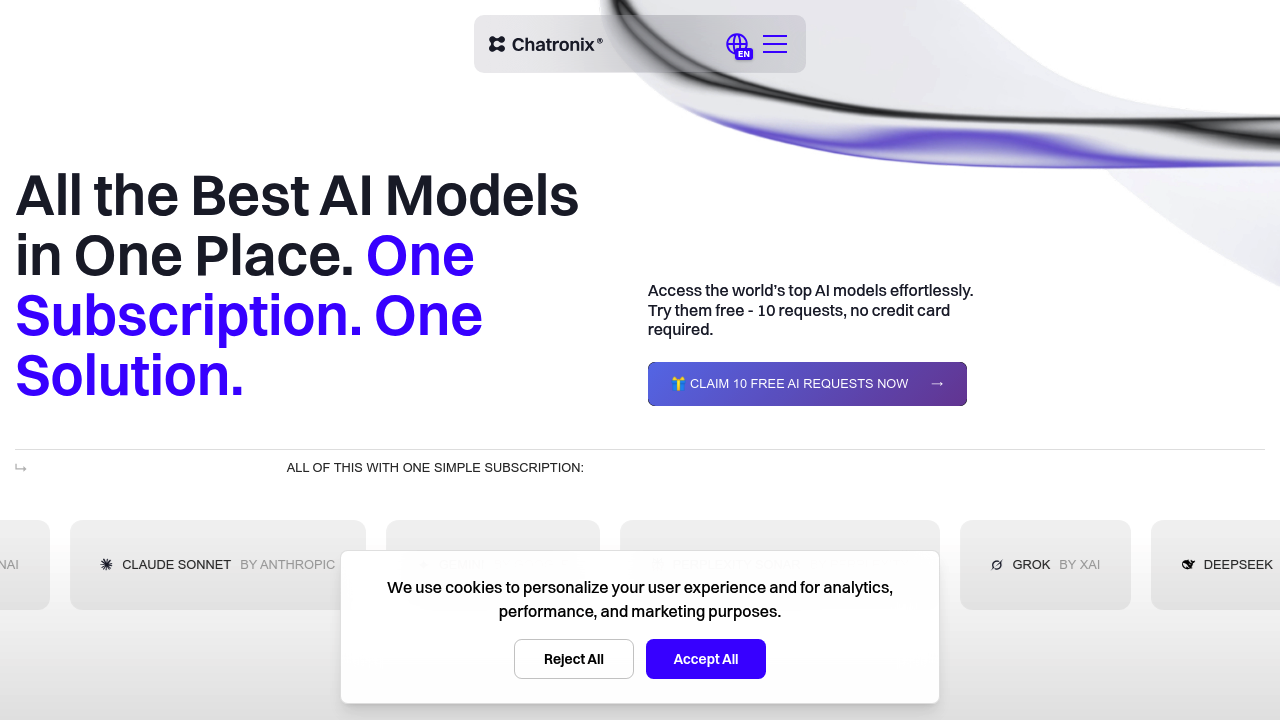
TAAFT functions as a unified API gateway that routes requests to six different language model providers through a single authentication layer. Instead of managing separate subscriptions to OpenAI, Anthropic, Google, Perplexity, xAI, and DeepSeek, users authenticate once and select which model they want to query. This service doesn't train its own models. It's middleware.
The data flow works like this: users submit a prompt through TAAFT's interface, select a model from the dropdown, and TAAFT forwards that request to the appropriate provider's API. Responses stream back through TAAFT's servers to the user. There's no model switching mid-conversation. Each thread stays with one provider. This architecture means you're still subject to each provider's rate limits, content policies, and availability. If Anthropic's API goes down, that model becomes unavailable through TAAFT too.
The 550+ expert-crafted prompts sit in a separate library organized into five categories: business, social media marketing, copywriting, education, and marketing. These aren't dynamic. They're pre-written templates covering tasks like strategic planning, lesson plan creation, and email marketing copy. You copy a prompt, modify variables, and paste it into whichever model you've selected. The prompts don't auto-populate or integrate with the model interface. They're reference material.
Output quality depends entirely on which underlying model you choose. TAAFT doesn't process or modify responses. If you select the OpenAI endpoint, you get OpenAI's output characteristics. Switch to DeepSeek, you get DeepSeek's behavior. This service adds no post-processing, no filtering beyond what each provider already implements.
The system offers 10 free requests without requiring payment information. After that, access requires a subscription, though specific pricing tiers aren't disclosed in available documentation. The free trial lets you test different models to see which handles your use cases best before committing.
Technical limitations are significant. There's no API access to TAAFT itself, so you can't programmatically route requests or build automations. No team features exist for sharing prompt libraries or managing multiple users. TAAFT doesn't offer mobile apps or browser extensions. You're working through a web interface only.
The core value proposition is subscription consolidation. If you're already paying for three or four of these services separately, routing through one billing relationship simplifies accounting. But you're adding a dependency layer. TAAFT's uptime now affects your access to all six models. There's also latency overhead from the additional routing hop, though likely minimal for most use cases.