
Fish Audio logo
AI Text-to-Speech FREEMIUM from $11/mo

Fish Audio

Fish Audio is an AI voice platform built around text-to-speech and voice cloning.

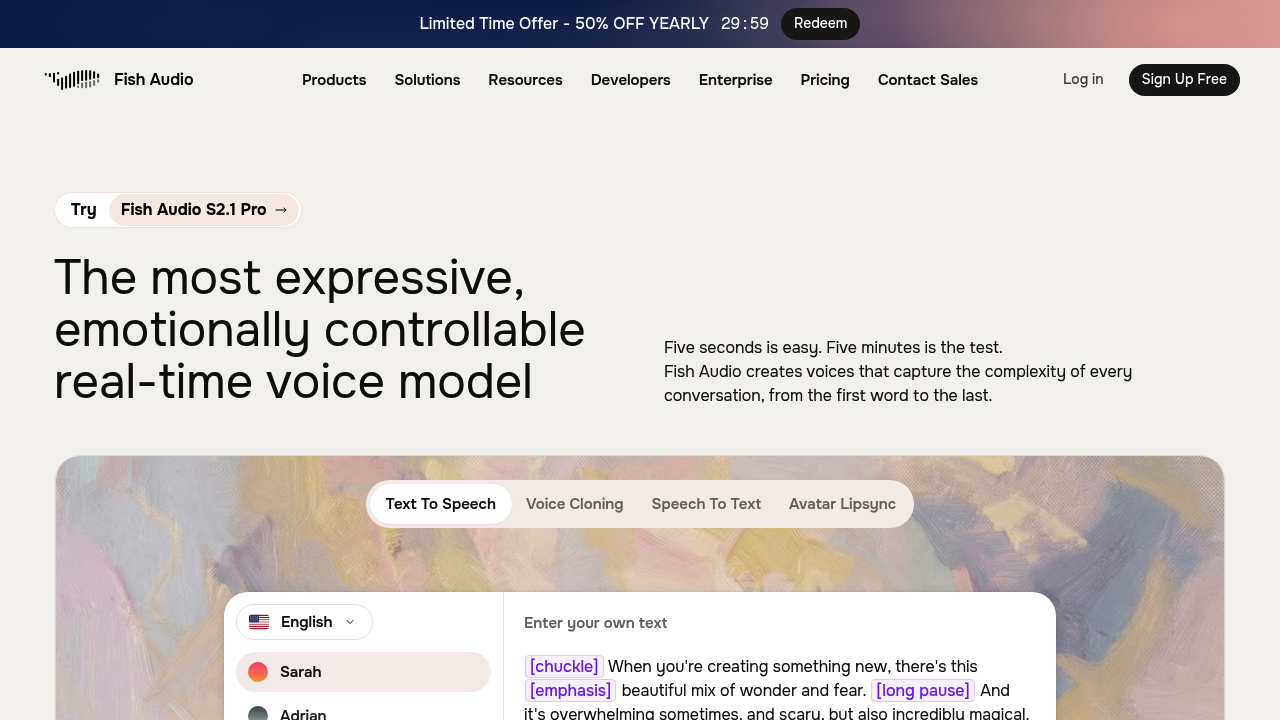
Its current S2.1 Pro model accepts inline emotion and sound tags such as [whispering], [excited], [laughing] and [pause], so a line can be directed rather than just read. A library of more than two million voices is…

Fish Audio screenshot

Fish Audio is an AI voice platform built around text-to-speech and voice cloning. Its current S2.1 Pro model accepts inline emotion and sound tags such as [whispering], [excited], [laughing] and [pause], so a line can be directed rather than just read. A library of more than two million voices is available, and a new voice can be cloned from about 15 seconds of audio. Speech to text and avatar lipsync sit alongside the speech tools.

Content creators are the most obvious audience, particularly YouTubers and explainer producers who need narration that matches the tone of a scene. Authors and audiobook publishers can use Story Studio to produce long-form narration with chapter-level control. Game developers, animators and interactive storytellers can clone signature voices or build brand personas. Developers and product teams building customer support bots or voice agents get a real-time API with low latency. Affiliate and enterprise programs exist for larger users.

Common projects include narrating a video series, producing an audiobook that meets ACX and Audible specifications, giving a game character a consistent voice, and powering a conversational chatbot with an empathetic or upbeat delivery. Lipsync lets you pair a Fish Audio voice with a generated image or video to make talking avatars, ads and explainers. The text box takes up to 30,000 characters per generation. Teams that need transcription can use the speech-to-text endpoint, which supports multiple speakers and emotion tags, while multilingual support covers voices in languages such as Japanese, French and Arabic.

Fish Audio alternatives

See all →

Frequently asked

6 questions
How do emotion tags work in Fish Audio?
Tags like [angry], [sad], [whispering] or [excited] into the text, along with sound tags such as [laughing], [sighing] or [pause]. The model then adjusts delivery at those points in the script.
Who uses Fish Audio?
Video creators, audiobook narrators, game and animation developers, and teams building customer support chatbots or voice agents. Developers can reach the same models through APIs.
Can I make an audiobook with it?
Story Studio handles audiobook narration with chapter-level control. Output is described as meeting ACX and Audible specifications without a recording booth.
How does voice cloning work?
Cloning takes from roughly 15 seconds of audio, and cloned or library voices can be used for narration, characters or brand personas. Cloning is available online and through the API.
Is there a limit on how much text I can generate at once?
The web text box counts characters out of 30,000. Longer projects such as audiobooks are handled through Story Studio.
Does Fish Audio offer an API and speech-to-text?
Developer APIs cover text to speech, speech to text, voice cloning and an end-to-end voice agent. Speech to text supports multiple speakers, emotion tags and natural-language descriptions.

Reviews (0)

Write review

No reviews yet. Be the first to share your experience.