
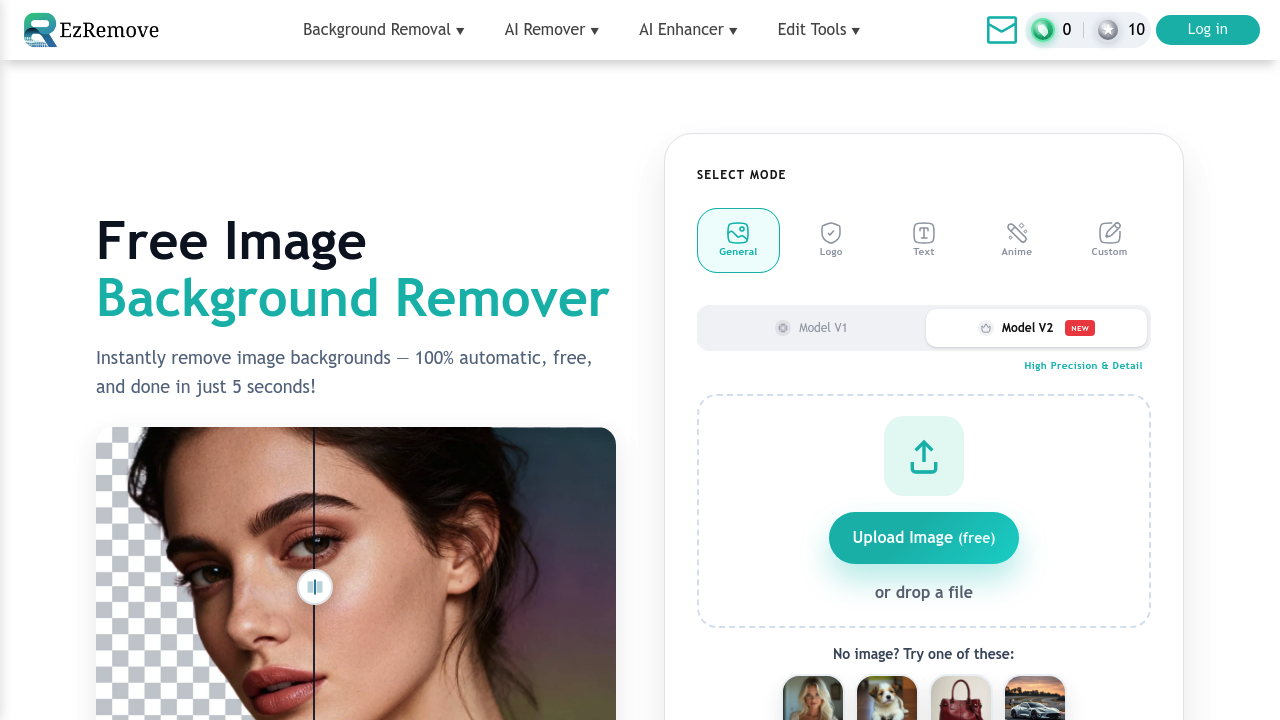
EzRemove processes images through AI models that detect foreground subjects and separate them from backgrounds in under three seconds. This service has processed over 50 million images using two model versions that handle different complexity levels. Model V1 and Model V2 each approach edge detection and transparency mapping differently, giving users options based on their image characteristics.
The system offers five specialized removal modes. General mode handles standard photography. Logo mode preserves sharp edges and brand elements. Text mode maintains character clarity. Anime mode accounts for illustrated art styles with distinct color boundaries. Custom mode lets users define specific parameters for unusual image types.
Processing happens entirely through web upload. Users drop an image, select a mode, and the AI segments the subject from background pixels. The output's a transparent PNG where the background's been replaced with alpha channel data. Processing time stays around five seconds regardless of image complexity, suggesting the models prioritize speed over exhaustive detail analysis.
Beyond basic removal, this service includes color replacement and an AI Background Generator. The generator creates new scenes behind subjects rather than leaving transparency. This uses separate generative models, Nano Banana AI and Seedream 4.0, which synthesize backgrounds based on the subject's lighting and perspective. The technical challenge here's matching generated lighting direction and shadow angles to the original subject, though the facts don't specify how well this alignment works in practice.
EzRemove bundles numerous other features. Magic Eraser removes unwanted objects from photos. Text Remover strips text overlays. Object Remover, People Remover, and Cleanup Pictures all target specific element types. There's also batch and video watermark removal, plus enhancement tools like AI Image Upscaler, Photo Enhancer, HD Photo Converter, and Photo Restoration. An AI Image Generator and Image To Image converter round out the suite. Each feature consumes credits from the same pool.
Free users get 20 credits daily but must log in each day to claim them. that is the main limitation. The credit system applies across all premium features, so heavy users of multiple functions will burn through allocations quickly.
Paid tiers work differently than most AI services. They're one-time purchases, not subscriptions. $4.99 gets 70 credits. $9.99 gets 300 credits. $17.90 gets 700 credits. $69.90 gets 3000 credits. $89.90 gets 5000 credits. Credits never expire. The per-credit cost drops as you buy larger packages, ranging from $0.071 per credit down to $0.018 per credit at the highest tier. Enterprise plans offer custom pricing with API access, team collaboration features, priority support, and dedicated account management.
This service targets eCommerce sellers who need clean product shots and social media users creating graphics. It's positioned as simpler than Photoshop for background work, which makes sense given the single-function interface versus learning layer masks and selection tools.
API access exists for enterprise customers, enabling automated batch processing or integration into existing workflows. No browser extension or mobile app's mentioned in the available information. The facts don't list any third-party integrations with design tools, eCommerce platforms, or social media schedulers.
The credit-per-use model means costs scale directly with volume. Each background removal, enhancement, or watermark strip costs credits. Heavy users need to calculate their monthly usage against the one-time package sizes to determine real cost-effectiveness versus subscription competitors.