
Dust logo
AI Agent FREEMIUM from €24/mo

Dust

Dust is a multiplayer AI platform where people and agents work from the same company context.

Teams connect more than 70 sources, including Slack, Notion, Google Drive, GitHub, Salesforce and Zendesk, then build agents on 20-plus frontier and open-source models from providers such as OpenAI, Anthropic, Google…

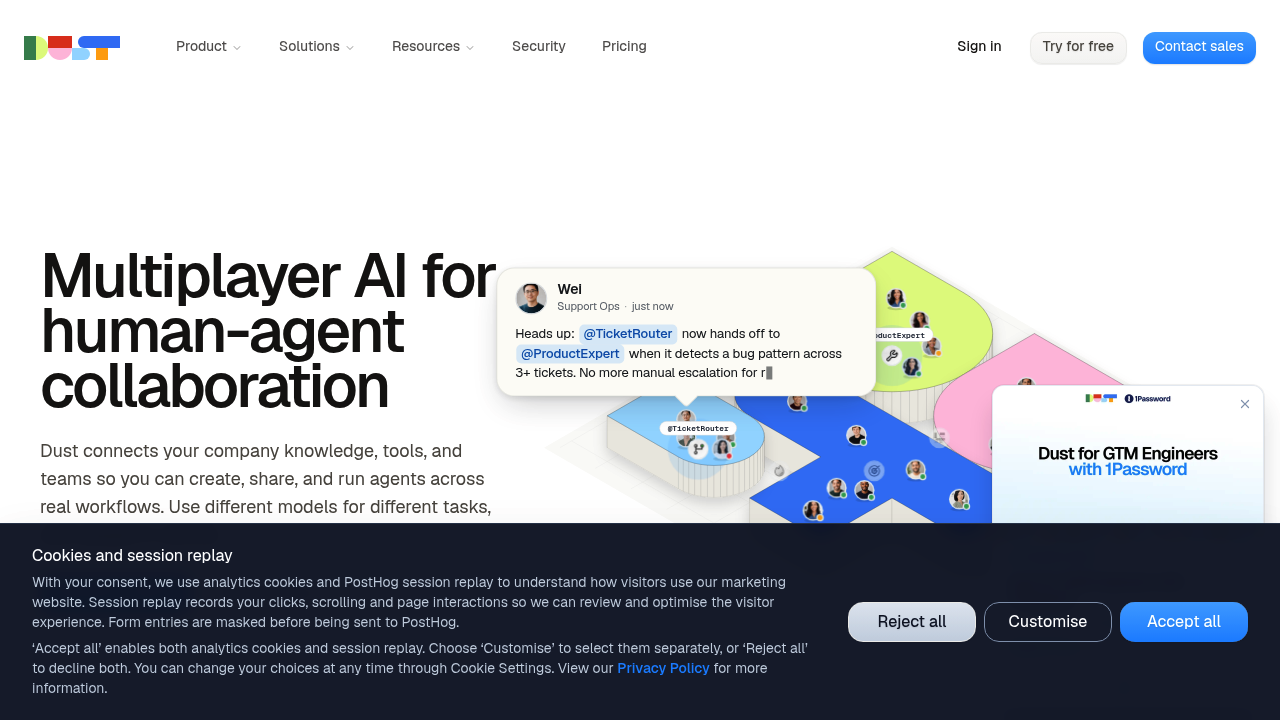
Dust screenshot

Dust is a multiplayer AI platform where people and agents work from the same company context. Teams connect more than 70 sources, including Slack, Notion, Google Drive, GitHub, Salesforce and Zendesk, then build agents on 20-plus frontier and open-source models from providers such as OpenAI, Anthropic, Google and Mistral. Agents can answer from the full picture across systems and take actions, with human review where needed. Administrators control permissions for data, tools and agents, and use audit logs and analytics to track adoption, usage, costs and ROI.

Dust is built for operations-minded teams in mid-size and large companies: engineering, customer support, sales, marketing and data groups, plus the AI leads and IT security staff who govern them. Over 3,000 organizations use it, and GTM engineers at companies such as Clay describe building agents that do work their teams once did by hand. Security reviewers get SOC 2 Type II certification, SCIM-synced groups, SSO, US or EU data residency and optional dedicated single-tenant deployment.

Concrete scenarios appear by department. Engineering uses agents for debugging with context from docs and past issues, automated code reviews, incident response runbooks and continuous documentation updates from code changes. Support teams triage and route tickets and draft replies grounded in a knowledge base. Sales and marketing teams pull context from CRM records and shared documents to prepare outreach and content, while data teams run analysis flows. Because skills, tools and conversations are shared, work can move between a person and an agent and back again within one workspace.

Dust alternatives

See all →

Frequently asked

6 questions
What does Dust let teams build?
Teams build, share and run AI agents that draw on company knowledge and connected tools. Agents can answer using context from several systems and take actions across workflows.
Who is Dust designed for?
Cross-functional business teams and the IT and security staff who oversee AI use, at organizations from growing companies to large enterprises. More than 3,000 organizations use it.
What is a concrete example of a Dust agent?
A support agent can triage and route tickets and draft replies grounded in a knowledge base. An engineering agent can run incident runbooks or keep documentation updated from code changes.
Which models and apps does Dust connect to?
It offers 20-plus frontier and open-source models from OpenAI, Anthropic, Google, Mistral and others. More than 70 connectors reach tools like Slack, Notion, Google Drive, GitHub, Salesforce and Zendesk.
What security controls does Dust include?
Dust reports SOC 2 Type II certification and US or EU data residency. A dual-layer permission model separates what agents can access from who can use them, backed by SCIM-synced groups and audit logs.
How do I get started with Dust?
You can try Dust for free from its website or contact sales for an enterprise setup. Enterprise deployment adds SSO, dedicated customer success support and priority support with an SLA.

Reviews (0)

Write review

No reviews yet. Be the first to share your experience.