
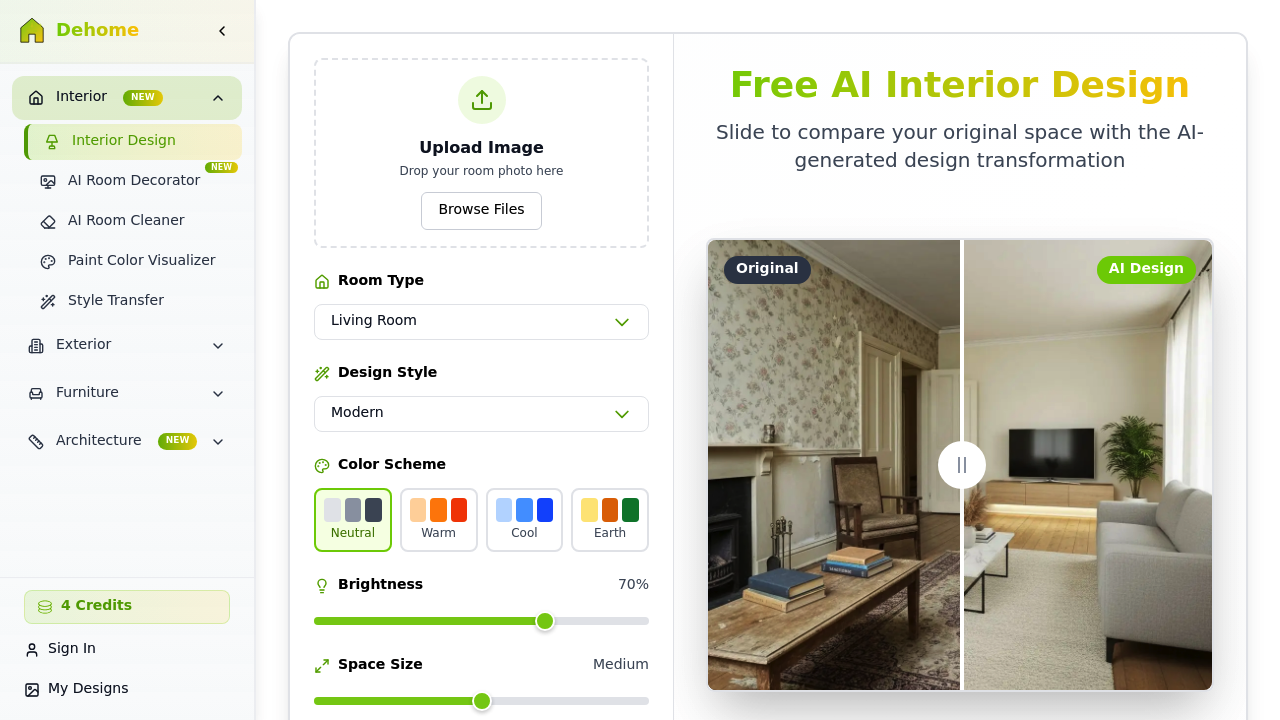
A real estate agent needs to stage a vacant property for online listings but doesn't have the budget for physical furniture or a professional designer. She uploads photos of the empty living room to DeHome.ai, selects a Scandinavian style with neutral colors, and gets four redesign options in under a minute. She downloads the high-resolution images and uses them in the property listing. The before-and-after slider helps potential buyers visualize the space's potential without the agent spending thousands on staging.
An interior designer working with three clients simultaneously hits a creative block on a modern bedroom project. He uploads the current room photo, experiments with different styles—switching between contemporary, mid-century, and minimalist—and adjusts brightness and color schemes through the interface. The AI analyzes spatial relationships and suggests furniture placement that respects traffic flow. He presents multiple design directions to his client within hours instead of sketching for days. This software cuts his concept development time by 80% while still letting him refine the final design manually.
DeHome.ai trains on millions of professional design images and applies machine learning to understand how rooms work spatially. It handles living rooms, bedrooms, kitchens, bathrooms, dining rooms, offices, and kids' rooms. The Style Transfer feature lets you apply eight different aesthetics to the same space. The Paint Color Visualizer tests wall colors before you buy a single gallon. The AI Room Cleaner removes clutter from photos digitally, and DeHome.ai extends to exterior design, furniture design, and architectural work.
Each generation costs four credits. New users start with zero credits, so there's an immediate barrier to testing this software. The credit system means you can't casually experiment with dozens of variations without tracking consumption. If you're trying to compare fifteen different color schemes across three rooms, you will burn through credits fast. This software also won't explain why it made specific furniture placement decisions or how it calculated optimal traffic flow—you get the visual output but not the design reasoning behind it.
DeHome.ai works best for people who need quick visual concepts: agents staging properties, homeowners planning renovations, designers speeding up early-phase work. It's 10 times faster than traditional design processes. But if you need detailed specifications, material lists, or custom furniture dimensions, DeHome.ai stops short. It shows you what could be, not how to build it. Someone expecting full construction-ready plans will hit a wall after the pretty pictures.