
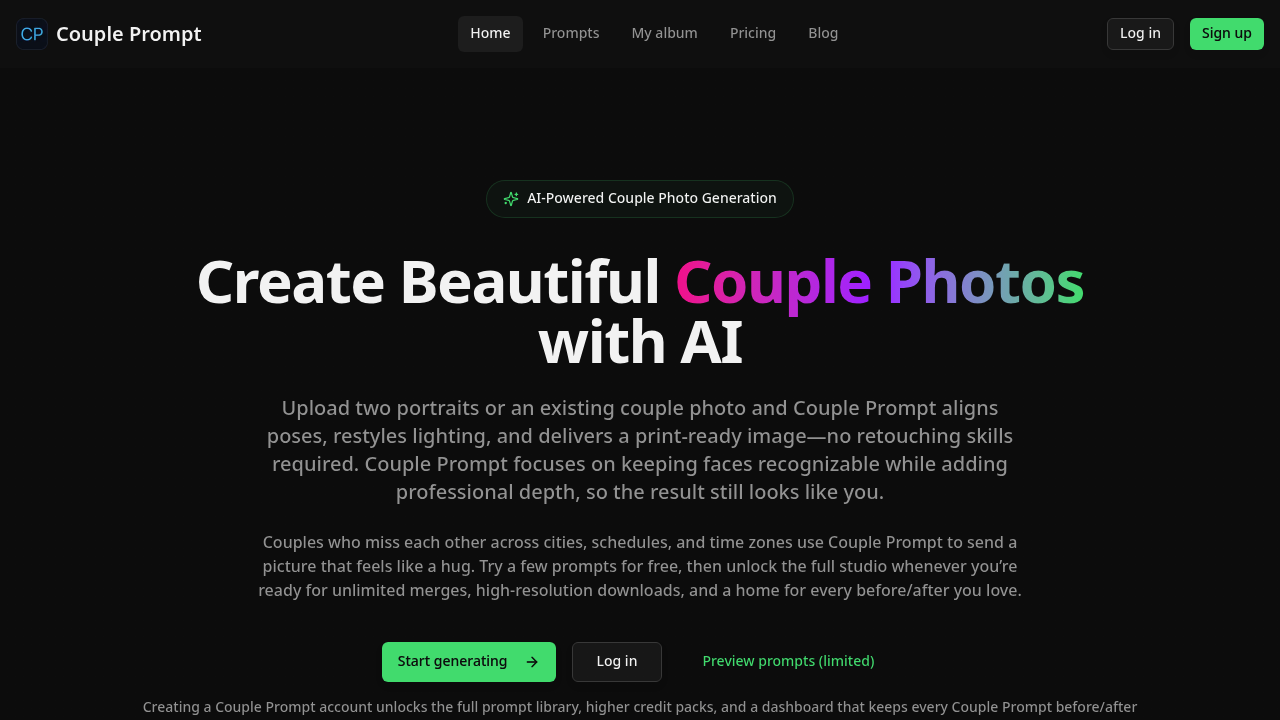
Takes two separate portraits and merges them into a single professional-looking couple photo. You upload individual headshots and the AI handles pose alignment, lighting balance, and depth reconstruction so both people look like they're actually standing together. It's built for long-distance relationships, mismatched schedules, or anyone who needs couple imagery without coordinating a photoshoot.
The tech works through edge-aware masking that keeps hair detail and clothing edges intact while blending faces into shared frames. You get curated style presets like Editorial Flash, Film Noir, and Cinematic that add professional depth without making people look fake. Background replacement pulls from city, nature, and indoor presets. The resolution rescue feature denoises and upscales images through multi-stage super-resolution, pushing output to print quality. Automatic tone and contrast balancing handles the technical stuff.
Face recognition stays consistent. That matters because template face swaps and lighting restyling can distort features if not handled carefully. The AI texture repair removes noise but keeps skin looking realistic instead of airbrushed. You can also enhance existing couple photos instead of merging new ones. Dashboard saves every before and after with credit history tracking. High-res JPG or PNG downloads available.
Does it actually work? The edge masking and depth reconstruction are solid technical additions that separate this from basic photo editors. But you're still relying on AI interpretation of how two people should look together in space. Lighting mismatches between source photos can create uncanny results even with automatic balancing.
Free tier gives you limited preview prompts to test it out. Full prompt library needs account creation. Unlimited merges and high-resolution downloads sit behind a paywall. Specific costs aren't listed beyond the free trial structure.
Wedding planners could use this for mockups before actual shoots. Busy parents who never manage to get in the same photo might find it useful. Long-distance partners are the obvious use case, especially when you want something more polished than a FaceTime screenshot. Creators needing relationship imagery for content without hiring models could save time.
The limitation is expectation management. This doesn't replace real couple photos. It creates believable composites. If your source portraits have wildly different lighting or angles, the output won't look natural. And you'll burn through free prompts fast if you're experimenting with styles.