
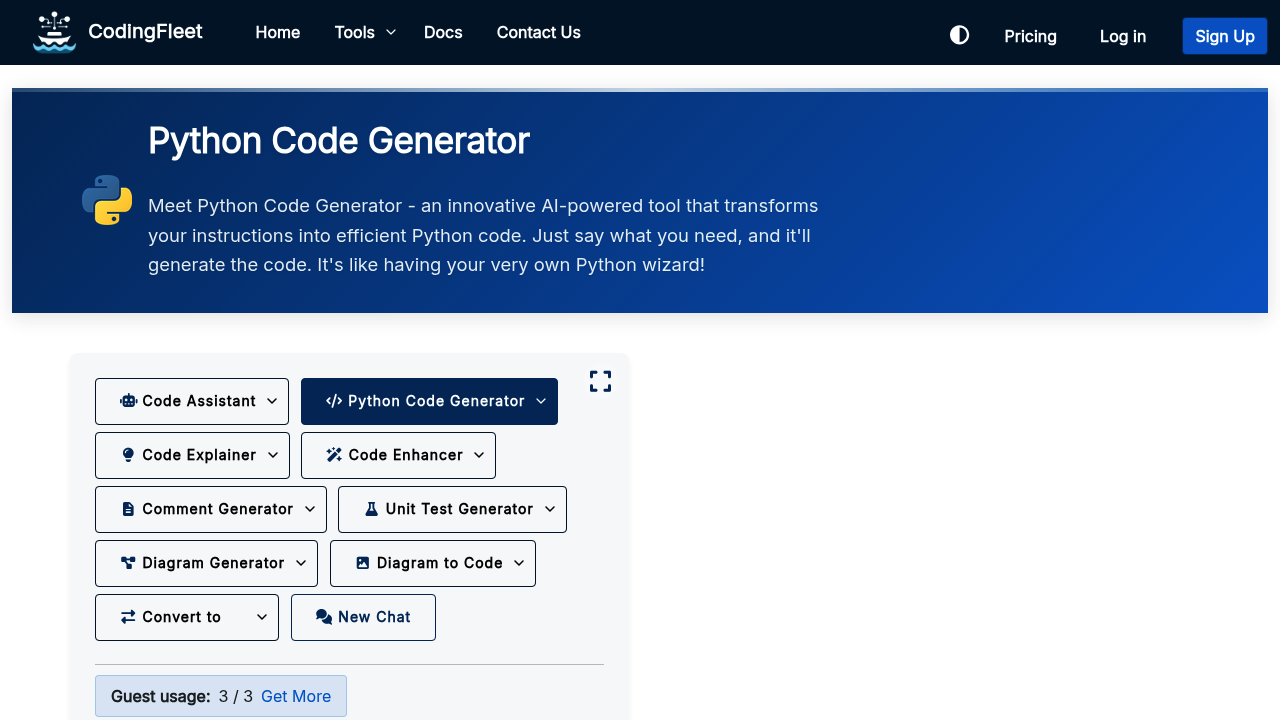
You get three uses as a guest before CodingFleet asks you to buy credits. After that? The cheapest option runs one credit per generation with their GPT-5.1 Codex Mini model. Not exactly generous—but it lets you test the water.
The Python code generator sits at the heart of what this thing does. You type instructions. It spits out code. Nothing fancy about the concept. But here's where it gets interesting: you're not locked into one AI model. CodingFleet gives you access to more than twenty different models. OpenAI. Anthropic. Google. DeepSeek. If Claude Sonnet isn't giving you what you want, switch to Gemini or Grok without leaving.
Junior developers might find the Code Explainer useful. It breaks down what code actually does instead of leaving you to decode regex patterns at midnight. CodingFleet also handles debugging and optimization through its Code Assistant feature.
Say you're building a data processing script for a client. Generate the initial code. Run the Unit Test Generator. Use the Code Enhancer to clean it up. All without bouncing between different services.
The 2,000 character input limit feels tight. Complex requirements don't always fit in that box. Code Execution is still in beta too—which means you can't always trust it for production work.
CodingFleet works if you value model flexibility over a polished single-model experience. You're essentially paying for choice rather than specialization.