
Codeaid logo
AI Recruiting FREEMIUM from $129/mo

Codeaid

Codeaid runs coding assessments and technical interviews through an AI system that generates questions, evaluates code, and scores candidates across multiple dimensions

This system was built by a team with 15 years in tech hiring after they couldn't find an existing tool that met their needs for developer and ML engineer evaluation. The AI Interviewer component autonomously generates…

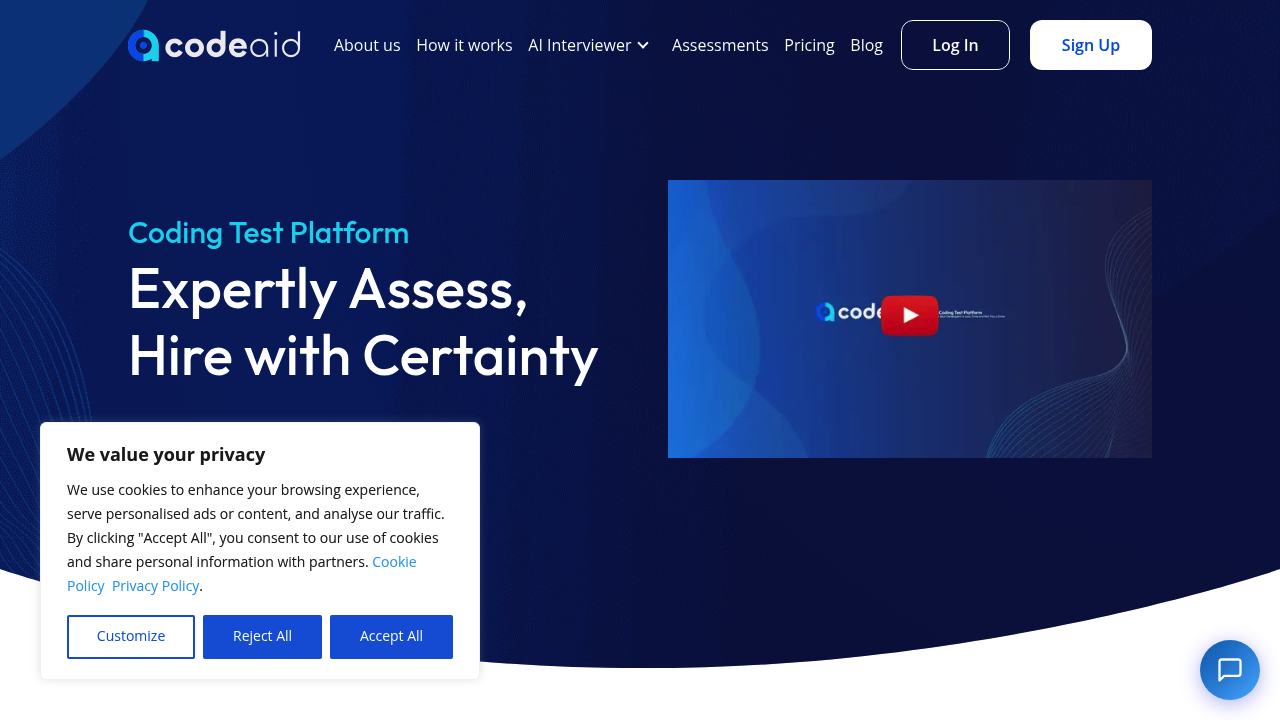
Codeaid screenshot

Codeaid runs coding assessments and technical interviews through an AI system that generates questions, evaluates code, and scores candidates across multiple dimensions. This system was built by a team with 15 years in tech hiring after they couldn't find an existing tool that met their needs for developer and ML engineer evaluation.

The AI Interviewer component autonomously generates interview questions tailored to specific roles and conducts real-time technical interviews. It doesn't just check if code produces correct output. The scoring system also analyzes code structure, examining how candidates implement object-oriented design, design patterns, asynchronous programming, and API development. This dual-layer evaluation catches candidates who might produce working code through memorization or external help but lack deeper understanding of software architecture.

For machine learning roles, the system integrates Jupyter Notebook environments directly into assessments. Candidates work with built-in datasets that can't be copied or searched externally. This makes the tests resistant to candidates looking up answers or using AI assistants to complete challenges. The datasets remain proprietary to the system, so there's no external reference material available online.

Tests run considerably longer than typical coding assessments. The system claims its evaluations are 10 times longer than industry average, allowing for more thorough skill measurement. Free plan users can create interviews with up to 25 questions, while Team plan subscribers get 75 questions per interview, and Enterprise users face no question limits.

The data pipeline flows through several validation points. When a candidate submits code, the system first runs it against test cases to verify output correctness. Then it parses the code structure to evaluate architectural decisions, pattern usage, and implementation quality. Manual grading remains available for detailed evaluation that automated systems might miss. The Feedback and Fix feature lets candidates iterate on their solutions, which provides insight into how they respond to criticism and debug issues.

Integration happens through direct connections to Recruitee, Greenhouse, and SmartRecruiters. These ATS platforms can trigger assessments automatically when candidates reach certain hiring stages. Results flow back into the recruiting system without manual data transfer.

The free plan accommodates 2 users and allows 5 candidate invites monthly. That's quite restrictive for active hiring teams. You're also limited to 3 active job openings and 2 interviews per opening. The challenge library and supported languages are reduced compared to paid tiers. Team plan starts at 99 dollars monthly for 5 users and 20 monthly invites. Enterprise pricing begins at 399 dollars monthly with unlimited users, invites, and custom interview templates. All paid plans include a 14-day trial.

Technical limitations center on the free tier's constraints. Two users can't support most hiring teams. Five monthly invites means you'll hit the cap quickly during active recruiting. The restricted language and framework support might exclude candidates who work in less common stacks. Even Team plan caps invites at 20 monthly, which could bottleneck high-volume hiring.

The system positions itself as the only ML-powered coding interview with non-copyable datasets built in. That's a specific claim roughly competitive differentiation. Whether that holds depends on how other platforms handle dataset security and AI resistance. The technical approach of combining output validation with structural analysis does provide more signal than output-only testing, but it requires more computational overhead and likely contributes to longer test durations.


Codeaid alternatives

See all →

Frequently asked

7 questions
Does Codeaid work for evaluating machine learning engineers?
Codeaid includes ML-specific assessment capabilities with integrated Jupyter Notebook environments for data science evaluations. The system tests ML development skills alongside standard coding abilities, examining how candidates handle data manipulation, model implementation, and algorithmic thinking. It uses built-in datasets that can't be copied externally, which prevents candidates from searching for solutions online or feeding prompts to AI assistants. The scoring analyzes both the correctness of ML implementations and the structural quality of the code, catching candidates who might produce working models without understanding underlying architecture.
How much does Codeaid cost per month?
Codeaid offers a free plan with 2 users and 5 candidate invites monthly, though it restricts you to limited languages and a reduced challenge library. The Team plan runs 99 dollars monthly for 5 users and 20 candidate invites, with access to all languages and 75 questions per interview. Enterprise starts at 399 dollars monthly with unlimited users, invites, and questions. All paid tiers include a 14-day free trial before billing begins.
Can Codeaid integrate with applicant tracking systems?
The platform connects directly to Recruitee, Greenhouse, and SmartRecruiters through native integrations. These connections let your ATS automatically trigger coding assessments when candidates reach specific hiring stages, then pull results back into the recruiting system without manual data transfer. There's no mention of API access in the available feature documentation, so custom integrations with other systems likely aren't supported on standard plans. The integration setup lives within the ATS platforms rather than requiring separate configuration in Codeaid.
What's the limit on how many candidates I can test with Codeaid?
The free plan caps you at 5 candidate invites per month, which becomes restrictive quickly during active hiring. Team plan increases that to 20 monthly invites for 99 dollars, though high-volume recruiting will still hit this ceiling. Enterprise removes invite limits entirely but starts at 399 dollars monthly. These monthly caps reset rather than roll over, so unused invites don't accumulate for future use.
How does Codeaid prevent candidates from cheating on coding tests?
The system uses proprietary datasets that exist only within the platform and can't be copied or searched externally. When candidates attempt to look up solutions or use AI assistants, they won't find references to these specific datasets anywhere online. Beyond dataset security, the dual-layer scoring checks both output correctness and code structure, which catches candidates who might generate working solutions without understanding architectural principles. Tests run roughly 10 times longer than industry average, making it harder to rely on external help throughout the entire assessment.
What coding skills can Codeaid actually evaluate?
The platform tests object-oriented design, design patterns, asynchronous programming, API development, and ML-specific implementations through its automated scoring system. It doesn't just verify that code produces correct output. The structural analysis examines how candidates architect solutions, implement patterns, and organize code. Manual grading remains available for edge cases where automated evaluation might miss nuanced implementation details. The Feedback and Fix feature lets you see how candidates respond to criticism and debug their own code, which reveals problem-solving approach beyond initial implementation.
Does the free version of Codeaid have enough features for small teams?
The free tier's 2-user limit and 5 monthly candidate invites create significant constraints for most hiring scenarios. You're also restricted to 3 active job openings, 2 interviews per opening, and 25 questions per interview, with reduced language support and a limited challenge library. These restrictions work for occasional hiring or trial evaluation but won't sustain regular technical recruiting. Most small teams actively hiring developers will need the Team plan at 99 dollars monthly to get 20 invites, 5 users, and full language coverage.

Traffic

Estimated monthly website visits · last 8 months

3.3K visits/mo
Monthly visits
3.3K
↑ 23.7% MoM
Global rank
#6,050,844
US #2,801,997
Category rank
#15
AI Recruiting
8.1K 6.7K 5.3K 3.8K 2.4K Jan 2026: 8.1K visits Jan 2026 Feb 2026: 2.4K visits Feb 2026 Mar 2026: 3.2K visits Mar 2026 Apr 2026: 3.4K visits Apr 2026 May 2026: 2.8K visits May 2026 Jun 2026: 3.7K visits Jun 2026 Jul 2026: 2.7K visits Jul 2026 Aug 2026: 3.3K visits Aug 2026

Reviews (0)

Write review

No reviews yet. Be the first to share your experience.