
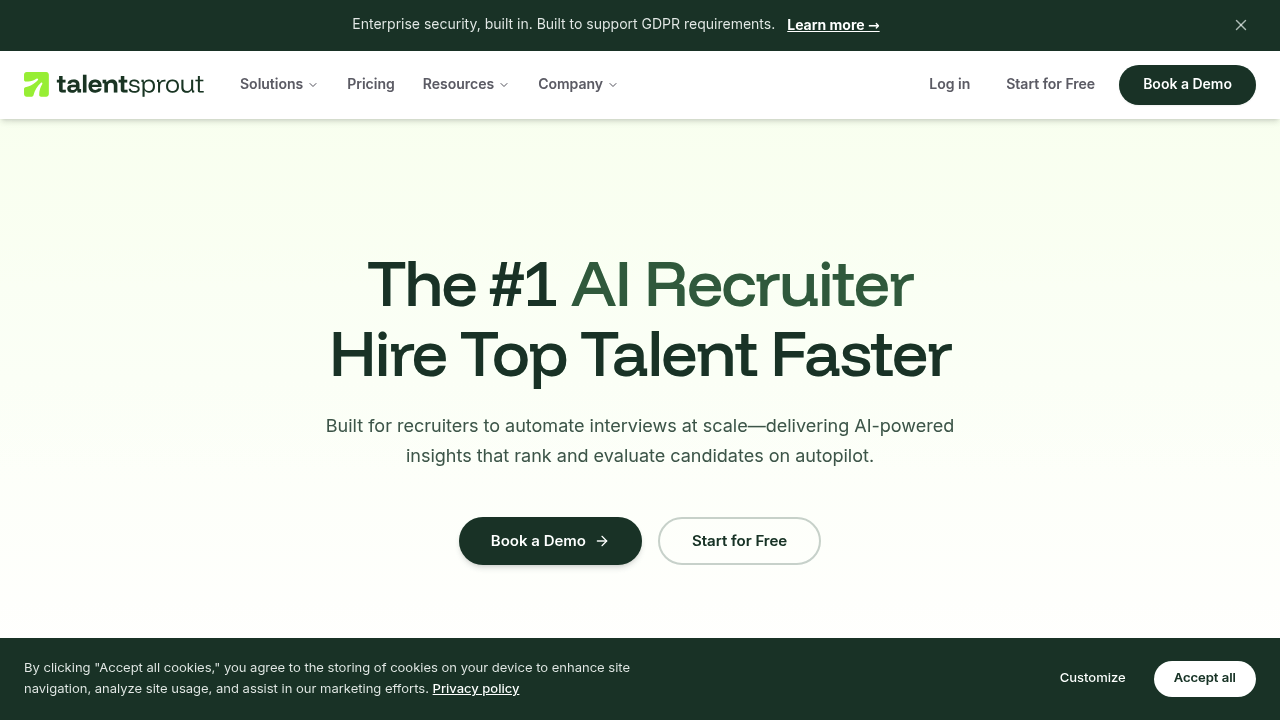
Candidate screening through voice and video interviews gets automated here. The system conducts conversations that branch based on what candidates say, asking follow-up questions that adapt to their responses rather than running through a static script. This happens through natural language processing that parses spoken answers in real time, determines relevance and depth, then generates contextually appropriate next questions. The conversational engine supports over 50 languages, handling accents and dialects across global candidate pools.
The technical pipeline starts when candidates receive an interview link. They can complete it whenever they want since there's no scheduling component. The AI interviewer asks questions, records responses through voice or video capture, then transcribes everything while the conversation's still happening. Behind the scenes, the system's running language proficiency assessments, analyzing communication patterns, and scoring responses against custom matrices that recruiters define upfront. Resume parsing happens in parallel, extracting structured data from unstructured documents and cross-referencing what candidates say against what they wrote.
Interview data flows into a scoring engine that evaluates candidates on whatever criteria the recruiting team configured. These matrices can weight technical skills differently than soft skills, or prioritize specific qualifications over others. The system generates summaries immediately after interviews wrap, pulling key points from transcripts and mapping them to evaluation criteria. All recordings get stored with timestamps, making it easy to jump to specific moments when reviewing candidates later.
Integration happens through APIs and direct connections to applicant tracking systems. The Enterprise tier supports 45 different ATS platforms, pushing candidate data, scores, and interview recordings directly into existing recruitment workflows. For teams using other systems, API access lets them build custom integrations that fit their specific tech stack.
The analytics dashboard aggregates interview data across all candidates, showing patterns in how people perform on different question types or where drop-off happens in the process. Enterprise customers get deeper reporting capabilities that break down metrics by role, department, location, or custom segments.
Branding customization extends to the entire candidate experience. The interview interface can carry company colors, logos, and messaging. Enterprise accounts get white-label options that remove any reference to the underlying service, making it look like a completely proprietary system.
This tool claims recruiters save over 15 hours weekly and cut time-to-hire by 70%. Candidate satisfaction supposedly hits 95%, though these metrics depend heavily on interview design and question quality. Poor configuration leads to frustrating candidate experiences regardless of the underlying technology.
Starter plans run $199 monthly for 50 interviews and two team seats. That's $4 per additional interview if you exceed the monthly allocation. Growth tier costs $499 monthly, covering 250 interviews and five seats at $2.50 per overage interview. Enterprise pricing isn't published but includes unlimited interviews and seats. The volume-based model means costs scale directly with hiring activity, which can get expensive during rapid growth periods.
Technical limitations center on volume constraints in lower tiers. Fifty interviews monthly works for small teams with steady hiring but falls short during seasonal spikes or expansion phases. The two-seat limit on Starter restricts collaboration since only two people can access the system simultaneously. Growth tier's five seats still bottlenecks larger recruiting operations. Moving between tiers requires jumping significant price points, there's no gradual scaling. The system can't handle every interview scenario either. Highly technical roles requiring live coding or complex problem-solving don't translate well to this format.