
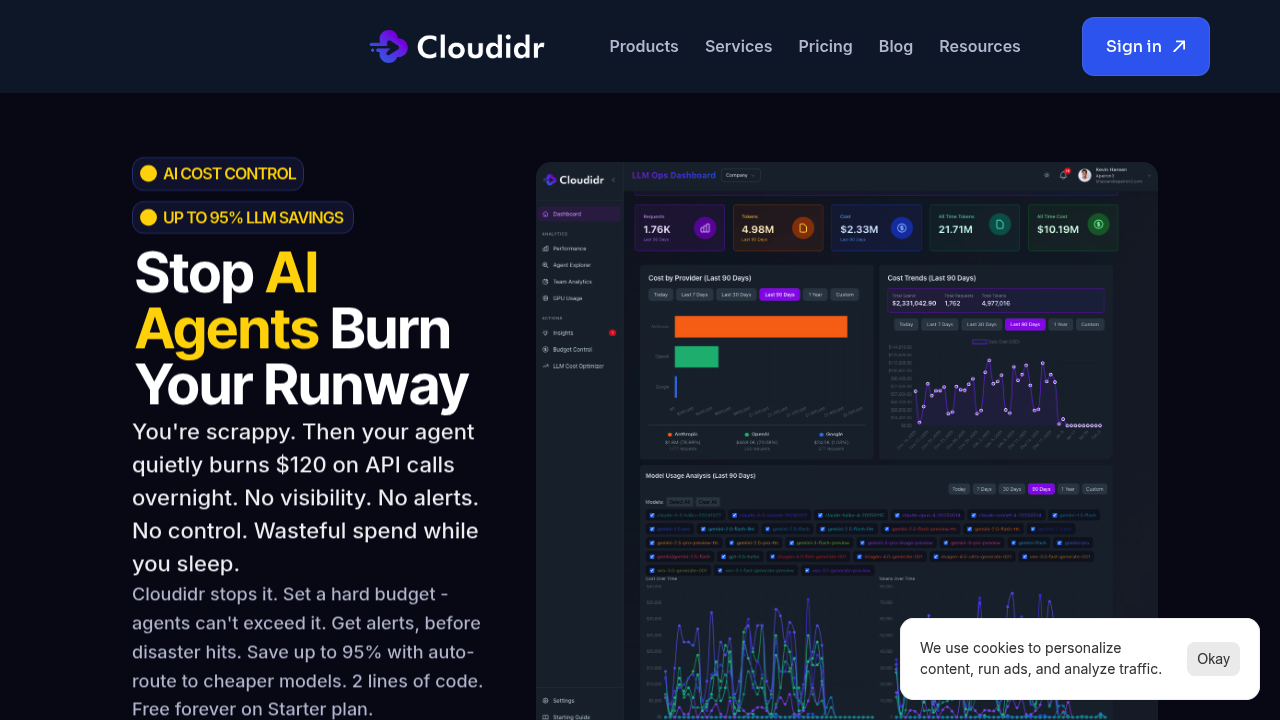
Cloudir LLM Ops tracks and controls costs for AI agent deployments by monitoring API spending in real time and automatically routing requests to cheaper models when possible. This system claims to reduce API costs by up to 95% through intelligent request routing across providers and hard budget enforcement that blocks requests once spending limits are reached.
The technical architecture works through a two-line code integration that intercepts API calls before they reach model providers. When a request comes in, the system logs the agent ID, team assignment, model selection, and token usage, then routes the call through to the selected provider. The routing engine can automatically redirect requests to cheaper models based on the task requirements, though the methodology for determining equivalent model capabilities isn't specified in technical detail. Response time overhead adds approximately 40 milliseconds per request.
Cost tracking breaks down by individual agent, team, model type, and specific API call. The dashboard updates in real time as requests flow through the system. Budget controls operate at two levels: soft alerts that trigger at 80% and 90% of spending thresholds, and hard blocks that automatically reject requests once the budget cap is hit. This prevents runaway costs from poorly configured agents or unexpected usage spikes.
This system uses AI-powered analysis to detect spending anomalies, though the specific machine learning methodology isn't detailed. The system flags unusual patterns in token consumption or request frequency that deviate from baseline behavior. Setup reportedly takes 60 seconds once you've integrated the two lines of code into your application.
Security architecture addresses a common concern with cost monitoring tools. API keys never get stored in the database. They pass through server memory for one to two seconds during request processing, then get cleared. You can verify this behavior by revoking an API key mid-request, which should cause the system to fail immediately rather than continuing to use a cached credential.
The service currently supports three major model providers. Integration depth is limited to these providers. If you're using other LLM APIs or self-hosted models, they won't work with the routing system. The starter plan tracks up to $5,000 per month in LLM spending, accommodates three team members, and controls budgets for five agents. Data retention lasts 90 days on this tier. The growth plan at $49 per month increases tracking to $30,000 monthly spend, ten team members, and 30 agents with one-year data retention. Scale pricing at $299 per month removes agent and team size limits, adds forecasting capabilities, extends retention to three years, and includes API access for programmatic cost analysis. Enterprise pricing is custom.
Technical limitations are significant for larger deployments. The starter plan's $5,000 tracking ceiling and five-agent limit won't accommodate production environments with multiple AI systems. Growth tier caps at $30,000 monthly spend and 30 agents, which might constrain scaling teams. The 40-millisecond overhead per request could accumulate in high-throughput applications processing thousands of requests per minute. The service lists 50-plus teams currently using the system, suggesting relatively early adoption. The routing logic's decision-making process for model substitution isn't transparent, making it difficult to predict when requests will get redirected to cheaper alternatives. Data retention policies mean historical cost analysis beyond 90 days requires upgrading from the free tier.