
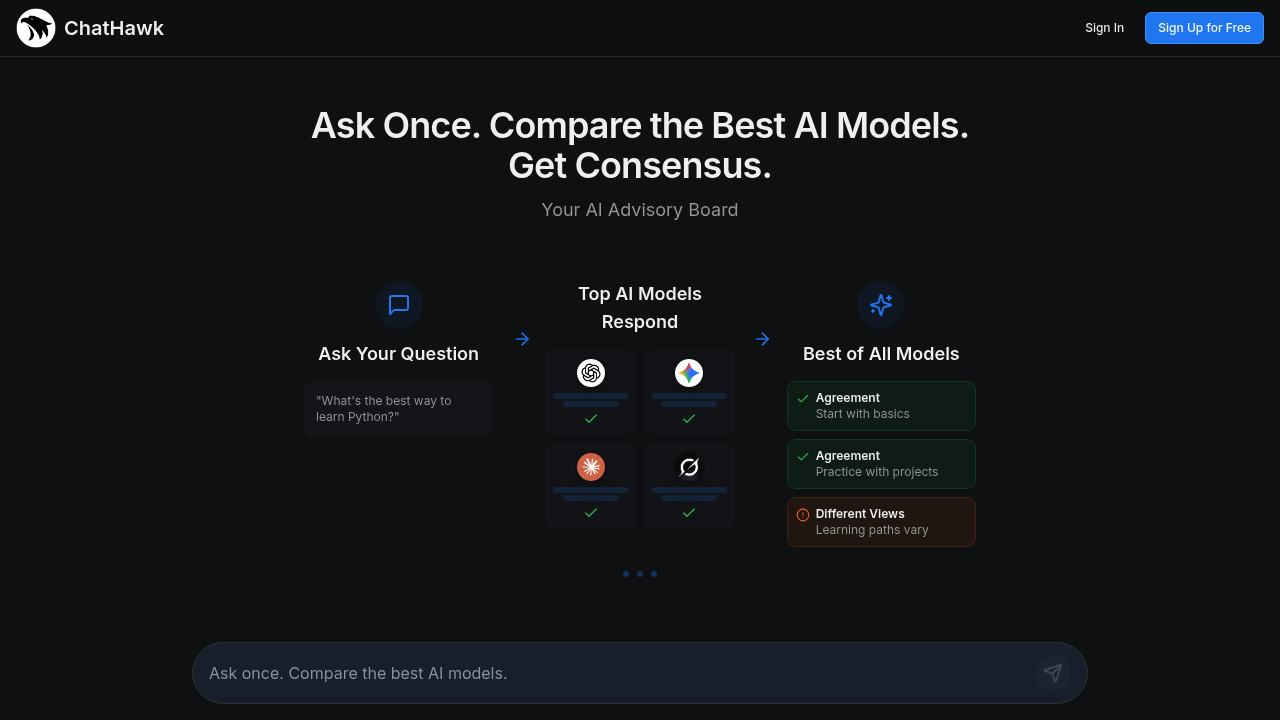
A product manager needs to decide whether to add a controversial feature. She asks the same question to four different AI assistants and gets wildly different answers — one says ship it immediately, another warns about legal risks, a third focuses on user experience concerns, and the fourth brings up technical debt. Now she's stuck reading through four separate responses, trying to figure out which advice actually matters.
ChatHawk runs that same question across multiple leading AI models at once, then shows where the models agree and where they conflict. Instead of switching between tabs and comparing answers manually, she sees all responses side by side. ChatHawk pulls the strongest points from each model and builds a single consensus answer. When three models flag the same legal concern but differ on implementation details, she knows that's the real issue to address. When only one model suggests a feature addition and the others stay silent, she can weigh whether that outlier perspective matters.
A consultant writing a market entry strategy faces similar chaos when trying to validate research across different AI tools. Each model brings different training data and reasoning approaches, which means each one might catch risks or opportunities the others miss. ChatHawk shows him which models performed best on his specific question type through its ranking system. If the financial projections question gets stronger answers from certain models while the competitive analysis question surfaces better insights from others, he learns which AI to trust for which work.
The combined answer feature matters most when models partially agree. A hiring manager asks about candidate assessment approaches and gets four responses that overlap on core principles but diverge on specifics. Rather than cherry-picking advice herself, she gets a synthesis that captures the consensus on fundamentals while flagging the areas where expert opinion splits.
The model ranking creates problems for questions that need creativity over accuracy. An art director asking about design concepts doesn't benefit from knowing which model provided the "most correct" answer because there isn't one. The consensus feature also struggles when the question needs a specific voice or style rather than factual accuracy. All four models might provide technically sound writing samples, but the consensus version strips out the distinctive qualities that made individual responses interesting.
Question limits bite fast. Fifty questions monthly on the Basic plan sounds reasonable until you realize that's barely two questions per workday. A researcher validating multiple hypotheses burns through that cap in a week. The Pro plan's 150 questions works out to seven daily, which covers moderate use but won't support someone treating this as their primary research tool. The free tier gives one question total, just enough to see how it works.
Over 500 decision-makers use ChatHawk, which suggests it's found an audience beyond the curious. ChatHawk works for anyone whose job involves making calls based on AI-generated insights and who can't afford to rely on a single model's blind spots. It makes less sense for routine tasks where any decent AI would suffice, or for creative work where consensus means mediocrity. At $10 monthly for Basic or $20 for Pro, the value depends entirely on whether comparing models actually improves your decisions enough to justify the cost and question limits.