
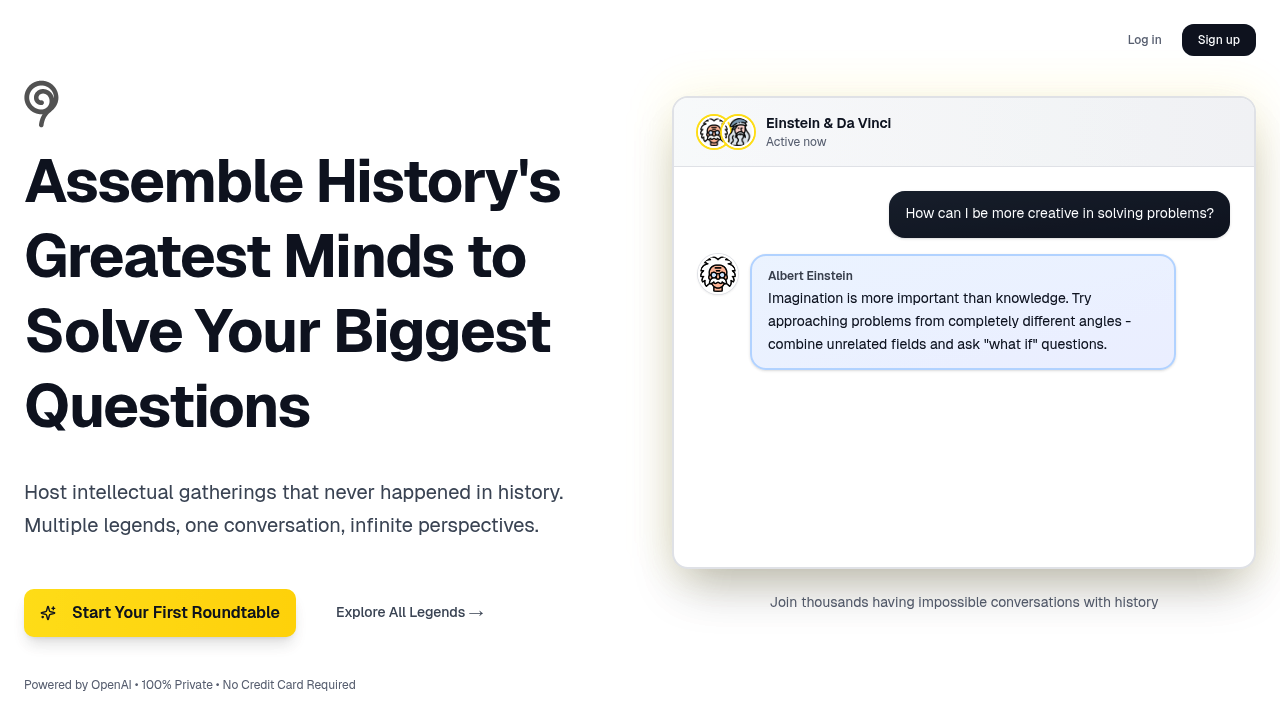
This service routes user inputs through OpenAI's language models to simulate conversations with historical figures. The system uses prompt engineering to maintain character consistency, drawing on documented speeches, writings, and biographical information to shape each figure's communication style. When you select Einstein, the AI doesn't access a database of Einstein quotes. It generates responses based on patterns learned during training about how Einstein wrote and spoke.
The roundtable feature handles multi-participant conversations by managing separate character contexts simultaneously. You can set up a discussion between Marie Curie and Leonardo da Vinci, and the system maintains distinct voices while allowing them to respond to each other's points. This requires the underlying model to juggle multiple personality frameworks within a single conversation thread, switching context as different figures contribute.
Twenty-two historical figures are available. The interface highlights popular pairings like Einstein with Curie or Shakespeare with Leonardo da Vinci, suggesting these combinations based on what thousands of users have already tried. Each conversation stays private, meaning the service doesn't use your discussions for training or share them with other users.
The quality depends entirely on OpenAI's training data. If a historical figure has extensive documented material, the AI can pull from richer context. Lesser-known figures might generate more generic responses. The system can't fact-check itself, so historical accuracy isn't guaranteed. it is generating plausible dialogue, not retrieving verified statements.
Technical constraints matter here. The AI occasionally produces anachronisms or attributes ideas to the wrong time period. It might have Einstein reference concepts that emerged after his death or blend different historical periods. The character consistency can slip during longer conversations as the context window fills up.
No credit card required to start using it. The service runs entirely through OpenAI's infrastructure, so any downtime or rate limiting on OpenAI's end affects availability. Response times fluctuate based on API load.
The roundtable mechanic is the distinguishing technical feature. Most conversational AI tools handle single-character interactions. Managing multiple distinct personas who can interact with each other requires more complex prompt architecture. The system needs to prevent characters from blending together while maintaining conversational flow.
This works best for creative exploration rather than historical research. The AI generates engaging dialogue but shouldn't replace actual historical sources. Think of it as a brainstorming tool that packages knowledge in an interactive format, not an authoritative reference.