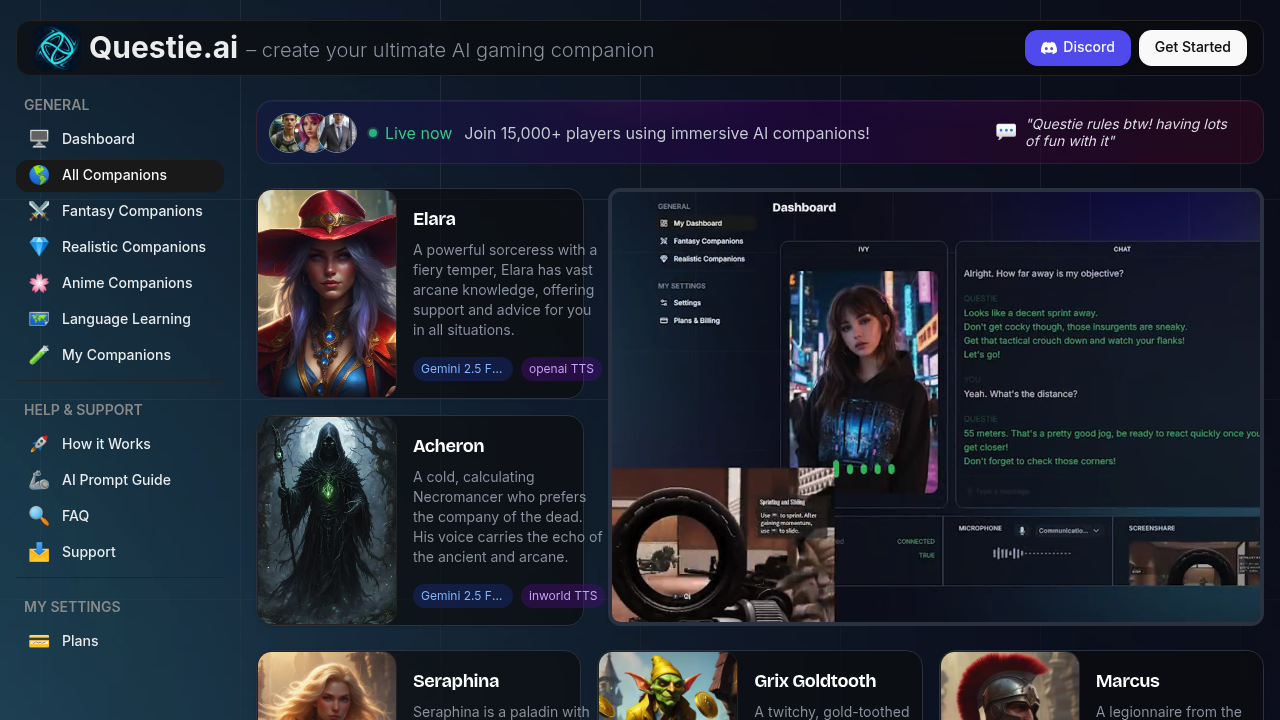
You open Questie AI and immediately start building a custom gaming companion. The system asks what kind of character you want — fantasy, realistic, or anime — then walks you through personality traits, backstory, and conversation style. You can get pretty specific here, defining memories the AI should have about you and knowledge areas it should focus on. The creation flow feels like you're designing a character for a game, which makes sense given the audience.
Once your companion's ready, you share your screen and start gaming. The AI watches through live screenshare and actually sees what's happening on your display. That's the Vision Language Model doing its thing. It doesn't just respond to what you say — it reacts to your gameplay. Miss a jump in a platformer and the AI comments on it. Find a hidden chest and you'll hear genuine excitement through voice chat. The commentary feels contextual because the AI's literally watching your screen in real-time.
The voice chat works surprisingly well. You're not typing while gaming, you're just talking like you'd talk to a friend on Discord. The service offers multiple text-to-speech options including OpenAI, Inworld, and Fishaudio, so you can pick a voice that doesn't grate on you after an hour. Some voices sound more natural than others. The AI model powering conversations comes in two variations — a standard version and a lighter one that presumably runs faster.
Over 15,000 gamers use the service now. It's caught on with streamers who want company during long solo sessions and people who enjoy AI roleplay. The service integrates with Discord, which fits how most gaming communities already communicate.
Where things get murky is customization depth. You can adjust personality and conversation preferences, but it's not always clear how much these settings actually change the AI's behavior until you've spent time with it. The screenshare connection occasionally lags behind intense action, so the AI might comment on something that happened three seconds ago. Not game-breaking but noticeable.
The service positions itself against traditional AI chatbots that don't actually see your screen. That visual context makes a real difference. Your companion isn't guessing what you're doing from text descriptions — it's watching alongside you. Whether that's worth it depends on how much you value having a reactive presence during gaming sessions instead of just background music or silence.