
A high school history teacher assigns an essay on Benjamin Franklin's views on democracy. Instead of skimming Wikipedia, a student opens Talk Through Time and asks Franklin directly about his Constitutional Convention debates. The AI responds based on Franklin's actual speeches and writings, offering perspectives that textbooks compress into footnotes. The student follows up with questions about Franklin's compromises with Southern delegates, getting detailed answers that spark three more questions. She walks away with material no search engine would surface.
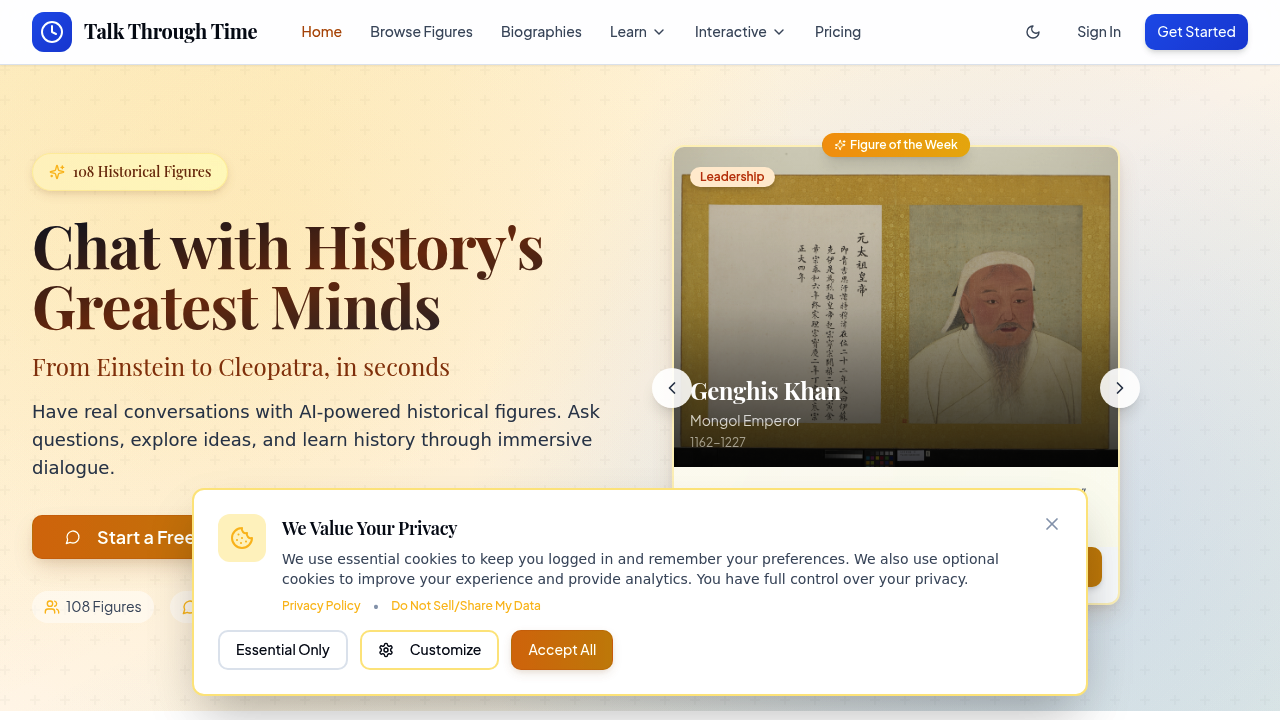
The service hosts 108 historical figures spanning philosophy, science, literature, leadership, arts, and innovation. Each AI personality draws from historical documents, speeches, and writings to simulate how that person might respond. Users can chat with Marcus Aurelius about Stoic philosophy, debate economic theory with Adam Smith, or ask Marie Curie about facing discrimination in science. The interface organizes figures by era and discipline, making it easy to find relevant voices for specific topics.
Custom debate scenarios let users stage conversations between historical figures who never met. A college student writing about social contract theory can orchestrate a debate between Thomas Hobbes and John Locke, watching their conflicting philosophies play out in real time. The service includes gamification with XP, badges, quests, and leaderboards, turning historical exploration into something competitive. A learning dashboard generates summaries and key takeaways from conversations, and conversation history tracking lets users revisit previous chats.
The mobile responsive interface works across devices. Recently added figures like Jane Goodall and Christopher Hitchens appear alongside ancient personalities like Julius Caesar. A "Figure of the Week" highlights specific historical personalities regularly.
Where it falls short matters. Every response comes from AI simulation, not actual quotes. A researcher can't cite these conversations as primary sources. The AI interprets how a figure might respond based on training data, which means answers reflect the algorithm's interpretation of historical materials, not definitive historical truth. A student asking Napoleon about military strategy gets plausible responses, but they're reconstructions, not documentation.
The free Explorer plan offers 5 conversations daily with access to 6 historical figures. That's enough to sample the experience but limiting for serious study. Premium Scholar costs $9.99 monthly and provides 20 chats per figure daily with access to over 100 figures. Ultimate Historian runs $24.99 monthly with unlimited chats, VIP priority support, and early access to new features.
A graduate student researching Enlightenment philosophy needs unlimited access to Voltaire, Rousseau, and Kant. The $24.99 plan makes sense. A casual history buff who checks in occasionally finds value in the free tier. A middle schooler writing book reports hits the 5-conversation limit fast and needs the $9.99 option.
This doesn't work for academic citation. Professors won't accept "I asked Socrates via AI" as a source. It's a learning tool, not a research database. Someone wanting verified historical quotes needs primary source archives instead. The 20-chat daily limit on Premium Scholar also frustrates deep research sessions where questions multiply quickly.
History enthusiasts exploring ideas casually get the most value. Students building understanding before diving into textbooks benefit. Educators looking for classroom engagement tools find creative applications. But scholars needing rigorous historical evidence should stick to academic databases and verified primary sources.