
C1 Artifacts API - Thesys logo
AI API FREEMIUM from $49/mo

C1 Artifacts API - Thesys

Developers building AI applications can now generate interactive UI components directly within their apps rather than forcing users to copy-paste between tools

C1 Artifacts API handles real-time creation of slides, reports, and other visual elements that users can edit and refine through simple prompts without leaving the conversation interface. The system works through three…

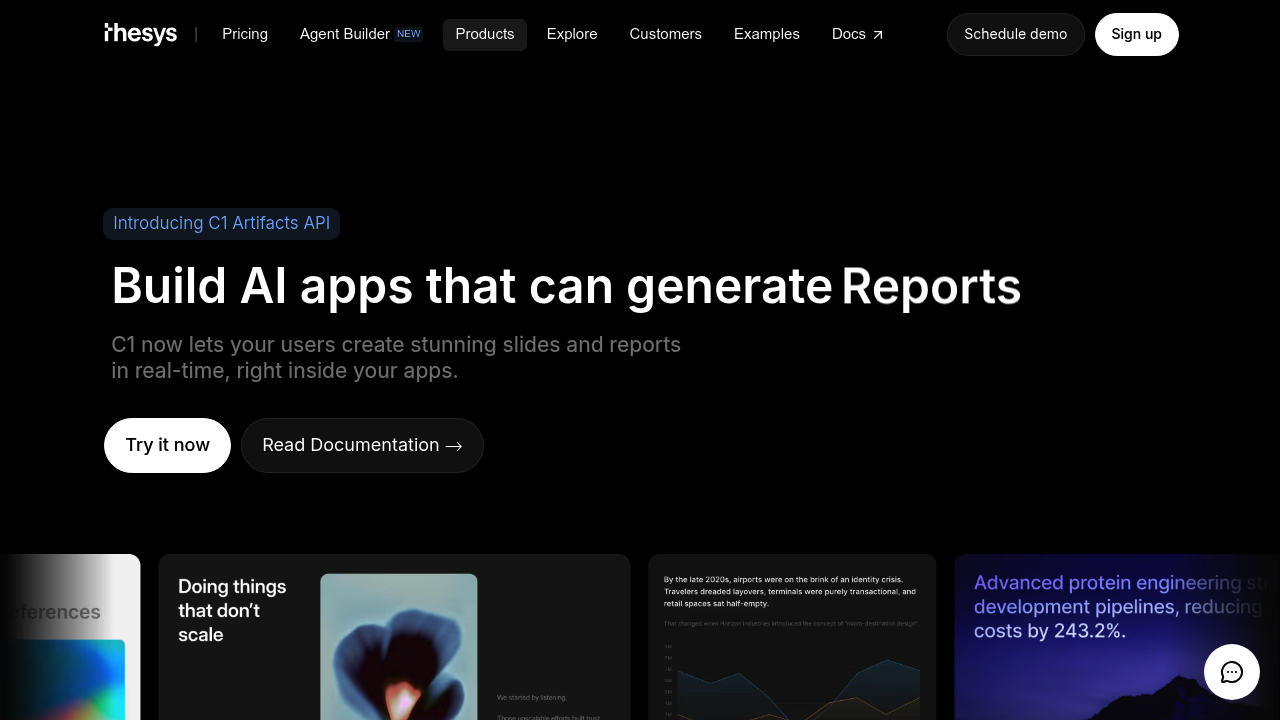
C1 Artifacts API - Thesys screenshot

Developers building AI applications can now generate interactive UI components directly within their apps rather than forcing users to copy-paste between tools. C1 Artifacts API handles real-time creation of slides, reports, and other visual elements that users can edit and refine through simple prompts without leaving the conversation interface.

The system works through three integration steps. Developers can implement it via SDK for programmatic control or use the Model Context Protocol for instant plug-in installation that requires zero coding. That MCP approach matters for speed. It connects to major AI platforms and coding environments like VS Code, Cursor, and n8n, letting users generate live artifacts in tools they already use daily.

The interactive component generation changes how chat interfaces function. Instead of producing static text responses, applications can now create editable slides and reports that users modify through conversational prompts. Someone might ask for a quarterly report, receive a fully formatted document, then request theme changes or layout adjustments through follow-up messages. The components update in real-time.

Customization runs deep. The API supports theme modifications and layout adjustments that persist across generated artifacts. Teams can establish visual consistency while still allowing individual users to tailor outputs. The share and collaboration features let multiple people work with the same generated components, though the facts don't specify whether this happens through unique links, workspace permissions, or another method.

The OpenAI API compatibility extends the reach beyond specific platforms. Any application built on OpenAI-compatible infrastructure can integrate artifact generation without rebuilding core architecture. This compatibility layer removes a common integration barrier where new capabilities require switching underlying services.

The Model Context Protocol implementation deserves attention because it separates C1 Artifacts from tools requiring extensive custom development. Non-technical users can install it as a plugin and start generating artifacts immediately in their preferred AI assistant. Technical teams get SDK access for deeper integration when they need programmatic control over component generation, styling, or data flow.

Component types center on business communication needs. Slides and reports represent the primary outputs, though the interactive UI component description suggests broader possibilities the facts don't detail. The prompt-based editing means users don't need to understand the underlying structure. They describe what they want changed and the system handles implementation.

Developers building chat interfaces, document automation tools, or presentation generators would find the most immediate value. The real-time generation removes the traditional workflow where AI suggests content that humans then manually format in separate applications.


C1 Artifacts API - Thesys alternatives

See all →

Frequently asked

6 questions
Is C1 Artifacts API free to use?
The available information doesn't specify whether C1 Artifacts API offers a free tier or what pricing structure exists. No free trial is mentioned in the current documentation. Developers interested in testing the API would need to contact Thesys directly to learn about pricing options and whether evaluation access is available. The three-step integration process suggests quick setup, but cost details remain undisclosed.
How do you integrate C1 Artifacts API into an application?
Integration happens through three steps using either SDK implementation or Model Context Protocol installation. The SDK route gives developers programmatic control over artifact generation, styling, and data flow for custom applications. The MCP approach requires no coding and works as an instant plug-in for tools like ChatGPT, Claude, VS Code, Cursor, and n8n. OpenAI API compatibility means applications already built on that infrastructure can add artifact generation without rebuilding core systems.
What can you build with C1 Artifacts API?
The API generates interactive slides, reports, and UI components that users can edit through conversational prompts without leaving the chat interface. Applications can produce fully formatted quarterly reports that users then modify by requesting theme changes or layout adjustments in follow-up messages. Chat interfaces transform from static text responses to dynamic document generation where components update in real-time. The system supports customizable themes and layouts with sharing capabilities for team collaboration on generated artifacts.
Does C1 Artifacts API work with ChatGPT and Claude?
C1 Artifacts API integrates directly with both ChatGPT and Claude through the Model Context Protocol implementation. Users can install it as a plugin and immediately start generating editable artifacts within these AI assistants. The integration also extends to development environments like VS Code and Cursor, plus automation platforms like n8n. This cross-platform compatibility lets users generate live components in whichever tool they already use for AI interactions.
What are the limitations of C1 Artifacts API?
The available documentation doesn't detail specific limitations around generation volume, component complexity, or usage restrictions. Information about mobile support is absent, with no mobile app mentioned for artifact creation or editing. Details about team feature specifics remain unclear, including whether collaboration happens through shared links, workspace permissions, or another method. The types of UI components beyond slides and reports aren't specified, leaving questions about what other interactive elements the API can generate.
Who should use C1 Artifacts API?
Developers building AI applications that generate business documents, presentations, or chat interfaces would find the most immediate application. Teams creating document automation tools can eliminate the copy-paste workflow where AI suggests content that users manually format elsewhere. Product builders working on conversational interfaces can add real-time slide and report generation that users refine through natural language. The tool targets scenarios where interactive, editable outputs matter more than static text responses.

Traffic

Estimated monthly website visits · last 8 months

120.5K visits/mo
Monthly visits
120.5K
↓ 1.7% MoM
Global rank
#367,850
IN #101,207
Category rank
#42
AI API
205.3K 171K 136.7K 102.5K 68.2K Dec 2025: 68.2K visits Dec 2025 Jan 2026: 83.4K visits Jan 2026 Feb 2026: 100.8K visits Feb 2026 Mar 2026: 136.4K visits Mar 2026 Apr 2026: 205.3K visits Apr 2026 May 2026: 145.4K visits May 2026 Jun 2026: 122.6K visits Jun 2026 Jul 2026: 120.5K visits Jul 2026

Reviews (0)

Write review

No reviews yet. Be the first to share your experience.