
Beam logo
AI Developer Tools FREEMIUM from $89/mo

Beam

Beam is a cloud runtime for AI workloads that offers serverless GPUs, task queues and sandboxes through a Python, TypeScript and Go SDK.

Developers decorate a function, pick a GPU such as an H100, and deploy with a single command, with no YAML or Dockerfiles. Memory snapshots and GPU checkpoint restore give sub-second cold starts, and containers scale…

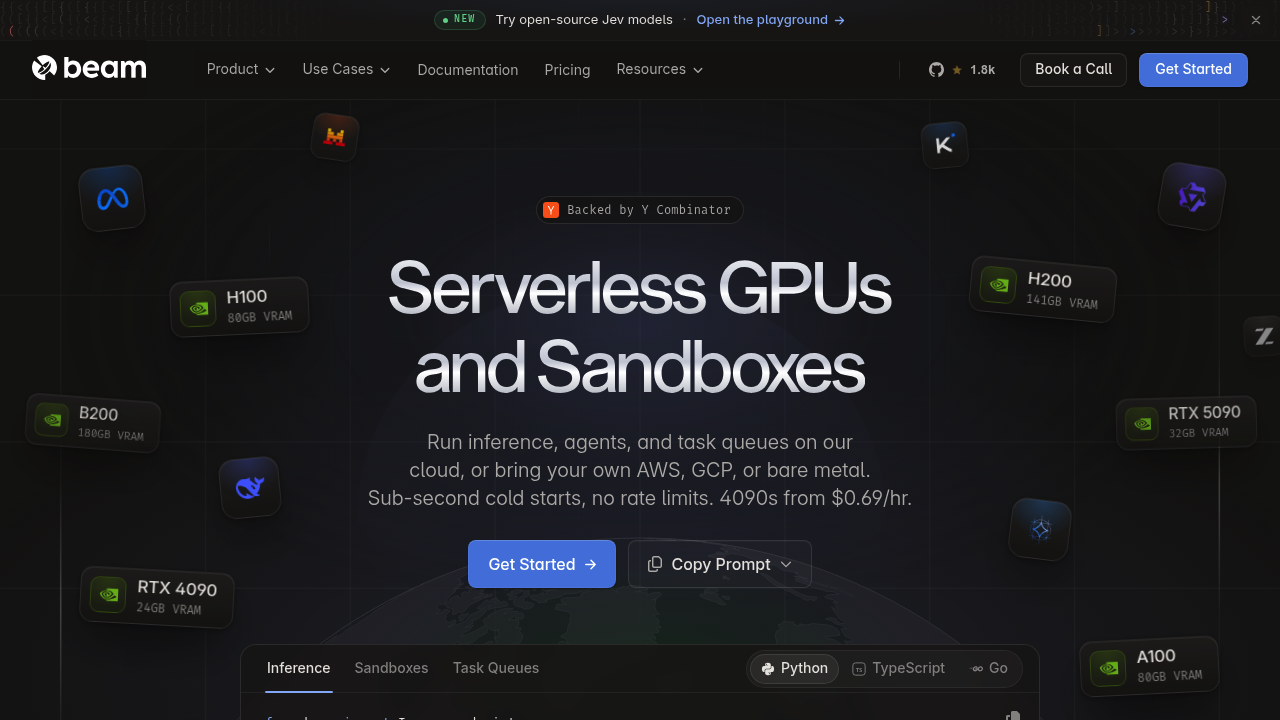
Beam screenshot

Beam is a cloud runtime for AI workloads that offers serverless GPUs, task queues and sandboxes through a Python, TypeScript and Go SDK. Developers decorate a function, pick a GPU such as an H100, and deploy with a single command, with no YAML or Dockerfiles. Memory snapshots and GPU checkpoint restore give sub-second cold starts, and containers scale down to zero when idle. Billing is by the millisecond while code runs: RTX 4090 workloads start from $0.69 per hour, sandboxes from $0.319 per hour, and on-demand H100 machines from $1.83 per hour.

Beam is aimed at developers, ML engineers and startups that need GPU capacity without managing clusters. Teams building AI agents can use sandboxes to run untrusted code in isolated, stateful environments, while product teams serving custom models can deploy endpoints that autoscale from zero to thousands of containers. Companies with existing cloud credits or hardware can connect AWS, GCP or bare metal accounts and run across all of them, which helps platform teams keep utilization high without lock-in.

Common workloads include custom model inference, for example serving a vLLM-backed model on an H100, and durable task queues that retry failed jobs and post results to a callback URL. Sandboxes support Docker-in-Docker, persistent volumes and file system snapshots, so a running environment can be snapshotted and restored into thousands of parallel runs for reinforcement learning or evaluation. Other uses include audio processing pipelines, training and fine-tuning, and hosting Streamlit or Gradio interfaces. Workloads route across more than 30 regions to stay close to users.


Beam alternatives

See all →

Frequently asked

6 questions
How does Beam keep cold starts short?
Distributed storage, memory snapshotting and GPU checkpoint restore work together. Beam reports boots up to 35 times faster than a traditional cold start, with sub-second starts for typical containers.
Who should consider Beam?
Developers, ML engineers and startups that deploy models or agents and want GPUs without running infrastructure. Teams with their own AWS, GCP or bare-metal capacity can attach it as well.
What can I do with Beam sandboxes?
Sandboxes run untrusted or agent-generated code in stateful, isolated environments with persistent volumes and Docker-in-Docker support. A running sandbox can be snapshotted and restored into thousands of concurrent runs.
How is Beam billed?
Serverless usage is billed by the millisecond, only while code runs. Examples include RTX 4090 endpoints from $0.69 per hour, sandboxes from $0.319 per hour and on-demand H100 machines from $1.83 per hour.
Does Beam lock me into its own cloud?
Workloads can run on Beam's cloud or on your own AWS, GCP or bare-metal accounts, and Beam can burst across them. Usage billed on Beam's cloud still follows its per-second rates.
Which languages and tools work with Beam?
SDKs are available for Python, TypeScript and Go, and deployment is a single beam deploy command. Examples include vLLM for serving models, and Streamlit and Gradio interfaces can be hosted too.

Reviews (0)

Write review

No reviews yet. Be the first to share your experience.