
Baserow logo
No-Code & Low-Code FREEMIUM from $10/mo

Baserow

Baserow is an open-source, no-code platform for building databases and applications.

Data lives in tables that can be viewed as a grid, gallery, kanban board, calendar, timeline, form or survey, and the same data can feed custom applications, dashboards and automated workflows. An AI assistant called…

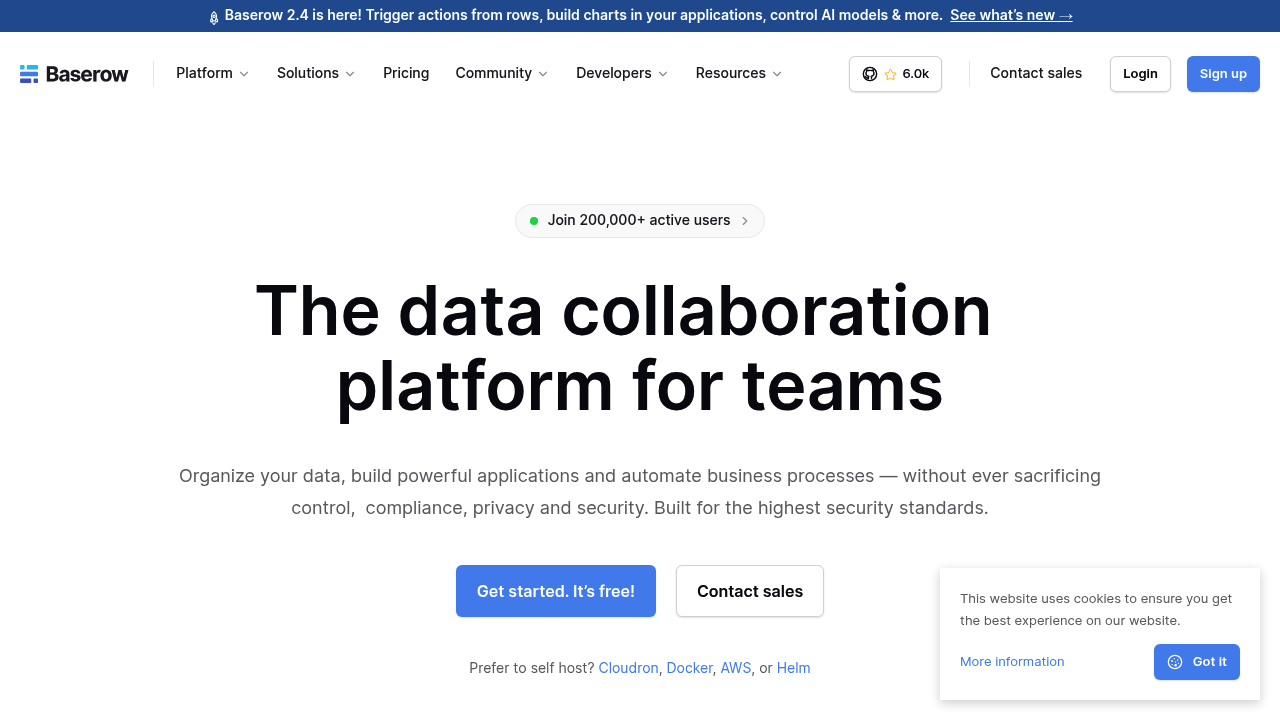
Baserow screenshot

Baserow is an open-source, no-code platform for building databases and applications. Data lives in tables that can be viewed as a grid, gallery, kanban board, calendar, timeline, form or survey, and the same data can feed custom applications, dashboards and automated workflows. An AI assistant called Kuma can build a database from a plain-language description, and an AI field and MCP server bring language models into rows. Baserow Cloud has a free plan at $0 with 3,000 rows per workspace, while Premium costs $10 per user per month and Advanced $18, both billed yearly. Self-hosting is also available through Docker, Cloudron, AWS or Helm.

Operations managers, project leads and small business owners use it to move off scattered spreadsheets without writing code. Developers appreciate the API-first design, backend and frontend plugins and the option to host everything on their own servers. Compliance-minded teams in risk management, healthcare or finance can lean on GDPR, HIPAA and SOC 2 certification and audit logs on higher plans. Agencies and internal IT groups can build client portals on top of shared data, and IT departments that want to avoid vendor lock-in often pick it as an alternative to Airtable.

Typical projects include CRMs, task and project trackers, risk registers, ESG reporting, purchasing workflows, advertising campaign planners and manufacturing checklists. Templates cover many of these, and data can be imported from CSV, XML, JSON or Excel files. Automations send emails, call webhooks or HTTP endpoints and react to row changes, so a new record can notify a team or update another system. Dashboards turn table data into charts for managers, and external users on portals can view or submit information without taking a paid seat, up to 500 on most plans.


Baserow alternatives

See all →

Frequently asked

6 questions
Which views and building blocks does Baserow offer?
Data can be displayed in grid, gallery, kanban, calendar, timeline, form and survey views. On top of tables you can build applications with pages and elements, dashboards with charts, and automations with triggers, conditions and loops.
Who is Baserow aimed at?
Teams that want to replace spreadsheets or build internal software without coding, from small businesses to regulated enterprises. Developers who want an open-source, self-hostable Airtable alternative are another core audience.
Can Baserow be used to build a CRM or project tracker?
Templates exist for task management, project management, CRM, risk assessment, ESG management and advertising campaigns. You adapt the fields and views, then add automations for notifications or integrations.
How much does Baserow cost?
The free plan costs $0 and includes 3,000 rows and 2GB of storage per workspace. Premium is $10 per user per month and Advanced is $18 when billed yearly, or $12 and $22 billed monthly. Enterprise pricing is on request.
What limits apply on the free plan?
Free workspaces are capped at 3,000 rows, 2GB of storage and 2,000 automation credits, and only grid, form and gallery views are included. Kanban, calendar, timeline and survey views and AI features require a paid plan.
How can I deploy Baserow?
Baserow Cloud is hosted for you, and a self-hosted edition runs through Docker, Cloudron, AWS or Helm. A managed private instance is available on request, and data can be imported from CSV, XML, JSON or Excel.

Reviews (0)

Write review

No reviews yet. Be the first to share your experience.