When research papers pile up and deadlines loom, sifting through dense academic text eats hours that could go toward actual analysis. AI Summarizer tackles this by condensing articles, research papers, medical reports, and news stories into digestible summaries that preserve the core information without the slog.
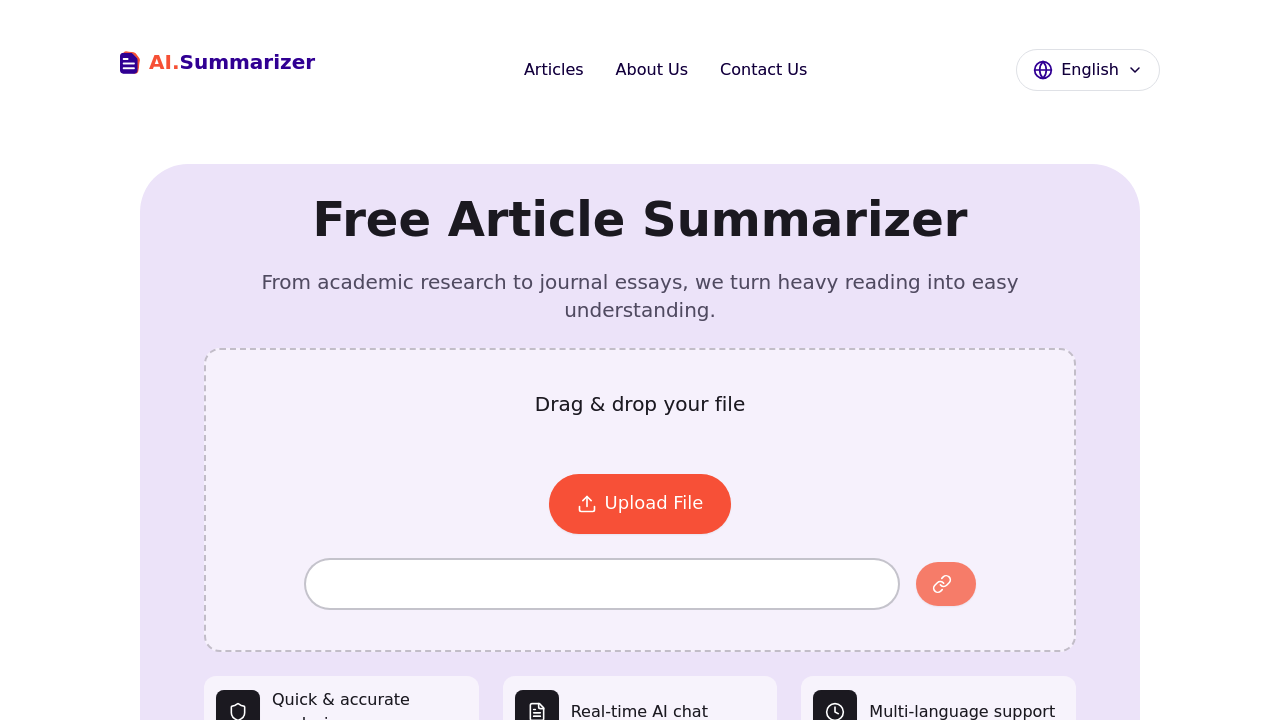
This system processes documents in about five seconds. Users drag and drop files directly into the interface, which accepts PDFs up to 30 MB in size. That capacity handles most academic papers and lengthy reports without forcing users to split files or compress them. The system works across content lengths, from brief news pieces to extensive research documents, adapting its analysis to whatever lands in the upload zone.
What sets this system apart comes after the initial summary. A real-time AI chat feature lets users ask follow-up questions about the summarized content. Someone reading a medical study could ask for clarification on methodology. A student tackling a philosophy paper could request examples of key concepts. This interactive layer turns the system from a one-shot summarizer into something closer to a research assistant that can dig deeper on demand.
Language support spans over 80 options including English, Spanish, German, Polish, French, Italian, and Portuguese. The system doesn't just translate, it summarizes in the target language, which matters for non-English speakers working with English-language research or vice versa. Performance varies by language popularity though. More common languages benefit from richer training data, producing detailed summaries. Less common languages still work but tend to generate simpler, more straightforward condensations that might miss subtle distinctions in the source text.
Security gets explicit attention here. Files get handled through secure channels with privacy flagged as a priority, addressing the concern that comes with uploading potentially sensitive research or proprietary documents.
The service runs entirely free. File upload works. Chat works. Multi-language support works. All without payment tiers or usage caps mentioned in the offering.
Teachers tracking education trends can scan multiple articles quickly. Students prepping for exams can extract key points from assigned readings without skimming and missing crucial details. Researchers drowning in literature reviews can pull out insights worth citing without reading every page of every source. The 30 MB file limit won't accommodate book-length manuscripts or image-heavy PDFs that balloon in size, but it covers standard academic and professional documents. Language performance drops with obscure tongues, so users working in minority languages should expect more basic output than their English-using counterparts get.