
A social media manager needs to create product videos for a launch campaign, generate hero images for landing pages, and produce Instagram ads — all before Friday. Instead of juggling five different AI subscriptions, she logs into one interface that connects to Sora 2, Veo 3.1, Flux 2 Pro, and eight other generation models. She types a prompt for a cinematic product video, gets 1080p footage without watermarks, then switches to another model for photorealistic product shots in 4K. Everything downloads clean and ready for client review.
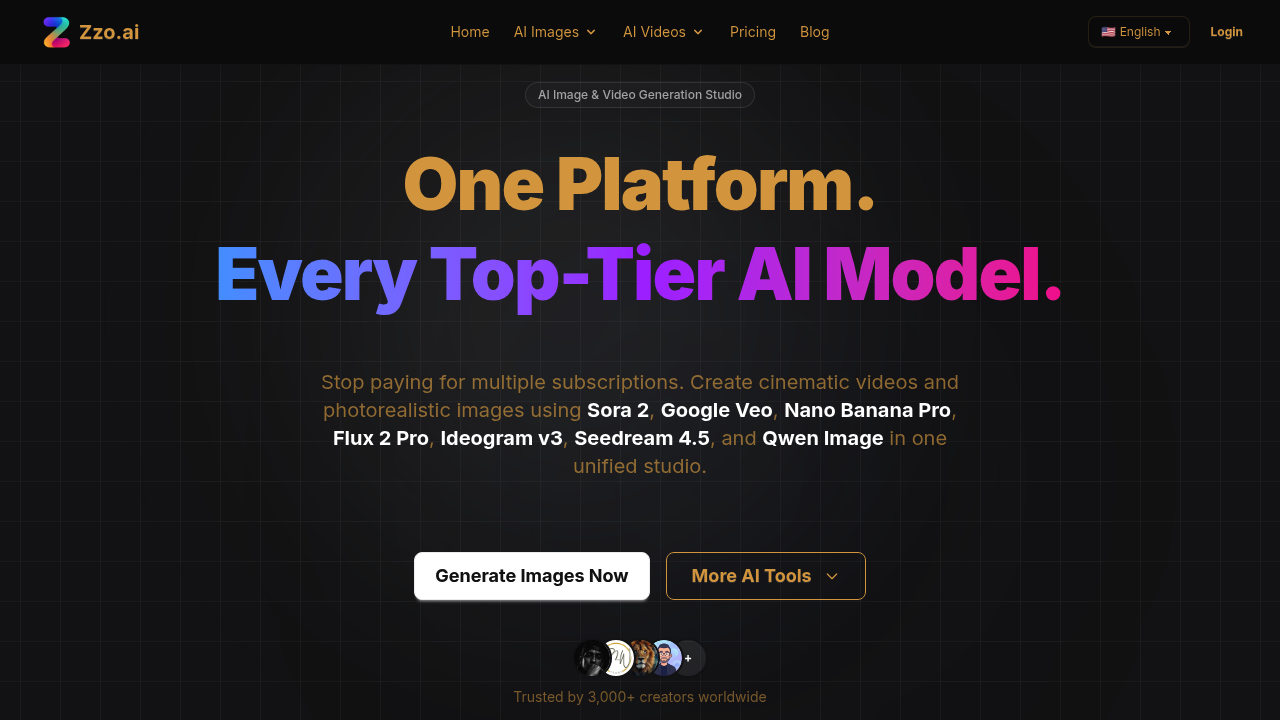
Zzo.ai consolidates access to multiple AI generation models from OpenAI, Google DeepMind, Black Forest Labs, xAI, and other providers into a single interface. The service handles both video creation and image work through a credit system that works across all connected models. A content creator can generate text-to-video content with Sora 2 or Veo 3.1, switch to Flux 2 Pro or Ideogram v3 for images, then use Qwen Image Edit to swap objects or fix artifacts in existing visuals. The system includes background removal, face swap functionality, and tools to animate static images into motion content.
The credit discounts run deep — some models cost 85% to 93% less than their standalone pricing. An e-commerce team that previously spent $105 monthly across multiple subscriptions for text generation, image creation, video production, and editing software now routes everything through one account. They claimed savings of $1,140 yearly by consolidating their AI tools into a single platform. Over 3,000 creators use the service.
A freelance video editor works on a documentary project that needs B-roll footage generated from text descriptions. He uses Veo 3.1 for establishing shots, then generates supporting imagery through multiple image models depending on what style the scene needs. When a client wants a different background in an existing shot, he runs it through the background removal tool instead of masking it manually in editing software. The text rendering feature handles lower thirds and title cards without typography errors.
The storage window creates pressure. Both subscription tiers limit file storage to 30 days, so a team working on longer projects needs to download and organize assets quickly or risk losing generated content. Credits expire too. Different models consume different credit amounts per generation, which makes budgeting tricky when experimenting across multiple providers. The credit packs only work for existing subscribers — someone can't just buy credits without committing to a yearly plan.
A marketing agency producing high-volume social content finds the Pro plan's 1,200 monthly credits stretch across dozens of client projects. They generate hundreds of variations for A/B testing, animate product photos for stories, and create video ads in multiple aspect ratios. The watermark-free downloads go straight into client deliverables. The service supports 12 languages, which helps when they're producing content for international markets.
Plans start at $99.99 yearly for Plus with 500 monthly credits, or $199.99 yearly for Pro with 1,200 credits and 4K generation. One-time credit packs range from $9.99 for 1,000 credits up to $39.99 for 4,500 credits, but those require an active subscription.
This doesn't fit solo creators who occasionally need AI imagery and don't want yearly commitments. The 30-day storage limit penalizes anyone who generates assets for future use. Teams already locked into enterprise contracts with individual AI providers won't see savings from consolidation.