
Voyage AI logo
AI API FREEMIUM

Voyage AI

Voyage AI makes embedding models and rerankers that raise the quality of search and retrieval, and it now operates as part of MongoDB.

Embeddings turn unstructured text into vectors, while rerankers reorder results for relevance, and together they feed more accurate answers into retrieval-augmented generation pipelines. The models support a 32K token…

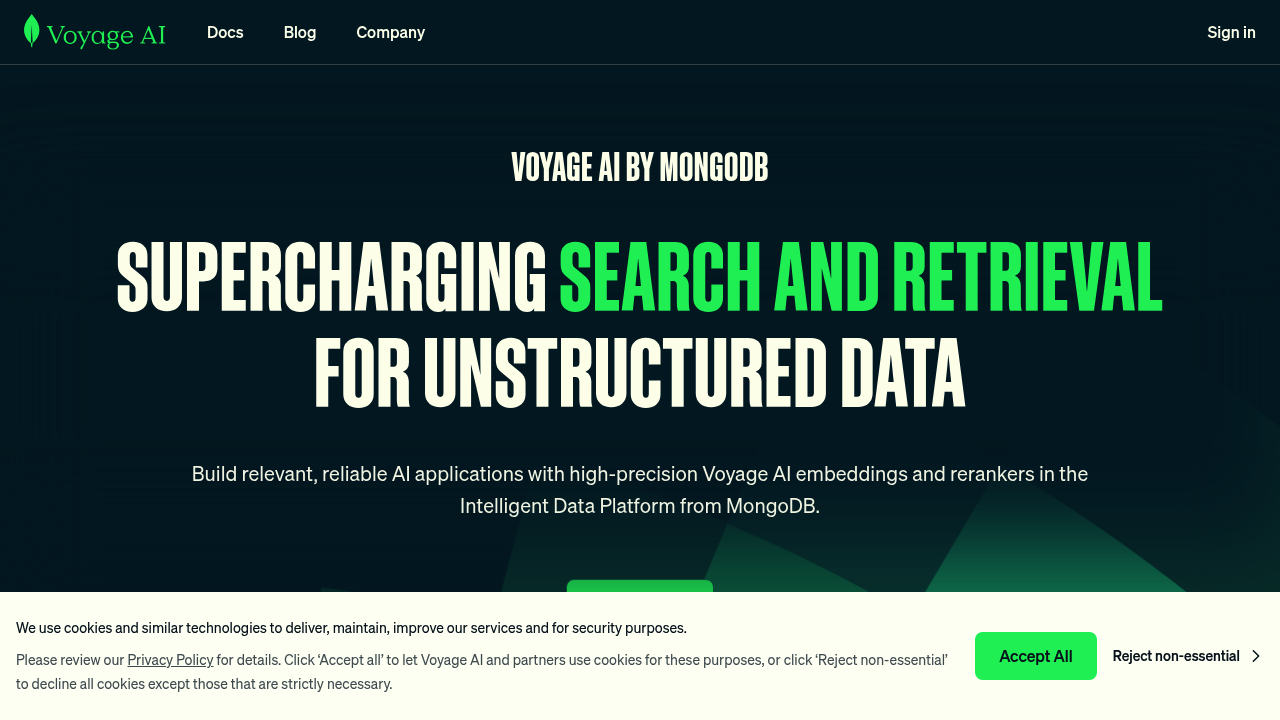
Voyage AI screenshot

Voyage AI makes embedding models and rerankers that raise the quality of search and retrieval, and it now operates as part of MongoDB. Embeddings turn unstructured text into vectors, while rerankers reorder results for relevance, and together they feed more accurate answers into retrieval-augmented generation pipelines. The models support a 32K token context, produce vectors three to eight times shorter than comparable ones to cut vector search and storage costs, and rank among the top performers on the RTEB enterprise retrieval benchmark. Access follows a pay-as-you-go, consumption-based model.

Machine learning engineers and application developers who build RAG systems, semantic search or recommendation features are the core users. Enterprises that need data to stay in their own environment can deploy in-VPC or request custom and on-premise licensing. Teams working in specialist fields can use domain models, as shown by the legal embeddings built for Harvey. The models are modular, so they work with any vector database and any language model rather than locking a team into one stack.

Practical scenarios include indexing a knowledge base so a chatbot can retrieve the right passages, improving enterprise document search by adding a reranking step, and fine-tuning embeddings on proprietary data. Harvey reports that custom legal embeddings reduced its irrelevant document rate by 25% and cut embedding dimensionality and vector database costs by threefold. The models are available through major cloud providers and data platforms, and they pair with MongoDB's database, search and analytics tools for teams that want a single data layer. Low latency and smaller models keep inference fast for live applications.


Voyage AI alternatives

See all →

Frequently asked

6 questions
What do Voyage AI embeddings and rerankers do?
Embeddings convert unstructured data into vectors for similarity search, and rerankers reorder retrieved results by relevance. Together they improve the quality of RAG answers.
Who is Voyage AI for?
Developers and enterprises building RAG pipelines, semantic search or AI applications over their own data are the target. Teams with legal or other domain-specific needs can use specialized models.
What is an example of a real result?
Harvey fine-tuned voyage-law-2 on its own datasets and cut its irrelevant document rate by 25%. Embedding dimensionality and vector database costs also fell threefold.
How does Voyage AI keep costs down?
Its vectors are 3x-8x shorter, which lowers vector search and storage costs. The company also says inference is twice as cheap with a model four times smaller.
What are the technical limits?
The longest context length it advertises is 32K tokens. Models are optimized for retrieval, so generation requires a separate language model.
Where can Voyage AI be deployed?
It is available as pay-as-you-go SaaS, through major cloud providers and data platforms, in a customer tenant inside a VPC, or as a custom on-premise deployment.

Reviews (0)

Write review

No reviews yet. Be the first to share your experience.