
Test Your Idea logo
AI Business Ideas Generator FREEMIUM from $9/mo

Test Your Idea

TAAFT pulls startup ideas through a validation engine that queries 40-plus live data sources in about 60 seconds

The system scrapes Reddit threads, Indie Hackers discussions, Hacker News comments, Product Hunt launches, Google Trends data, YouTube content, and Quora questions to build a picture of market reality. It's not…

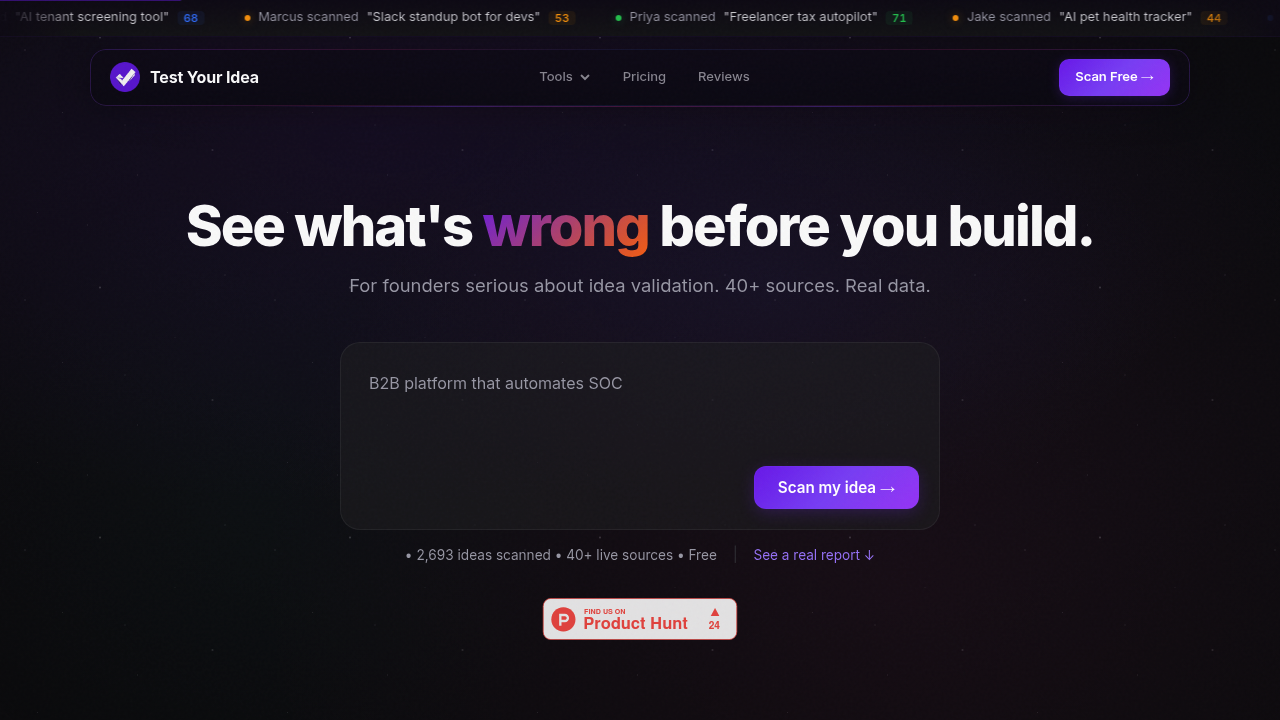
Test Your Idea screenshot

TAAFT pulls startup ideas through a validation engine that queries 40-plus live data sources in about 60 seconds. The system scrapes Reddit threads, Indie Hackers discussions, Hacker News comments, Product Hunt launches, Google Trends data, YouTube content, and Quora questions to build a picture of market reality. It's not analyzing your pitch deck or business plan. It's looking at what people are actually saying in communities where founders and early customers congregate.

The pipeline generates a viability score from 0 to 100. This score considers weak spots in your concept, competitor density, and whether real demand signals exist in the wild. The free Reality Check tier gives you two scans with the score, a verdict, market size estimates, and previews of two competitors. Paid reports expand that to 20 competitors with pricing structures, funding history, and specific weaknesses mapped out.

Technical output includes TAM, SAM, and SOM calculations for market sizing. Revenue projections come in three scenarios rather than a single optimistic forecast. The Niche Coach feature analyzes your positioning and suggests three pivot directions if your initial angle looks crowded. The go-to-market plan identifies target customer segments and distribution channels based on where similar products gained traction.

The Investor-Ready package adds manual review on top of the automated analysis. Someone spends over two hours per package building a 20-slide pitch deck, a four-page investment memo, an 18-month financial model, a 35-item due diligence checklist, and pitch preparation materials. This isn't purely algorithmic generation. There's human QA in the loop.

The Build with AI add-on costs nine dollars and connects the validation data to major language model platforms. You can pipe the research into conversational interfaces for further iteration. The integration doesn't automate building your product but it does let you query the validation findings through a chat interface.

Around 2,500 ideas have been scanned through the system. Four out of five founders reportedly improve their viability score after applying the fixes suggested in the reports. The system was tested on Uxia, a startup that later raised a million-dollar pre-seed round, though that's correlation rather than causation.

The Founder Report costs 29 dollars for a single scan. Five-report packs drop the per-report cost to $17.80. Ten-report packs go down to $14.90 each. The Investor-Ready package runs $299 at early pricing, normally $499. All paid tiers include a 14-day money-back guarantee. Free tier users can't access the fix playbook or detailed go-to-market plans.

Technical limitations are straightforward. The free plan caps you at two scans total, not two per month. You can't get more without paying. Free scans show only two competitor previews while paid reports surface up to 20. The system depends on public data from forums and communities, so if your market doesn't discuss problems openly online, the demand signals will be thin. The 60-second scan time suggests the analysis prioritizes breadth over depth. You're getting rapid pattern matching across dozens of sources rather than deep ethnographic research into a single channel.

The competitor comparison mentions DimeADozen at $39 per report with static PDFs and no live data, ValidatorAI with free and $120 tiers that apparently validate everything, and Listen Labs with enterprise pricing. The positioning here is scrappy founder tool rather than enterprise research platform.

Test Your Idea alternatives

See all →

Frequently asked

7 questions
How accurate is Test Your Idea's validation score?
The system calculates a 0-100 viability score by pattern-matching across 40-plus live data sources including Reddit, Indie Hackers, Hacker News, Product Hunt, Google Trends, YouTube, and Quora. Four out of five founders reportedly improve their score after implementing suggested fixes, though that measures iteration rather than prediction accuracy. The tool was tested on Uxia before their million-dollar pre-seed raise, but that's one data point rather than statistical validation. The 60-second scan time means you're getting breadth across dozens of sources rather than deep analysis of any single channel, so the score reflects surface-level market signals more than long-term viability.
Can I use Test Your Idea for free or do I need to pay?
The Reality Check tier stays free forever and includes two total scans, not two per month. Each free scan gives you a viability score with verdict, market size estimates, and previews of two competitors plus blockers and leverage points. Paid plans start at $29 for a single Founder Report that maps up to 20 competitors with pricing and weaknesses, includes a go-to-market plan, Niche Coach with three pivot directions, and revenue projections in three scenarios. Five-report packs drop the cost to $17.80 per report while ten-report packs go down to $14.90 each.
What data sources does Test Your Idea actually scan?
The pipeline queries 40-plus live sources where founders and early customers discuss problems openly, including Reddit threads, Indie Hackers discussions, Hacker News comments, Product Hunt launches, Google Trends data, YouTube content, and Quora questions. This isn't static database analysis or pitch deck review. The system scrapes real conversations to surface demand signals, competitor intelligence, and market reality in about 60 seconds. If your target market doesn't talk about their problems in public forums, the demand signals will be thin since the tool depends entirely on publicly available community data.
Does Test Your Idea work for B2B SaaS ideas or just consumer products?
The validation engine works across business models since it's scanning community discussions rather than analyzing specific verticals. B2B SaaS ideas get analyzed through the same 40-plus data sources, pulling signals from Indie Hackers where founders discuss tooling needs, Reddit communities like r/SaaS, and Hacker News threads about enterprise software. The limitation is that enterprise B2B conversations happen less openly than consumer product discussions, so you might get thinner demand signals for ideas targeting large corporations versus small businesses or prosumer markets.
What's included in the Investor-Ready package that costs $299?
The package includes over two hours of manual review on top of automated analysis, producing a 20-slide pitch deck, four-page investment memo with market thesis, 18-month financial model with three scenario projections, 35-item due diligence checklist, and pitch preparation guide. This isn't purely algorithmic output like the Founder Report. Someone reviews your validation data and builds investor-facing materials with human QA in the loop. Early pricing sits at $299 versus the normal $499, with a 14-day money-back guarantee.
How does Test Your Idea compare to DimeADozen or ValidatorAI?
DimeADozen charges $39 per report but delivers static PDFs without live data connections, so you're getting point-in-time analysis rather than current market signals. ValidatorAI offers free and $120 tiers but apparently validates most ideas regardless of actual viability, which defeats the purpose of validation. Test Your Idea sits at $29 for a Founder Report with live data from 40-plus sources and competitor mapping, or free for two basic scans. The technical difference is the live data pipeline versus static analysis or overly optimistic algorithmic validation.
Can Test Your Idea scan the same idea multiple times as I refine it?
Free tier users get exactly two scans total, not two per month, so you'd burn both scans testing iterations of the same concept. Paid plans don't have that restriction. The five-report pack at $89 gives you five separate scans at $17.80 each, while the ten-report pack at $149 drops to $14.90 per scan. Four out of five founders improve their viability score after implementing fixes, which suggests iterative scanning helps refine positioning and identify which pivots actually move the needle versus cosmetic changes.

Traffic

Estimated monthly website visits · last 0 months

Global rank
#11,678,991

Not enough historical data for a chart yet.

Reviews (0)

Write review

No reviews yet. Be the first to share your experience.