Most voice conversion frameworks leak the original speaker's characteristics into the output. Retrieval Voice Conversion sidesteps this problem differently. Its top1 retrieval system swaps input features with training set features during processing. You'll get cleaner voice conversions without unwanted timbre bleeding through.
RVC runs on VITS architecture but adds practical improvements for developers. Fast training works even on budget graphics cards. You can achieve decent results with just 10 minutes of clean voice data. More always helps though.
Real-time processing hits 90ms latency with ASIO devices. Standard setups get 170ms. That's fast enough for live applications.
Voice cloning researchers working on character voices for games would find the model fusion feature useful. You can blend different voice characteristics through ckpt-merge to create entirely new timbres. The integrated UVR5 model handles vocal separation automatically — no manual preprocessing of audio files needed.
AMD and Intel graphics acceleration broadens hardware compatibility beyond the usual NVIDIA requirements. The RMVPE pitch extraction algorithm eliminates those annoying mute voice artifacts that plague other conversion tools. Python dependencies above 3.8 are required. You'll need to download additional pre-trained models separately.
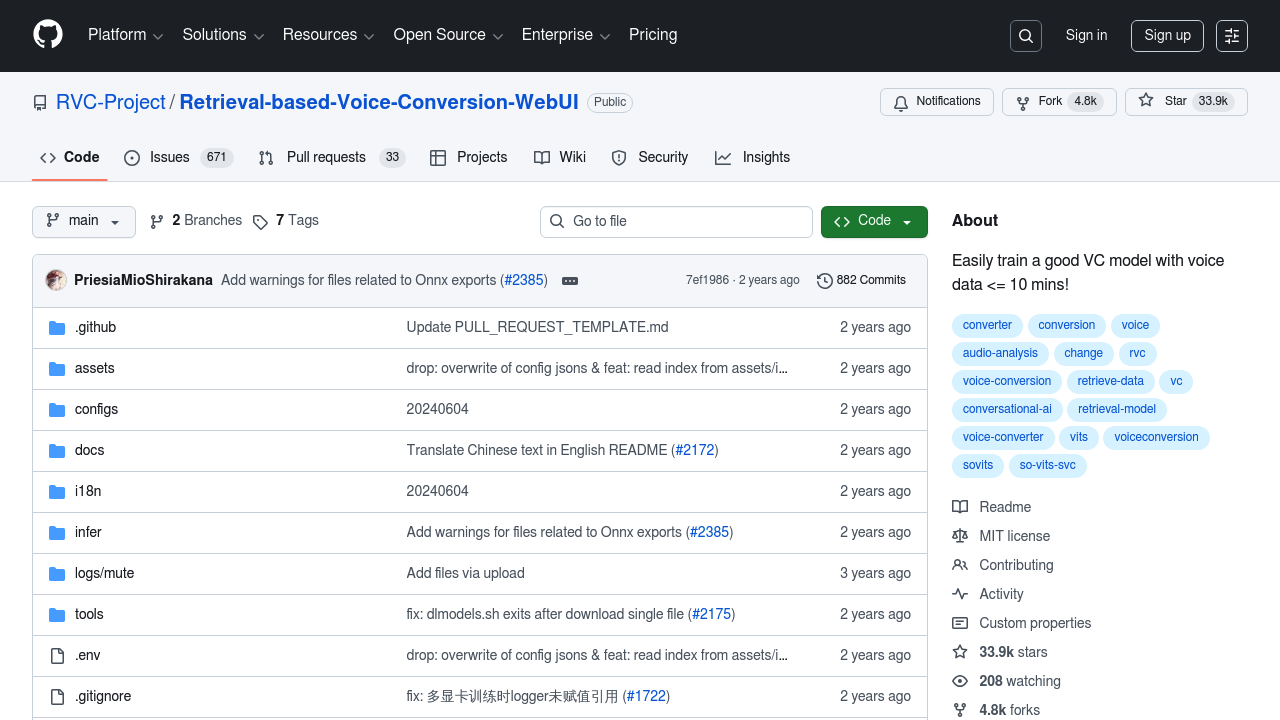
With 34.4k GitHub stars and active development pointing toward RVCv3, the project maintains momentum. The base model trains on nearly 50 hours of VCTK dataset, providing a solid foundation for custom voice work.