
Roboflow logo
AI Image Recognition FREEMIUM from $39/mo

Roboflow

Roboflow is a computer vision platform that turns images, videos and camera streams into structured data.

Teams label datasets with AI assistance, train models from dozens of architectures, chain models into workflows, and deploy them to cloud GPUs or edge hardware. Inference runs serverless on Roboflow's GPUs or…

Roboflow screenshot

Roboflow is a computer vision platform that turns images, videos and camera streams into structured data. Teams label datasets with AI assistance, train models from dozens of architectures, chain models into workflows, and deploy them to cloud GPUs or edge hardware. Inference runs serverless on Roboflow's GPUs or self-hosted on NVIDIA Jetson, Raspberry Pi and standard GPU servers. A free tier includes 10 credits a month, enough to train roughly 30 models, while Core starts at $39 a month with larger credit packs and Enterprise adds an uptime SLA.

Roboflow is built for machine learning engineers, software developers, and operations teams in manufacturing, logistics, energy, healthcare and robotics who need vision AI in production without assembling the pipeline themselves. Hobbyists and students can start on the free tier, and startups use Core for training and Workflows. Large enterprises choose custom plans for volume pricing, private weights, data residency in the US or EU, and industrial add-ons such as MQTT, OPC and PLC triggers. Developers who prefer open source can use the company's supervision, inference and RF-DETR libraries directly.

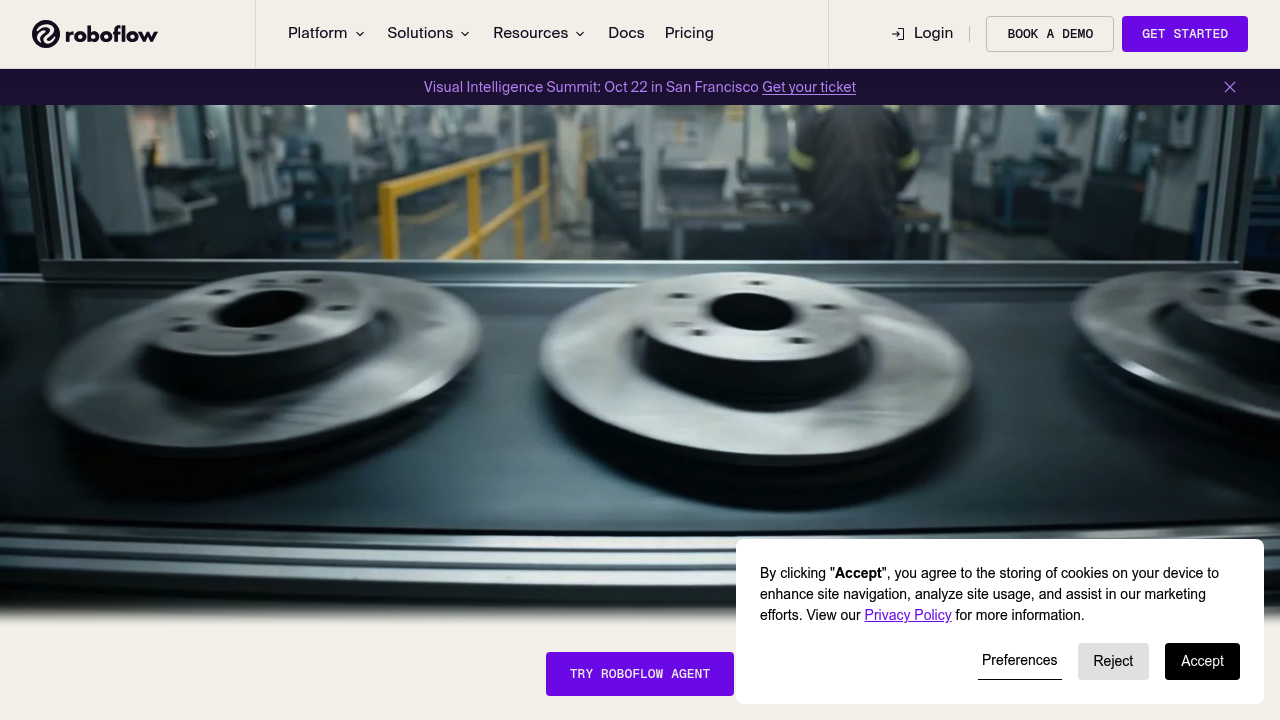
Common scenarios include catching defects on an assembly line, counting and tracking items on a conveyor with a line counter, inspecting rail wheels or infrastructure, and improving warehouse safety by detecting people and vehicles. A workflow can combine an object detection model, a tracker and an email alert to flag stoppages automatically. Teams label thousands of images quickly with frontier models, train a custom detector, and deploy it to cameras on site. Vision Events then store detections as queryable data, and Active Learning feeds new images back to improve the model.

Roboflow alternatives

See all →

Frequently asked

6 questions
What does Roboflow do for computer vision projects?
It covers the full pipeline: annotating images, training detection and segmentation models, orchestrating workflows, and deploying inference to the cloud or edge. Roboflow Agent can also build a vision solution from a plain-language description.
Who uses Roboflow?
Developers, ML engineers and operations teams in manufacturing, logistics, energy, healthcare and robotics. Individuals can begin on the free tier, and enterprises use custom plans with SLAs and commercial licensing.
What is a concrete example of a Roboflow workflow?
A conveyor monitor can combine an object detection model, a tracker and a line counter, then send an email notification when throughput stops. Detections are saved as Vision Events so teams can query them later.
What does Roboflow cost?
The free tier includes 10 credits a month, about 30 trained models or 80,000 inferences. Core starts at $39 a month with 20 credits, and larger monthly credit packs rise to $1,399 a month, while Enterprise pricing is custom.
How does usage billing work on Roboflow?
Inference and training consume credits. Serverless inference is billed per image, for example 0.0001875 credits per image for RF-DETR Medium, and self-hosted inference on your own hardware is included.
Where can Roboflow models run?
Models can run on Roboflow's serverless GPUs or on your own NVIDIA Jetson, Raspberry Pi or GPU server through Roboflow Inference. Model weights can be downloaded, and workspaces stay private unless you share them to Roboflow Universe.

Reviews (0)

Write review

No reviews yet. Be the first to share your experience.