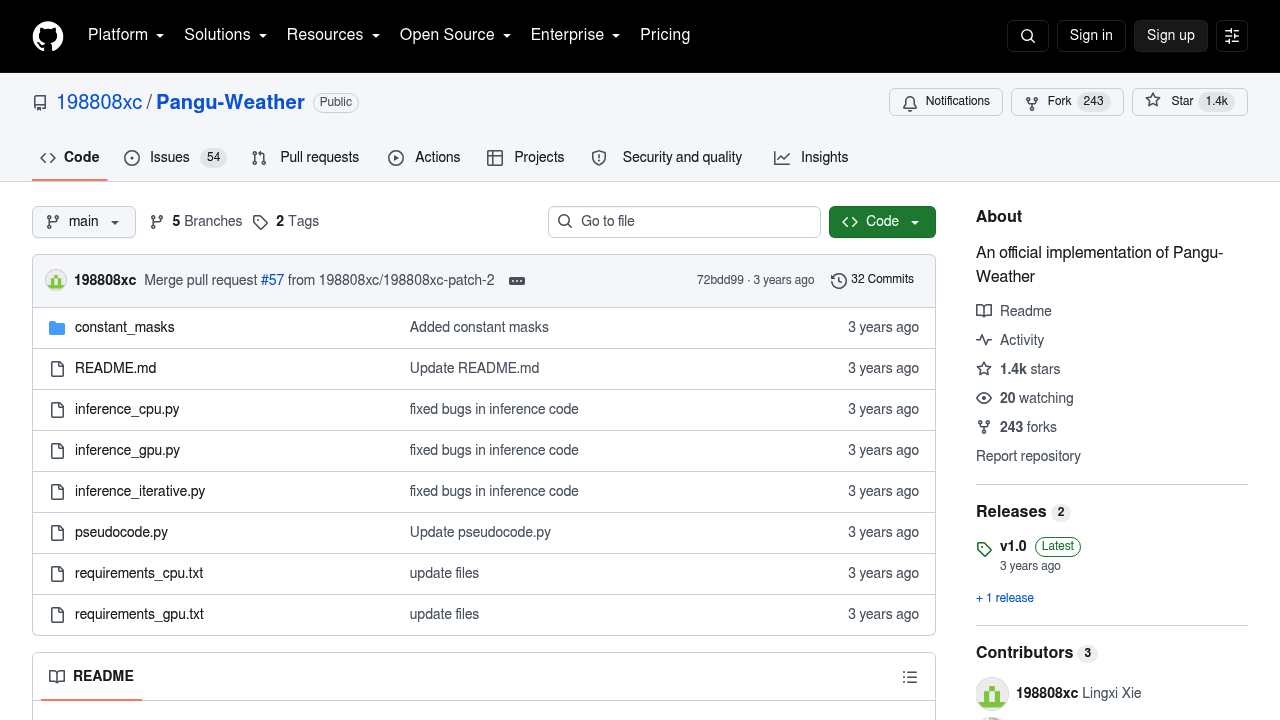
Pangu-Weather is an open repository for a 3D high-resolution neural network model that forecasts global weather. The code accompanies a Nature paper from 2023 on accurate medium-range forecasting. It includes pseudocode, inference scripts for CPU and GPU, and instructions for obtaining four pre-trained models, with 1-hour, 3-hour, 6-hour and 24-hour lead times, each around 1.1GB. The models are stored in ONNX format, so they can be run from Python, C++, C#, Java and other languages.
Atmospheric scientists and meteorology researchers use it to test data-driven forecasting against traditional numerical methods. Machine learning engineers can study the architecture through the pseudocode and the lite-version training notes. Students and university groups with a GPU can reproduce forecasts without building a model from scratch, and teams with only CPUs can use the CPU requirements file. Users should be comfortable with Python and NumPy, since input data must be prepared as arrays for surface and upper-air variables.
Researchers load surface and upper-air arrays, run the 24-hour model, and chain models iteratively to produce longer-range global forecasts. Forecasting groups compare its output against operational systems, and the model was made available as part of ECMWF's operational suite in July 2023, where its charts can be searched under the name PANGU. Engineers adapt the ONNX files into their own pipelines in different languages, and educators use the repository to teach how a 3D deep learning model handles weather variables. Groups with limited compute can follow the lite-version training instructions released in July 2023.