
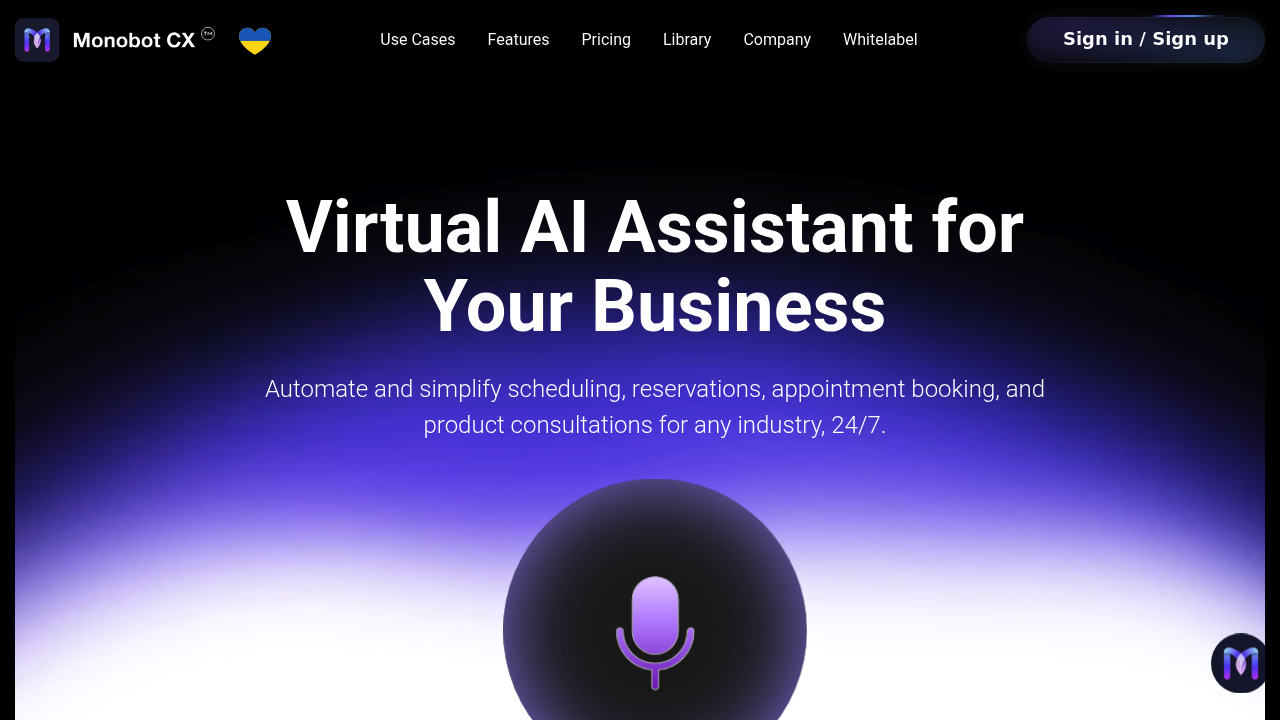
Voice agents that handle actual phone conversations. That's what you're getting with Monobot, an AI system built specifically for contact centers and BPO operations that need to automate routine calls without sounding like robots.
This system handles both inbound and outbound calls across pretty typical business scenarios. Scheduling appointments, booking reservations, checking order status, qualifying leads, running identity verifications. Claims it can automate 80% of routine calls and cut resolution time by 35%. The voice quality sits around 0.700 seconds latency, which keeps conversations feeling natural rather than stilted.
What makes this different from basic chatbots? The AI Workspace feature blends automation with human support. Your live agents get real-time suggestions and contextual prompts during calls, plus instant access to knowledge bases without switching screens. Every conversation gets automatically summarized and transcribed. Sentiment analysis runs in real-time so agents know when to adjust their approach. When the AI can't handle something, it routes to humans smoothly.
Setup works through a no-code interface with flow visualization showing conversation paths. You get dedicated phone numbers, SMS capabilities, webhooks, and both built-in connectors and open API access for custom integrations. Testing happens automatically for AI agents. The company claims 5-minute setup time and promises 92% of issues solved on first contact.
Does it actually work across industries? Monobot targets numerous sectors: executive transport, banking, healthcare, real estate, airlines, insurance, retail, eCommerce, IT support, education, utilities, telecom, government, logistics, manufacturing. That's either impressive versatility or a scattershot approach depending on how you look at it.
Now the gaps. HIPAA compliance costs an extra $1000 monthly on top of your base plan. That's steep if you're in healthcare. The 99.99% infrastructure uptime guarantee only comes with Enterprise pricing. Same with 24x7 support and dedicated support teams. Lower tiers get Monday-through-Friday assistance with response times ranging from 12 to 48 hours depending on your plan.
The pricing model uses credits rather than fixed feature bundles. You spend credits on chat, voice, calls, or transcription however you need. Starter runs $200 monthly with voice minutes at $0.27 each and workspace minutes at $0.05. Growth costs $500 monthly, dropping voice to $0.25 per minute. Business hits $1000 monthly with $0.22 per voice minute. Enterprise goes custom with volume-based pricing and includes 240+ hours of professional services.
That credit system offers flexibility but requires math. You'll need to estimate your actual usage patterns to know if you're getting value. A high-volume operation might burn through credits fast.
This works best for contact centers already overwhelmed with repetitive call volume. If you're handling thousands of appointment confirmations or status checks weekly, the automation makes sense. Smaller operations with occasional phone support might not hit the volume needed to justify $200 monthly minimum. Companies needing healthcare compliance should factor in that extra grand for HIPAA before committing.
The blended approach where AI assists human agents rather than replacing them completely feels practical. But those tiered support limitations mean you're somewhat on your own unless you're paying Enterprise rates.