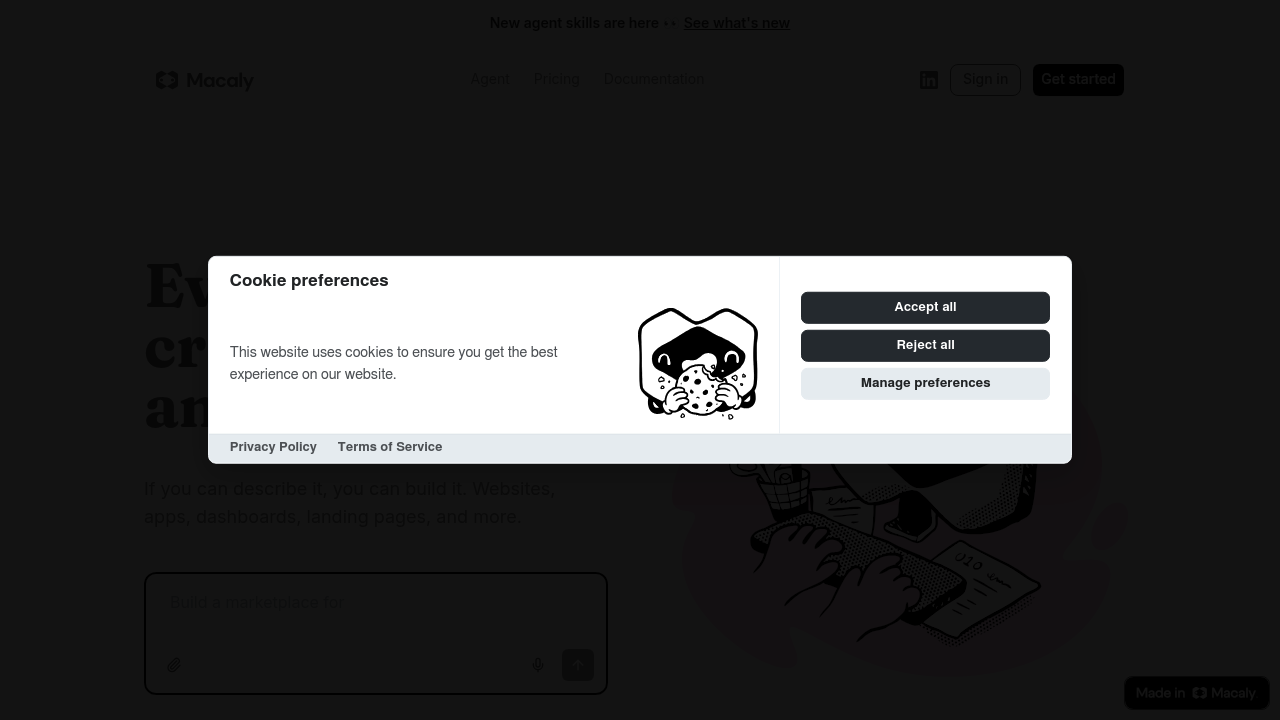
Macaly processes natural language descriptions and canvas sketches to generate functional websites and web applications. The system interprets user intent through conversational inputs, translating requests into HTML, CSS, and JavaScript code that runs on its hosting infrastructure. Users can either describe what they want in plain language or sketch wireframes directly on a canvas interface, and the AI builds the corresponding pages and components.
The data pipeline connects several subsystems. Built-in databases handle user accounts, blog posts, and product catalogs without requiring external database setup. When users request features that need data storage, Macaly provisions database tables and relationships automatically. The analytics engine tracks page views, clicks, form submissions, and user navigation paths, storing this telemetry in a separate data layer that populates the dashboard interface.
Image generation runs through Macaly's AI models to create hero images, backgrounds, icons, and graphics based on text prompts. The system also handles image editing requests, modifying existing assets according to user instructions. All generated and uploaded media goes into the assets library, where users can organize images, videos, and documents for reuse across projects.
The direct edit mode lets users click any element on a rendered page and modify it immediately. This sits alongside the conversational interface, giving users two paths to make changes. The AI interprets edits in context, understanding whether a user wants to adjust styling, content, or functionality. Global styles propagate design decisions across multiple pages, maintaining consistency without manual updates to each component.
Authentication and form submission handling run server-side. Macaly manages user sessions, password security, and form data collection without requiring users to configure these systems separately. SEO tools generate meta titles, descriptions, structured data markup, and XML sitemaps automatically based on page content and user specifications.
Code access and Github integration let users export their projects or sync them to repositories. This means the generated code isn't locked into Macaly. Users can pull the underlying HTML, CSS, and JavaScript to modify it externally or deploy it elsewhere. The web scraping and web search features let the AI pull external data into projects during the building process.
Credits measure computational usage. The free plan provides up to 1M credits daily, consumed based on request complexity. Simple page edits use fewer credits than generating entire multi-page applications or running multiple AI image generation requests. The hosting-only plan at $5 monthly doesn't include AI credits and only supports one custom domain. Pro costs $25 monthly with credits, private chats, custom domain support, code access, and removes Macaly's badge. Enterprise plans offer custom credit allocations, data retention policies, SAML SSO, and API access.
Free tier limitations include public chats only, a macaly-app.com subdomain, and Macaly's badge on published sites. Private chats require a paid plan. Custom domains aren't available on the free tier. The hosting-only plan specifically excludes AI functionality, serving only as infrastructure for projects already built.
Github integration is the primary third-party connection. Enterprise plans add Slack channels for support. Macaly doesn't require external integrations for core functionality since databases, hosting, analytics, and SEO tools are built directly into the system. This reduces the technical complexity of connecting separate services but also means users work within Macaly's architecture choices.
The canvas sketching feature distinguishes the workflow from purely conversational builders. Users can wireframe layouts visually before the AI translates sketches into working code. This connects visual design tools and code generation systems.